

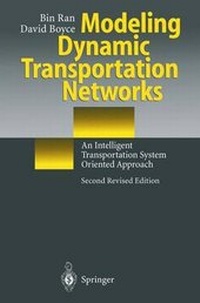
Modeling Dynamic Transportation Networks
An Intelligent Transportation System Oriented Approach
2nd Edition
Published on 16. July 1996
Book
Hardback
XX, 356 pages
978-3-540-61139-4 (ISBN)
Description
This book seeks to summarize our recent progress in dynamic trans portation network modeling. It concentrates on ideal dynamic network models based on actual travel times and their corresponding solution algorithms. In contrast, our first book DynamIc Urban Transportation Network Models - The ory and Implications for Intelligent Vehicle-Hzghway Systems (Springer-Verlag, 1994) focused on instantaneous dynamic network models. Comparing the two books, the major differences can be summarized as follows: 1. This book uses the variational inequality problem as the basic formulation approach and considers the optimal control problem as a subproblem for solution purposes. The former book used optimal control theory as the basic formulation approach, which caused critical problems in some circumstances. 2. This book focuses on ideal dynamic network models based on actual travel times. The former book focused on instantaneous dynamic network models based on currently prevailing travel times. 3. This book formulates a stochastic dynamic route choice model which can utilize any possible route choice distribution function instead of only the logit function. 4. This book reformulates the bilevel problem of combined departure time/ route choice as a one-level variational inequality. 5. Finally, a set of problems is provided for classroom use. In addition, this book offers comprehensive insights into the complexity and challenge of applying these dynamic network models to Intelligent Trans portation Systems (ITS). Nevertheless, the models in this text are not yet fully evaluated and are subject to revision based on future research.
More details
Edition
2nd rev. ed.
Language
English
Place of publication
Heidelberg
Germany
Publishing group
Springer Berlin
Target group
Professional and scholarly
Edition type
Revised edition
Illustrations
29 s/w Tabellen
29 black & white tables, biography
Dimensions
Height: 23.5 cm
Width: 15.5 cm
Weight
705 gr
ISBN-13
978-3-540-61139-4 (9783540611394)
DOI
10.1007/978-3-642-80230-0
Schweitzer Classification
Other editions
Additional editions
Bin Ran | David Boyce
Modeling Dynamic Transportation Networks
An Intelligent Transportation System Oriented Approach
Book
12/2011
2nd Edition
Springer
€53.49
Shipment within 7-9 days
Previous edition
Bin Ran | David Boyce
Dynamic Urban Transportation Network Models
Theory and Implications for Intelligent Vehicle-Highway Systems
Book
10/1994
Springer
€85.59
Article exhausted; check for reprint
Content
I Dynamic Transportation Network Analysis.- 1 Introduction.- 1.1 Requirements for Dynamic Modeling.- 1.2 Urban Transportation Network Analysis.- 1.3 Overview of Dynamic Network Models.- 1.4 Hierarchy of Dynamic Network Models.- 1.5 Notes.- II Mathematical Background.- 2 Variational Inequalities and Continuous Optimal Control.- 2.1 Variational Inequality Problems.- 2.1.1 Definitions.- 2.1.2 Existence and Uniqueness.- 2.1.3 Relaxation Algorithm.- 2.2 Continuous Optimal Control Problems.- 2.2.1 Definitions.- 2.2.2 No Constraints.- 2.2.3 Equality and Inequality Constraints.- 2.2.4 Equality and Nonnegativity Constraints.- 2.3 Hierarchical Optimal Control Problems.- 2.3.1 Static Two-Person Games.- 2.3.2 Dynamic Games.- 2.3.3 Bilevel Optimal Control Problems.- 2.4 Notes.- 3 Discrete Optimal Control and Nonlinear Programming.- 3.1 Discrete Optimal Control Problems.- 3.1.1 No Constraints.- 3.1.2 Equality and Inequality Constraints.- 3.1.3 Equality and Nonnegativity Constraints.- 3.2 Nonlinear Programming Problems.- 3.2.1 Unconstrained Minimization.- 3.2.2 General Constraints.- 3.2.3 Linear Equality and Nonnegativity Constraints.- 3.2.4 Discrete Optimal Control and Nonlinear Programs.- 3.3 Solution Algorithms.- 3.3.1 One Dimensional Minimization.- 3.3.2 Frank-Wolfe Algorithm.- 3.4 Notes.- III Deterministic Dynamic Route Choice.- 4 Network Flow Constraints and Definitions of Travel Times.- 4.1 Flow Conservation Constraints.- 4.2 Definitions.- 4.3 Flow Propagation Constraints.- 4.3.1 Type I.- 4.3.2 Type II.- 4.3.3 Type III.- 4.4 First-In-First-Out Constraints.- 4.5 Link Capacity and Oversaturation.- 4.5.1 Maximal Number of Vehicles on a Link.- 4.5.2 Maximal Exit Flow from a Link.- 4.5.3 Constraints for Spillback.- 4.6 Notes.- 5 Ideal Dynamic Route Choice Models.- 5.1 An Example with Two Parallel Routes.- 5.2 Definition of an Ideal State.- 5.3 A Route-Time-Based Model.- 5.3.1 Route-Time-Based Conditions.- 5.3.2 Dynamic Network Constraints.- 5.3.3 The Variational Inequality Problem.- 5.4 A Link-Time-Based Model.- 5.4.1 Link-Time-Based Conditions.- 5.4.2 The Variational Inequality Problem.- 5.5 A Numerical Example.- 5.6 A Multi-Class Route-Cost-Based Model.- 5.6.1 Multi-Class Route-Cost-Based Conditions.- 5.6.2 Dynamic Network Constraints.- 5.6.3 The Variational Inequality Problem.- 5.7 A Multi-Class Link-Cost-Based Model.- 5.7.1 Multi-Class Link-Cost-Based Conditions.- 5.7.2 The Variational Inequality Problem.- 5.8 Notes.- 6 A Solution Algorithm for an Ideal Route Choice Model.- 6.1 Statement of the Algorithm.- 6.1.1 Discrete VI Model for the Link-Time-Based Case.- 6.1.2 Relaxation Procedure and Optimization Problem.- 6.1.3 The Frank-Wolfe Method.- 6.2 Solving the LP Subproblem.- 6.3 Computational Experience.- 6.4 Notes.- 7 Instantaneous Dynamic Route Choice Models.- 7.1 Definition of an Instantaneous State.- 7.2 A Route-Time-Based Model.- 7.2.1 Route-Time-Based Conditions.- 7.2.2 Dynamic Network Constraints.- 7.2.3 The Variational Inequality Problem.- 7.3 A Link-Time-Based Model.- 7.3.1 Link-Time-Based Conditions.- 7.3.2 The Variational Inequality Problem.- 7.4 Solution Algorithm.- 7.4.1 Discrete VI Model for the Link-Time-Based Case.- 7.4.2 Relaxation Procedure and Optimization Program.- 7.4.3 The Frank-Wolfe Method.- 7.4.4 Numerical Example.- 7.5 Notes.- 8 Extensions of Instantaneous Route Choice Models.- 8.1 Optimal Control Model 1.- 8.1.1 Model Formulation.- 8.1.2 Optimality Conditions.- 8.1.3 DUO Equivalence Analysis.- 8.2 Optimal Control Model 2.- 8.2.1 Model Formulation.- 8.2.2 Optimality Conditions.- 8.3 A Multi-Class Route-Cost-Based Model.- 8.3.1 Multi-Class Route-Cost-Based Conditions.- 8.3.2 Dynamic Network Constraints.- 8.3.3 The Variational Inequality Problem.- 8.4 A Multi-Class Link-Cost-Based Model.- 8.4.1 Multi-Class Link-Cost-Based Conditions.- 8.4.2 The Variational Inequality Problem.- 8.5 Notes.- IV Stochastic Dynamic Route Choice.- 9 Ideal Stochastic Dynamic Route Choice Models.- 9.1 Redefinition of Dynamic Travel Times.- 9.2 Formulation of the Model.- 9.2.1 Network Constraints.- 9.2.2 Stochastic Route Choice and the Ideal SDUO State.- 9.2.3 Two Popular Route Choice Functions.- 9.2.4 Ideal Route Choice Conditions and VI Problem.- 9.2.5 Analysis of Dispersed Route Choice.- 9.3 Solution Algorithm.- 9.3.1 The Discrete Variational Inequality Problem.- 9.3.2 The Relaxation Method.- 9.3.3 Method of Successive Averages.- 9.3.4 Summary of the Solution Algorithm.- 9.3.5 A Logit-Based Ideal Stochastic Loading.- 9.3.6 Proof of the Algorithm.- 9.4 Numerical Example.- 9.5 Notes.- 10 Instantaneous Stochastic Dynamic Route Choice Models.- 10.1 Formulation of the Model.- 10.1.1 Network Constraints.- 10.1.2 Definition of an Instantaneous SDUO State.- 10.1.3 Instantaneous Route Choice Conditions and VI Problem.- 10.2 Solution Algorithm.- 10.2.1 The Discrete Variational Inequality Problem.- 10.2.2 The Relaxation Method.- 10.2.3 Method of Successive Averages.- 10.2.4 Summary of the Solution Algorithm.- 10.2.5 A Logit-Based Instantaneous Stochastic Loading.- 10.2.6 Proof of the Algorithm.- 10.3 An Instantaneous Optimal Control Model.- 10.4 Numerical Example.- 10.5 Notes.- V General Dynamic Travel Choices.- 11 Combined Departure Time/Route Choice Models.- 11.1 Additional Network Constraints.- 11.2 A Route-Based Model.- 11.2.1 Route-Based Conditions.- 11.2.2 Dynamic Network Constraints.- 11.2.3 The Variational Inequality Problem.- 11.3 A Link-Based Model.- 11.3.1 Link-Based Conditions.- 11.3.2 The Variational Inequality Problem.- 11.4 Solution Algorithm and An Example.- 11.4.1 Discrete Variational Inequality Problem.- 11.4.2 Relaxation Procedure and Optimization Problem.- 11.4.3 Numerical Example.- 11.5 Notes.- 12 Combined Mode/Departure Time/Route Choice Models.- 12.1 The Combined Travel Choice Problem.- 12.2 Individual Travel Choice Problems.- 12.2.1 Mode Choice Problem.- 12.2.2 Departure Time/Route Choice for Motorists.- 12.3 The Link-Time-Based Model.- 12.3.1 Network Constraints.- 12.3.2 The Variational Inequality Problem.- 12.4 Notes.- VI Implications for ITS.- 13 Link Travel Time Functions for Dynamic Network Models.- 13.1 Functions for Various Purposes.- 13.2 Stochastic Link Travel Time Functions.- 13.2.1 Moving Queue Concept.- 13.2.2 Cruise Time.- 13.2.3 Delay and Link Travel Time Functions.- 13.3 Deterministic Link Travel Time Functions.- 13.4 Implications of the Proposed Functions.- 13.4.1 Number of Link Flow Variables.- 13.4.2 Physical Constraints for Link Traffic Flow.- 13.4.3 Notes on Functions for Arterial Links.- 13.5 Functions for Freeway Segments.- 13.6 Notes.- 14 Implementation in Intelligent Transportation Systems.- 14.1 Implementation Issues.- 14.1.1 Traffic Prediction.- 14.1.2 Dynamic Route Guidance.- 14.1.3 Integrated Traffic Control/Information System.- 14.1.4 Incident Management.- 14.1.5 Congestion Pricing.- 14.1.6 Operations and Control for AHS.- 14.1.7 Transportation Planning.- 14.2 Practical Considerations.- 14.2.1 Rolling Horizon Implementation.- 14.2.2 Traveler Knowledge of Information.- 14.2.3 Response to Current and Anticipated Conditions.- 14.2.4 Flow-Based vs. Vehicle-Based Models.- 14.2.5 Different Types of Travelers.- 14.3 Data Requirements.- 14.3.1 Time-Dependent O-D Matrices.- 14.3.2 Network Geometry and Control Data.- 14.3.3 Traffic Flow Data.- 14.3.4 Traveler Information.- 14.4 Notes.- References.- Author Index.- List of Figures.- List of Tables.