

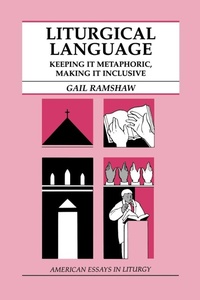
Liturgical Language
Keeping It Metaphoric, Making It Inclusive
Published on 1. February 1996
Book
Paperback/Softback
54 pages
978-0-8146-2408-1 (ISBN)
Description
"Liturgical language" denotes those words used by Christians in their communal praise and prayer. Liturgical language is often metaphoric, as metaphors help us explain the unexplainable they help the human mind contemplate the divine. Problems with liturgical language occur when these metaphors exclude some Christians when their aim should instead be to bring all Christians into communion with God. Recognizing that both metaphoric and inclusive language are necessary in Christian worship, Ramshaw clarifies how these need not be contradictory criteria for forming liturgical language.
Through a review of the history of language, Ramshaw illustrates the difficulties of forming texts from words that have undergone numerous translations and whose primary meanings have also changed throughout the centuries. An examination of trends in generic American English, the vernacular on which liturgical texts are to be built, reveals two tasks for liturgists: the arduous work of retranslating liturgical texts and the creative work of crafting intercessions, hymns, and homilies that are inclusive in language. Her discussion of symbolic imagery and theological language illustrates how essential it is that words be evaluated and chosen with understanding and care.
Ramshaw writes for those who find beauty and truth in metaphor and for those who strive to invite everyone to the Eucharistic banquet. She encourages all who formulate liturgical language to contemplate with seriousness and Vision the ultimate objective of this language so that it can speak with meaning and beauty to all.
Through a review of the history of language, Ramshaw illustrates the difficulties of forming texts from words that have undergone numerous translations and whose primary meanings have also changed throughout the centuries. An examination of trends in generic American English, the vernacular on which liturgical texts are to be built, reveals two tasks for liturgists: the arduous work of retranslating liturgical texts and the creative work of crafting intercessions, hymns, and homilies that are inclusive in language. Her discussion of symbolic imagery and theological language illustrates how essential it is that words be evaluated and chosen with understanding and care.
Ramshaw writes for those who find beauty and truth in metaphor and for those who strive to invite everyone to the Eucharistic banquet. She encourages all who formulate liturgical language to contemplate with seriousness and Vision the ultimate objective of this language so that it can speak with meaning and beauty to all.
Reviews / Votes
Ramshaw makes an excellent contribution to the discussion on liturgical language with this efficiently packed essay.Modern Liturgy Ramshaw's brief work points out some directions liturgists can take in this new millennium.Philippiniana SacraMore details
Series
Language
English
Place of publication
Collegeville, MN
United States
Target group
Professional and scholarly
Product notice
Paperback (trade)
Dimensions
Height: 229 mm
Width: 152 mm
Thickness: 3 mm
Weight
92 gr
ISBN-13
978-0-8146-2408-1 (9780814624081)
Copyright in bibliographic data and cover images is held by Nielsen Book Services Limited or by the publishers or by their respective licensors: all rights reserved.
Schweitzer Classification
Person
Gail Ramshaw studies and crafts liturgical language from her home outside of Washington, DC. A Lutheran laywoman, a past president of the North American Academy of Liturgy and recipient of its Berakah award, and professor emerita of religion at La Salle University, she has published extensively about biblical metaphors, the Revised Common Lectionary, and parish liturgical practice.
Content
Contents
1. The Challenge for Liturgical Language 5
What is meant by "liturgical language"? 5
Metaphor the method 7
Inclusivity the goal 10
An oxymoron 11
2. Our Linguistic History 13
Implications of a translation religion 13
The development of English 15
3. Generic Speech 18
Synedoche, convention, or misogyny? 18
Androcentric speech in the liturgy 19
Pronouns for god 21
4. Symbolic Imagery 25
Why so much symbolic imagery? 25
Proclaiming "the kingdom of God" 27
Forming "the body of Christ" 29
Conquering "Egypt" 30
Curing "blindness" 32
5. Theological Language 35
Theology in and out of the liturgy 35
Circumlocution 36
Catachresis 38
6. The Householder's Treasure 41
What is old 41
What is new 42
At least some gems 43
Endnotes 47
1. The Challenge for Liturgical Language 5
What is meant by "liturgical language"? 5
Metaphor the method 7
Inclusivity the goal 10
An oxymoron 11
2. Our Linguistic History 13
Implications of a translation religion 13
The development of English 15
3. Generic Speech 18
Synedoche, convention, or misogyny? 18
Androcentric speech in the liturgy 19
Pronouns for god 21
4. Symbolic Imagery 25
Why so much symbolic imagery? 25
Proclaiming "the kingdom of God" 27
Forming "the body of Christ" 29
Conquering "Egypt" 30
Curing "blindness" 32
5. Theological Language 35
Theology in and out of the liturgy 35
Circumlocution 36
Catachresis 38
6. The Householder's Treasure 41
What is old 41
What is new 42
At least some gems 43
Endnotes 47