

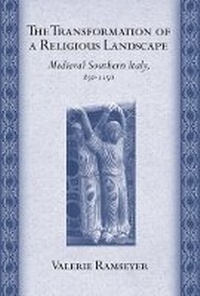
The Transformation of a Religious Landscape
Medieval Southern Italy, 850-1150
Published on 8. June 2006
Book
Hardback
248 pages
978-0-8014-4403-6 (ISBN)
Description
The Transformation of a Religious Landscape paints a detailed picture of the sheer variety of early medieval Christian practice and organization, as well as the diverse modes in which church reform manifested itself in the eleventh and twelfth centuries.
From the rich archives of the abbey of the Holy Trinity of Cava, Valerie Ramseyer reconstructed the complex religious history of southern Italy. No single religious or political figure claimed authority in the region before the eleventh century, and pastoral care was provided by a wide variety of small religious houses. The line between the secular and the regular clergy was not well pronounced, nor was the boundary between the clergy and the laity or between eastern and western religious practices.
In the second half of the eleventh century, however, the archbishop of Salerno and the powerful abbey of Cava acted to transform the situation. Centralized and hierarchical ecclesiastical structures took shape, and an effort was made to standardize religious practices along the lines espoused by reform popes such as Leo IX and Gregory VII. Yet prelates in southern Italy did not accept all aspects of the reform program emanating from centers such as Rome and Cluny, and the region's religious life continued to differ in many respects from that in Francia: priests continued to marry and have children, laypeople to found and administer churches, and Greek clerics and religious practices to coexist with those sanctioned by Rome.
From the rich archives of the abbey of the Holy Trinity of Cava, Valerie Ramseyer reconstructed the complex religious history of southern Italy. No single religious or political figure claimed authority in the region before the eleventh century, and pastoral care was provided by a wide variety of small religious houses. The line between the secular and the regular clergy was not well pronounced, nor was the boundary between the clergy and the laity or between eastern and western religious practices.
In the second half of the eleventh century, however, the archbishop of Salerno and the powerful abbey of Cava acted to transform the situation. Centralized and hierarchical ecclesiastical structures took shape, and an effort was made to standardize religious practices along the lines espoused by reform popes such as Leo IX and Gregory VII. Yet prelates in southern Italy did not accept all aspects of the reform program emanating from centers such as Rome and Cluny, and the region's religious life continued to differ in many respects from that in Francia: priests continued to marry and have children, laypeople to found and administer churches, and Greek clerics and religious practices to coexist with those sanctioned by Rome.
Reviews / Votes
"Based upon extensive archival research, this exceptional monograph, focused upon the Principality of Salerno, documents how a range of eclectic religious practices and institutions, drawn from both Greek and Latin Christianity, persisted beyond the era of Gregorian reform. Although the authority to reform derived from the papacy, which promoted uniformity, the region's archbishop and the abbey of Cava had considerable autonomy in practice to shape and implement reforms in ways suitable for the distinct religious culture of Salerno." "This deeply impressive study of ecclesiastical life in Salerno reveals the enduring and creative coexistence of both the Greek and Latin Christian traditions in medieval southern Italy, as well as the limits of papal reform efforts in the eleventh and twelfth centuries to impose a Roman uniformity on this distinctive local church. Valerie Ramseyer demonstrates not only that ecclesiastical life in the Prinicipality of Salerno differed markedly from that in Carolingian Europe but also that it retained many of its distinctive features after the Gregorian reform. This highly significant and richly drawn portrait of the Salernitan church contributes to a new ecclesiastical history that acknowledges the rich diversity of Christian practice and institutional forms in medieval Europe." -- Maureen Miller, University of California, Berkeley "This interesting, intelligent, and useful book makes a valuable contribution to the relatively limited Anglophone literature on early medieval southern Italy and to the wider literature on the early medieval church." -- Graham A. Loud, University of Leeds "Valerie Ramseyer has written a major contribution to the religious history of tenth- to eleventh-century Italy with this book. The period is too often seen simply through the experience of Rome and the Popes; Ramseyer shows how the changes of the period occurred in the rest of Italy, through the experience of one of the leading towns in the South. We are all in her debt." -- Chris Wickham, University of BirminghamMore details
Series
Language
English
Place of publication
Ithaca
United States
Target group
College/higher education
Professional and scholarly
Product notice
Paper over boards
Dimensions
Height: 235 mm
Width: 155 mm
Thickness: 21 mm
Weight
907 gr
ISBN-13
978-0-8014-4403-6 (9780801444036)
Copyright in bibliographic data and cover images is held by Nielsen Book Services Limited or by the publishers or by their respective licensors: all rights reserved.
Schweitzer Classification
Other editions
Additional editions
E-Book
10/2015
Cornell University Press
€50.99
Available for download
Person
Valerie Ramseyer is Associate Professor of History at Wellesley College.
Content
Introduction
Part I. Christianity in the Lombard Era (c. 849-1077)
Chapter 1. Society and Government before the Normans
Chapter 2. Religious Authority and Ecclesiastical Organization before Centralization
Chapter 3. Religious Houses and the Clergy before Reform
Part II. Reorganization and Reform in the Norman Period (c. 1050-1130)
Chapter 4. The New Archbishopric of Salerno
Chapter 5. The Construction of a Monastic Lordship: The Abbey of the Holy Trinity of Cava
Epilogue: Changes and Continuities
Works Cited
Index
Part I. Christianity in the Lombard Era (c. 849-1077)
Chapter 1. Society and Government before the Normans
Chapter 2. Religious Authority and Ecclesiastical Organization before Centralization
Chapter 3. Religious Houses and the Clergy before Reform
Part II. Reorganization and Reform in the Norman Period (c. 1050-1130)
Chapter 4. The New Archbishopric of Salerno
Chapter 5. The Construction of a Monastic Lordship: The Abbey of the Holy Trinity of Cava
Epilogue: Changes and Continuities
Works Cited
Index