

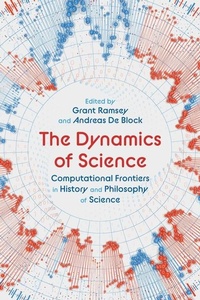
The Dynamics of Science
Computational Frontiers in History and Philosophy of Science
Published on 6. December 2022
Book
Hardback
308 pages
978-0-8229-4737-0 (ISBN)
Description
Millions of scientific articles are published each year, making it difficult to stay abreast of advances within even the smallest subdisciplines. Traditional approaches to the study of science, such as the history and philosophy of science, involve closely reading a relatively small set of journal articles. And yet many questions benefit from casting a wider net: Is most scientific change gradual or revolutionary? What are the key sources of scientific novelty? Over the past several decades, a massive effort to digitize the academic literature and equip computers with algorithms that can distantly read and analyze a digital database has taken us one step closer to answering these questions. The Dynamics of Science brings together a diverse array of contributors to examine the largely unexplored computational frontiers of history and philosophy of science. Together, they reveal how tools and data from automated textual analysis, or machine "reading," combined with methods and models from game theory and cultural evolutionary theory, can begin to answer fundamental questions about the nature and history of science.
Reviews / Votes
A valuable advancement in bridging the gap between philosophy of science and quantitative studies of science. * Metascience * Dynamics of Science makes a convincing case that historians should consider applying their deep reading skills to much larger sets of text than they have previously thought possible. However, to do so, they may have to learn new skills or, better yet, collaborate with colleagues who have different backgrounds so that they can incorporate computational methods in their work. * H-Net Reviews * This is a valuable volume that . . . reveals a new field full of potential. * British Journal for the History of Science * A revolution is brewing in the discipline of history and philosophy of science, and it is easy to foresee a near future in which computational methods will be as important to the historian and philosopher of science as historical case studies are nowadays. If you don't want to miss the revolution, Grant Ramsey and Andreas De Block's groundbreaking volume is a must-read: its eleven chapters by an all-star cast will show you the promises of this new approach. -- Edouard Machery, University of PittsburghMore details
Language
English
Place of publication
Pittsburgh PA
United States
Target group
Professional and scholarly
Product notice
sewn/stitched
Cloth over boards
Dimensions
Height: 229 mm
Width: 155 mm
Thickness: 30 mm
Weight
614 gr
ISBN-13
978-0-8229-4737-0 (9780822947370)
Copyright in bibliographic data and cover images is held by Nielsen Book Services Limited or by the publishers or by their respective licensors: all rights reserved.
Schweitzer Classification
Other editions
Additional editions

Grant Ramsey | Andreas De Block
The Dynamics of Science
Computational Frontiers in History and Philosophy of Science
E-Book
11/2022
University Press of Mississippi
€63.49
Available for download
Persons
Grant Ramsey (Editor)
Grant Ramsey is a research professor at the Institute of Philosophy, KU Leuven, Belgium. His work centers on philosophical problems at the foundation of evolutionary biology. He runs the Ramsey Lab, a highly collaborative research group focused on issues in the philosophy of the life sciences.
Andreas De Block (Editor)
Andreas De Block is a professor at the Institute of Philosophy, KU Leuven, Belgium. His current research interests revolve around philosophy of sex, science, and values, and experimental philosophy of medicine. He likes to collaborate with researchers from other disciplines, and has published with legal scholars, psychologists, economists, sport scientists, and biologists.
Grant Ramsey is a research professor at the Institute of Philosophy, KU Leuven, Belgium. His work centers on philosophical problems at the foundation of evolutionary biology. He runs the Ramsey Lab, a highly collaborative research group focused on issues in the philosophy of the life sciences.
Andreas De Block (Editor)
Andreas De Block is a professor at the Institute of Philosophy, KU Leuven, Belgium. His current research interests revolve around philosophy of sex, science, and values, and experimental philosophy of medicine. He likes to collaborate with researchers from other disciplines, and has published with legal scholars, psychologists, economists, sport scientists, and biologists.