

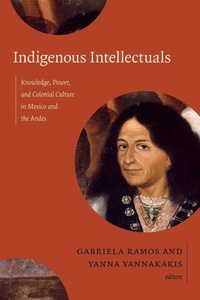
Indigenous Intellectuals
Knowledge, Power, and Colonial Culture in Mexico and the Andes
Published on 18. April 2014
Book
Paperback/Softback
344 pages
978-0-8223-5660-8 (ISBN)
Description
Via military conquest, Catholic evangelization, and intercultural engagement and struggle, a vast array of knowledge circulated through the Spanish viceroyalties in Mexico and the Andes. This collection highlights the critical role that indigenous intellectuals played in this cultural ferment. Scholars of history, anthropology, literature, and art history reveal new facets of the colonial experience by emphasizing the wide range of indigenous individuals who used knowledge to subvert, undermine, critique, and sometimes enhance colonial power. Seeking to understand the political, social, and cultural impact of indigenous intellectuals, the contributors examine both ideological and practical forms of knowledge. Their understanding of "intellectual" encompasses the creators of written texts and visual representations, functionaries and bureaucrats who interacted with colonial agents and institutions, and organic intellectuals.
Contributors. Elizabeth Hill Boone, Kathryn Burns, John Charles, Alan Durston, MarIa Elena MartInez, Tristan Platt, Gabriela Ramos, Susan Schroeder, John F. Schwaller, Camilla Townsend, Eleanor Wake, Yanna Yannakakis
Contributors. Elizabeth Hill Boone, Kathryn Burns, John Charles, Alan Durston, MarIa Elena MartInez, Tristan Platt, Gabriela Ramos, Susan Schroeder, John F. Schwaller, Camilla Townsend, Eleanor Wake, Yanna Yannakakis
Reviews / Votes
"The beauty of this volume is that the collected essays touch on so many topics key to colonial studies today... that it is no longer possible to exclude indigenous intellectuals from the scholarly discussion or the university classroom. With regard to the latter, the volume is a boon to those who have long wished to include indigenous voices in their advanced undergraduate and graduate-level seminars but did not know where to begin." - Kelly S. McDonough (Ethnohistory) "The editors' framing of the project is thoughtful. They are sensitive to historical change on both the Indigenous and European sides of the cultural divide, and to the many ways in which knowledge could be inscribed.... The contributors to Indigenous Intellectuals deserve great credit for putting their topic on the map and making major advances within it." - Raphael Folsom (Canadian Journal of Native Studies) "[T]his volume... represents a major step forward in further deconstructing Spanish presentations of colonial realities." - Claudia Brosseder (American Historical Review)More details
Language
English
Place of publication
North Carolina
United States
Target group
College/higher education
Product notice
Paperback (trade)
Illustrations
29 photographs, 5 maps, 2 figures
Dimensions
Height: 229 mm
Width: 152 mm
Thickness: 19 mm
Weight
496 gr
ISBN-13
978-0-8223-5660-8 (9780822356608)
Copyright in bibliographic data and cover images is held by Nielsen Book Services Limited or by the publishers or by their respective licensors: all rights reserved.
Schweitzer Classification
Other editions
Additional editions
Ramos Gabriela Ramos
Indigenous Intellectuals
Knowledge, Power, and Colonial Culture in Mexico and the Andes
E-Book
04/2014
1st Edition
Duke University Press Books
€208.99
Available for download
Persons
Gabriela Ramos is University Lecturer in Latin American History at the University of Cambridge and Fellow and College Lecturer at Newnham College, Cambridge. She is the author of Death and Conversion in the Andes: Lima and Cuzco, 1532-1670.
Yanna Yannakakis is Associate Professor of History at Emory University. She is the author of The Art of Being In-Between: Native Intermediaries, Indian Identity, and Local Rule in Colonial Oaxaca, also published by Duke University Press.
Yanna Yannakakis is Associate Professor of History at Emory University. She is the author of The Art of Being In-Between: Native Intermediaries, Indian Identity, and Local Rule in Colonial Oaxaca, also published by Duke University Press.
Content
Foreword / Elizabeth Hill Boone ix Acknowledgments xvii Introduction / Gabriela Ramos and Yanna Yannakakis 1 Part I. Indigenous Functionaries: Ethnicity, Networks, and Institutions 1. Indigenous Intellectuals in Andean Colonial Cities / Gabriela Ramos 21 2. The Brothers Fernando de Alva Ixtilxochitl and Bartolome de Alva: Two "Native" Intellectuals of Seventeenth-Century Mexico / John Frederick Schwaller 39 3. Trained by Jesuits: Indigenous Letrados in Seventeenth-Century Peru / John Charles 60 4. Making Law Intelligible: Networks of Translation in Mid-Colonial Oaxaca / Yanna Yannakakis 79 Part II. Native Historians: Sources, Frameworks, and Authorship 5. Chimalpahin and Why Women Matter in History / Susan Schroeder 107 6. The Concept of the Nahua Historian: Don Juan Zapata's Scholarly Tradition / Camilla Townsend 132 7. Cristobal Choquescasa and the Making of the Huarochiri Manuscript / Alan Durston 151 Part III. Forms of Knowledge: Genealogies, Maps, and Archives 8. Indigenous Genealogies: Lineage, History, and the Colonial Pact in Central Mexico and Peru / Maria Elena Martinez 9. The Dawning Places: Celestially Defined Land Maps, Titulos Primordiales, and Indigenous Statements of Territorial Possession in Early Colonial Mexico / Eleanor Wake 202 10. The Quilcaycamayoq: Making Indigenous Archives in Colonial Cuzco / Kathryn Burns 237 Conclusion / Tristan Platt 261 Bibliography 279 Contributors 307 Index 311