

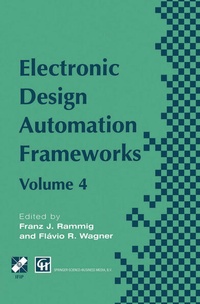
Electronic Design Automation Frameworks
Proceedings of the fourth International IFIP WG 10.5 working conference on electronic design automation frameworks
Published on 31. August 1995
Book
Hardback
X, 282 pages
978-0-412-71010-0 (ISBN)
Description
Design frameworks have become an important infrastructure for building complex design systems. Electronic Design Automation Frameworks presents a state-of-the-art review of the latest research results covering this topic; results which are also of value for other design frameworks. The book contains the selected proceedings of the Fourth International Working Conference on Electronic Design Frameworks, organized by the International Federation for Information Processing and held in Gramado, Brazil, in November 1994.
More details
Series
Edition
1995 ed.
Language
English
Place of publication
New York
United States
Target group
Professional and scholarly
Research
Product notice
sewn/stitched
Cloth over boards
Illustrations
X, 282 p.
Dimensions
Height: 234 mm
Width: 156 mm
Thickness: 18 mm
Weight
585 gr
ISBN-13
978-0-412-71010-0 (9780412710100)
DOI
10.1007/978-0-387-34880-3
Schweitzer Classification
Other editions
Additional editions
Franz J. Rammig | Flavio Wagner
Electronic Design Automation Frameworks
Proceedings of the fourth International IFIP WG 10.5 working conference on electronic design automation frameworks
Book
02/2013
Springer
€160.49
Shipment within 15-20 days
Content
One Transaction-Based Approaches.- 1 Transaction-based design data processing in the PRIMA framework.- 2 A configurable cooperative transaction model for design frameworks.- Two Data Management and Tool Integration.- 3 Configuration management in the STAR framework.- 4 Autocap: an automatic tool encapsulator.- 5 Schema evolution in the STAR framework.- Three Data Types.- 6 Integration of a domain conceptual model with the EDIF information model.- 7 Generating abstract datatypes with remote access capabilities.- 8 Extending view technology for complex integration tasks.- Four Federated Systems.- 9 Framework and multi-formalism: the ASAR project.- 10 Enhancing the data openness of frameworks by database federation services.- 11 Interoperability support by integration of EXPRESS models.- Five Communicationn and Distribution.- 12 Communication in a distributed environment.- 13 Basic requirements for an efficient inter-framework-communication.- 14 Resource-oriented load distribution in a framework environment.- Six Design Management.- 15 Design Flow Management: more than convenient tool invocation.- 16 Planning and managing multi-disciplinary and concurrent design processes.- 17 A user model supporting communication in high-level design systems.- Seven Special Design Environments.- 18 A framework for electrical test engineering automation.- 19 A compound information model for high-level synthesis.- 20 An object-oriented CAE framework for asynchronous circuit synthesis.- Eight Standards.- 21 Design representation in EDIF Version 3 0 0 and CFI Version 1.0.- 22 STEP technology for ECAD databases.- Nine Design Representation and Interfaces.- 23 Towards design formalization to support reuse in ECAD frameworks.- 24 A generator for graph-based design representations.- 25 The visualinterface of the STAR framework.- Index of contributors.