

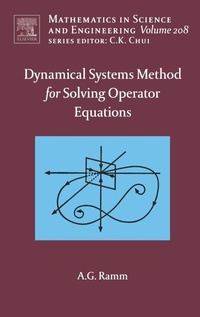
Dynamical Systems Method for Solving Nonlinear Operator Equations: Volume 208
Published on 25. September 2006
Book
Hardback
304 pages
978-0-444-52795-0 (ISBN)
Description
Dynamical Systems Method for Solving Nonlinear Operator Equations is of interest to graduate students in functional analysis, numerical analysis, and ill-posed and inverse problems especially. The book presents a general method for solving operator equations, especially nonlinear and ill-posed. It requires a fairly modest background and is essentially self-contained. All the results are proved in the book, and some of the background material is also included. The results presented are mostly obtained by the author.
More details
Series
Language
English
Place of publication
Oxford
United Kingdom
Publishing group
Elsevier Science & Technology
Target group
Professional and scholarly
Mathematicians, numerical analysists, specialists in scientific computing, engineers and others interested in solving operator equations, ill-posed and inverse problems.
Product notice
Laminated cover
Dimensions
Height: 234 mm
Width: 156 mm
Thickness: 19 mm
Weight
610 gr
ISBN-13
978-0-444-52795-0 (9780444527950)
Copyright in bibliographic data and cover images is held by Nielsen Book Services Limited or by the publishers or by their respective licensors: all rights reserved.
Schweitzer Classification
Other editions
Additional editions
Alexander G. Ramm
Dynamical Systems Method for Solving Nonlinear Operator Equations
E-Book
09/2006
Elsevier
€143.00
Available for download
Person
Content
1. Introduction2. Ill-posed problems3. DSM for well-posed problems4. DSM and linear ill-posed problems5. Some inequalities6. DSM for monotone operators7. DSM for general nonlinear operator equations8 DSM for operators satisfying a spectral assumption9. DSM in Banach spaces10. DSM and Newton-type methods without inversion of the derivative11. DSM and unbounded operators12. DSM and nonsmooth operators13. DSM as a theoretical tool14. DSM and iterative methods15. Numerical problems arising in applications16. Auxiliary results from analysis