

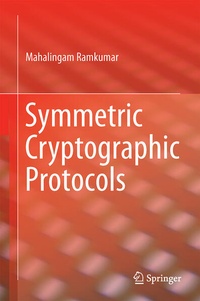
Symmetric Cryptographic Protocols
Published on 19. August 2014
Book
Hardback
XVII, 234 pages
978-3-319-07583-9 (ISBN)
Description
This book focuses on protocols and constructions that make good use of the building blocks for symmetric cryptography. The book brings under one roof, several esoteric strategies of utilizing symmetric cryptographic blocks. The specific topics addressed by the book include various key distribution strategies for unicast, broadcast and multicast security and strategies for constructing efficient digests of dynamic databases using binary hash trees.
Reviews / Votes
From the book reviews:
"Experienced security practitioners and cryptography researchers will benefit from reading this book. . the book provides a thorough analysis of key distribution and predistribution techniques, alongside pertinent applications. I would recommend this book as an advanced-level resource on symmetric cryptography and its application to diverse application scenarios." (Zubair Baig, Computing Reviews, February, 2015)
More details
Edition
2014 ed.
Language
English
Place of publication
Cham
Switzerland
Publishing group
Springer International Publishing
Target group
Professional and scholarly
Research
Illustrations
20 s/w Abbildungen, 1 farbige Abbildung
XVII, 234 p. 21 illus., 1 illus. in color.
Dimensions
Height: 241 mm
Width: 160 mm
Thickness: 20 mm
Weight
547 gr
ISBN-13
978-3-319-07583-9 (9783319075839)
DOI
10.1007/978-3-319-07584-6
Schweitzer Classification
Other editions
Additional editions
Mahalingam Ramkumar
Symmetric Cryptographic Protocols
Book
09/2016
Springer
€106.99
Shipment within 10-15 days
Mahalingam Ramkumar
Symmetric Cryptographic Protocols
E-Book
08/2014
1st Edition
Springer
€96.29
Available for download
Person
Dr. Ramkumar is an Associate Professor, at the Dept. of CSE, MSU since August 2009.
Content
Introduction.- Some Useful Constructions.- Non-scalable Key Distribution Schemes.- MLS for Internet Security Protocols.- Scalable Key Distribution Schemes.- Scalable Extensions of Non-scalable Schemes.- Using PKPSs With Tamper-Responsive Modules.- Broadcast Authentication and Broadcast Encryption.- Authenticated Data Structures.- Universal Trusted Computing Bases.- Conclusions and References.