

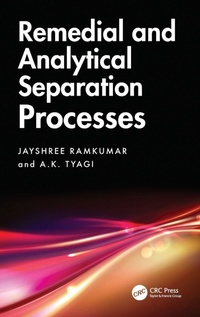
Remedial and Analytical Separation Processes
1st Edition
Published on 15. November 2024
Book
Hardback
138 pages
978-1-032-45885-4 (ISBN)
Description
This book describes a comprehensive, integrated view of separation science backed by discussions about simple extraction and partition processes to give a better understanding of advanced techniques like chromatography and membrane separations. It paves the way for an understanding of the fundamental physical and chemical phenomena involved in separations and a concise overview of transport reactions. A chapter dedicated to phytoremediation gives an understanding of the various processes involved in the bioremediation of environmental media.
Features:
Provides synchronous aspects of the separation process for remediation, including phytoremediation and analysis using chromatography
Addresses basic separation techniques for water solutions
Discusses mechanistic views of various separation processes
Includes the mechanism of separation using membranes and sorbents
Helps the reader understand the connection between the different discrete separation processes
This book is aimed at senior undergraduate and graduate students in environmental engineering and analytical chemistry.
Features:
Provides synchronous aspects of the separation process for remediation, including phytoremediation and analysis using chromatography
Addresses basic separation techniques for water solutions
Discusses mechanistic views of various separation processes
Includes the mechanism of separation using membranes and sorbents
Helps the reader understand the connection between the different discrete separation processes
This book is aimed at senior undergraduate and graduate students in environmental engineering and analytical chemistry.
More details
Language
English
Place of publication
London
United Kingdom
Publishing group
Taylor & Francis Ltd
Target group
College/higher education
Professional and scholarly
Academic and Postgraduate
Illustrations
14 s/w Abbildungen, 2 s/w Photographien bzw. Rasterbilder, 12 s/w Zeichnungen, 1 s/w Tabelle
1 Tables, black and white; 12 Line drawings, black and white; 4 Halftones, black and white; 16 Illustrations, black and white
Dimensions
Height: 240 mm
Width: 161 mm
Thickness: 13 mm
Weight
396 gr
ISBN-13
978-1-032-45885-4 (9781032458854)
Copyright in bibliographic data and cover images is held by Nielsen Book Services Limited or by the publishers or by their respective licensors: all rights reserved.
Schweitzer Classification
Other editions
Additional editions
Jayshree Ramkumar | A.K. Tyagi
Remedial and Analytical Separation Processes
Book
approx. 07/2026
1st Edition
CRC Press
€66.00
Not yet published
Jayshree Ramkumar | A.K. Tyagi
Remedial and Analytical Separation Processes
E-Book
11/2024
1st Edition
CRC Press
€73.99
Available for download
Jayshree Ramkumar | A.K. Tyagi
Remedial and Analytical Separation Processes
E-Book
11/2024
1st Edition
CRC Press
€73.99
Available for download
Persons
Jayshree Ramkumar obtained her MSc (Analytical Chemistry) in 1993 from Madras University, Chennai and joined Bhabha Atomic Research Centre (BARC) Training School, Mumbai in the same year. After completing one year orientation course in Nuclear Science and Technology, she joined the Analytical Chemistry Division of BARC in 1994. She is also an Associate Professor (Chemistry) at Homi Bhabha National Institute (HBNI), Mumbai. She has been involved in research in areas of separation science and analytical chemistry. Her PhD was on the studies using Nafion membranes and bulk liquid membrane for achieving separation of various species like metal ions and organic compounds. She was awarded MANA fellowship for carrying out postdoctoral research at National Institute of Materials Science, (NIMS) Tsukuba, Japan. Her work involved the synthesis of mesoporous materials for applications as sorbents for removal of toxic species. She has been collaborating with universities through the BRNS and AERB projects as the principal collaborator. She has reviewed BRNS, AERB and DST project proposals for their suitability for funding. She is member of Doctoral committee of HBNI, Editorial board of journals and serves as external examiner for PhD students of different Universities. She has more than 75 publications including papers in international journals and book chapters to her credit.
A. K. Tyagi joined Chemistry Division, BARC in 1986 through BARC Training School and received Ph.D. degree in 1992. He did postdoctoral research at Max-Planck Institute, Stuttgart, Germany (1995-96). He occupied various positions at BARC such as Director, Chemistry Group, Director, Bio-Science Group, Head, Chemistry Division etc. He was a Distinguished Scientist, DAE. Presently, he is Dean, Homi Bhabha National Institute (HBNI), Mumbai and Honorary Professor at JNCASR, Bengaluru. His research interests are in the field of nanomaterials, functional materials, nuclear materials, metastable materials and Hybrid materials. He has to his credit 47 PhD students (awarded: 36, Submitted: 3 and ongoing: 8) and about 650 papers in journals. He has been conferred with a number of awards such as such as DAE-Homi Bhabha Science and Technology Award, DAE-SRC Outstanding Researcher Award, MRSI Medal; MRSI-ICSC Materials Science Senior Award; MRSI-CNR Rao Prize in Advanced Materials; MRSI Distinguished Materials Scientist of the year award ; CRSI Bronze Medal and so forth. He is a Fellow of several national and international science academies such as National Academy of Sciences, India (FNASc); Indian Academy of Sciences (FASc); Indian National Academy of Engineering (FNAE); Indian National Science Academy (FNA); Royal Society of Chemistry (FRSC) and The World Academy of Sciences (FTWAS).
A. K. Tyagi joined Chemistry Division, BARC in 1986 through BARC Training School and received Ph.D. degree in 1992. He did postdoctoral research at Max-Planck Institute, Stuttgart, Germany (1995-96). He occupied various positions at BARC such as Director, Chemistry Group, Director, Bio-Science Group, Head, Chemistry Division etc. He was a Distinguished Scientist, DAE. Presently, he is Dean, Homi Bhabha National Institute (HBNI), Mumbai and Honorary Professor at JNCASR, Bengaluru. His research interests are in the field of nanomaterials, functional materials, nuclear materials, metastable materials and Hybrid materials. He has to his credit 47 PhD students (awarded: 36, Submitted: 3 and ongoing: 8) and about 650 papers in journals. He has been conferred with a number of awards such as such as DAE-Homi Bhabha Science and Technology Award, DAE-SRC Outstanding Researcher Award, MRSI Medal; MRSI-ICSC Materials Science Senior Award; MRSI-CNR Rao Prize in Advanced Materials; MRSI Distinguished Materials Scientist of the year award ; CRSI Bronze Medal and so forth. He is a Fellow of several national and international science academies such as National Academy of Sciences, India (FNASc); Indian Academy of Sciences (FASc); Indian National Academy of Engineering (FNAE); Indian National Science Academy (FNA); Royal Society of Chemistry (FRSC) and The World Academy of Sciences (FTWAS).
Content
1. Introduction to Environment Alteration and Reshaping 2. Separation Process: Imperative to Human Life 3. Membrane Separation: Primordial Water Treatment Technique 4. Sorption: Backbone of Separation Science 5. Phytoremediation: An Emerging Green Auxillary Technique 6. Chemical Precipitation, Coagulation, and Flocculation: Triad of Great Versatility 7. Chromatographic Techniques: Workhorse of Analytical Chemistry 8. Broad conclusions and Future Perspectives