

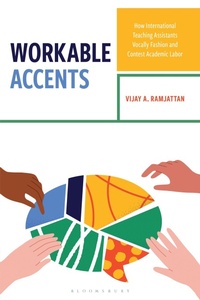
Workable Accents
How International Teaching Assistants Vocally Fashion and Contest Academic Labor
Will be published approx. on 21. January 2027
Book
Paperback/Softback
184 pages
978-1-6669-5835-5 (ISBN)
Description
An in-depth exploration of how international teaching assistants (ITAs) make their accents workable to fulfill their duties as academic laborers.
In this book, "workable" refers not only to manipulating an accent, but also to ensuring that an accent achieves certain objectives such as being perceived as an intelligible speaker, an expert educator, and an acceptable worker. Drawing on commentaries from ITAs working in Canadian universities, Vijay A. Ramjattan highlights how crafting a workable accent is not an apolitical endeavor, but rather a practice that works within and against the various communicative affordances of neoliberal academia. Just as it can involve fashioning one's voice to satisfy oppressive communication norms, a workable accent can also contest these norms to varying degrees. Ramjattan ultimately demonstrates that (academic) institutions must do a better job at addressing how vocally marginalized workers are heard at work.
In this book, "workable" refers not only to manipulating an accent, but also to ensuring that an accent achieves certain objectives such as being perceived as an intelligible speaker, an expert educator, and an acceptable worker. Drawing on commentaries from ITAs working in Canadian universities, Vijay A. Ramjattan highlights how crafting a workable accent is not an apolitical endeavor, but rather a practice that works within and against the various communicative affordances of neoliberal academia. Just as it can involve fashioning one's voice to satisfy oppressive communication norms, a workable accent can also contest these norms to varying degrees. Ramjattan ultimately demonstrates that (academic) institutions must do a better job at addressing how vocally marginalized workers are heard at work.
Reviews / Votes
With this book, Ramjattan establishes himself as the leading thinker on accentism in educational linguistics and beyond. Not only does this book bring together utterly pressing matters of political economy, higher education, racialization, and labour consciousness, it provides strategies for casting off oppressive models around what makes a good teacher. By listening closely to teachers of various multilingual competencies, Ramjattan undoes allegedly common-sense notions around how and when accent is assessed and assessible, identifies precisely how it is used as supremacist wedge to keep people down and out of power, and discerns what schools and universities need to do to provide a truly just workplace for all. In a moment inclined toward cynical impulses and reactionary dread, this is instead a book driven by justice, commitment, attentiveness, respect for people, and clarity of educational purpose. -- David Gramling * University of British Columbia *More details
Language
English
Place of publication
United States
Publishing group
Bloomsbury Publishing Plc
Target group
Professional and scholarly
Product notice
Paperback (trade)
Unsewn / adhesive bound
Dimensions
Height: 229 mm
Width: 152 mm
Thickness: 28 mm
Weight
503 gr
ISBN-13
978-1-6669-5835-5 (9781666958355)
Copyright in bibliographic data and cover images is held by Nielsen Book Services Limited or by the publishers or by their respective licensors: all rights reserved.
Schweitzer Classification
Person
Vijay A. Ramjattan is Assistant Professor in the Language and Literacies Education department at the Ontario Institute for Studies in Education, University of Toronto.
Content
Acknowledgments
Introduction
Chapter 1: Theorizing Workable Accents
Chapter 2: Achieving and Expanding Intelligibility
Chapter 3: Displaying and Creating Expertise
Chapter 4: Being Acceptable to Others and Oneself
Chapter 5: Workable Accents and (International Teaching Assistant) Work
Conclusion
References
Index
About the Author
Introduction
Chapter 1: Theorizing Workable Accents
Chapter 2: Achieving and Expanding Intelligibility
Chapter 3: Displaying and Creating Expertise
Chapter 4: Being Acceptable to Others and Oneself
Chapter 5: Workable Accents and (International Teaching Assistant) Work
Conclusion
References
Index
About the Author