

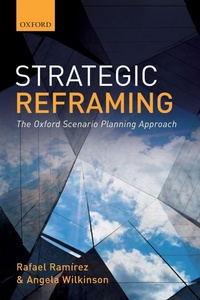
Strategic Reframing
The Oxford Scenario Planning Approach
Published on 21. June 2018
Book
Paperback/Softback
288 pages
978-0-19-882066-6 (ISBN)
Description
Traditional strategy assumes stability and predictability. Today's world is better characterised by turbulence, uncertainty, novelty and ambiguity - conditions that contribute disruptive changes and trigger the search for new ways of coping.
This book aims to become the premier guide on how to do scenario planning to support strategy and public policy. Co-authored by three experts in the field, the book presents The Oxford Scenario Planning Approach (OSPA). The approach is both intellectually rigorous and practical. Methodological choices and theoretical aspects in practice are detailed in reference to the relevant literatures and grounded in 6 case studies the authors have been involved with.
The book makes several contributions to the field, centred on how learning with scenario planning is supported by re-framing and re-perception; how this iterative process can be embedded in corporate or government settings, and how it helps those that it supports to do well in today's world.
The book is written in an accessible style and will be a useful introductory text as well as a useful guide for the more experienced scenario planning practitioner and scholar.
This book aims to become the premier guide on how to do scenario planning to support strategy and public policy. Co-authored by three experts in the field, the book presents The Oxford Scenario Planning Approach (OSPA). The approach is both intellectually rigorous and practical. Methodological choices and theoretical aspects in practice are detailed in reference to the relevant literatures and grounded in 6 case studies the authors have been involved with.
The book makes several contributions to the field, centred on how learning with scenario planning is supported by re-framing and re-perception; how this iterative process can be embedded in corporate or government settings, and how it helps those that it supports to do well in today's world.
The book is written in an accessible style and will be a useful introductory text as well as a useful guide for the more experienced scenario planning practitioner and scholar.
More details
Language
English
Place of publication
Oxford
United Kingdom
Target group
Professional and scholarly
Dimensions
Height: 234 mm
Width: 156 mm
Thickness: 15 mm
Weight
424 gr
ISBN-13
978-0-19-882066-6 (9780198820666)
Copyright in bibliographic data and cover images is held by Nielsen Book Services Limited or by the publishers or by their respective licensors: all rights reserved.
Schweitzer Classification
Other editions
Additional editions
E-Book
03/2016
1st Edition
OUP eBook
€24.99
Available for download
Book
03/2016
Oxford University Press
€104.70
Shipment within 15-20 days
E-Book
03/2016
1st Edition
OUP eBook
€24.99
Available for download
Persons
Rafael Ramirez is Director of the Oxford Scenarios Programme and has pioneered work in organizational aesthetics; the interactive design of strategy; and how scenarios work. He was Visiting Professor of Scenarios and Corporate Strategy at Shell International 2000-2003 and Chairman of the World Economic Forum's Global Agenda Council of Strategic Foresight. Rafael holds a PhD from the Wharton School, speaks Spanish, English and French fluently, has lived in five countries, and has worked on scenarios and futures work in some 30 countries since 1980.
Angela Wilkinson has contributed to over 100 futures studies and has directed several international multi-stakeholder scenario planning and foresight initiatives. She has over 30 years of analytical, managerial and consultancy experience, including board-level responsibility, honed in a wide range of organisations and international bodies, spanning the public and private sector. She is a member of the WEF's Global Strategic Foresight Community. Angela was Director of Futures Programmes, Smith School of Enterprise and Environment, and Director of Futures Research, James Martin Institute, University of Oxford. She spent nearly a decade in Shell's global scenario team. She has a Ph.D in Physics.
Angela Wilkinson has contributed to over 100 futures studies and has directed several international multi-stakeholder scenario planning and foresight initiatives. She has over 30 years of analytical, managerial and consultancy experience, including board-level responsibility, honed in a wide range of organisations and international bodies, spanning the public and private sector. She is a member of the WEF's Global Strategic Foresight Community. Angela was Director of Futures Programmes, Smith School of Enterprise and Environment, and Director of Futures Research, James Martin Institute, University of Oxford. She spent nearly a decade in Shell's global scenario team. She has a Ph.D in Physics.
Author
Fellow in Strategy and Director of the Oxford Scenarios ProgrammeFellow in Strategy and Director of the Oxford Scenarios Programme, Said Business School, University of Oxford
Strategic Foresight CounsellorStrategic Foresight Counsellor, Organisation for Economic Cooperation and Development (OECD)
Content
1: Introduction: Scenario Planning - The Oxford Approach
2: Oxford Scenario Planning Approach as social process
3: Scenario Planning as a Knowledge Acquisition and Generation Process
4: Working with Scenario Planning Learners
5: How Scenario Planning Is Done: The Oxford Scenario Planning Approach in Action
6: Learning and Teaching: Scenario Planning in Executive Development
7: Conclusion: An Incomplete Guide to Scenario Planning and the Beginning of a Conversation
Appendices
2: Oxford Scenario Planning Approach as social process
3: Scenario Planning as a Knowledge Acquisition and Generation Process
4: Working with Scenario Planning Learners
5: How Scenario Planning Is Done: The Oxford Scenario Planning Approach in Action
6: Learning and Teaching: Scenario Planning in Executive Development
7: Conclusion: An Incomplete Guide to Scenario Planning and the Beginning of a Conversation
Appendices