

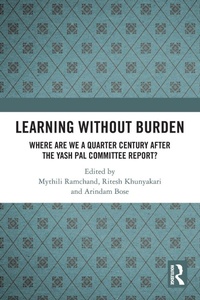
Learning without Burden
Where are We a Quarter Century after the Yash Pal Committee Report
1st Edition
Published on 29. January 2024
Book
Paperback/Softback
436 pages
978-1-032-29067-6 (ISBN)
Description
This book looks at education reforms, planning and policy through an exploration of the Yash Pal Committee report (1993) in India, which made recommendations to improve the quality of learning while reducing cognitive burden on students.
It analyses the wide-ranging impact the report had on curriculum, pedagogy, teacher education reforms and the national policy on education. The book examines the legacy of the report, tracing the various deliberations and critical engagements with issues around literacy, language and mathematics learning, curriculum reforms and classroom practices, assessment and evaluation. It reviews contemporary developments in research on learning in diverse disciplines and languages through the lens of the recommendations made by the Learning without Burden report while engaging with challenges and systemic issues which limit inclusivity and access to quality education.
Drawing on extensive research and first-hand academic and teaching experience, this book will attract attention and interest of students and researchers of educational policy and analysis, linguistics, sociology and South Asian studies. It will also be of interest to policy makers, think tanks and civil society organisations.
It analyses the wide-ranging impact the report had on curriculum, pedagogy, teacher education reforms and the national policy on education. The book examines the legacy of the report, tracing the various deliberations and critical engagements with issues around literacy, language and mathematics learning, curriculum reforms and classroom practices, assessment and evaluation. It reviews contemporary developments in research on learning in diverse disciplines and languages through the lens of the recommendations made by the Learning without Burden report while engaging with challenges and systemic issues which limit inclusivity and access to quality education.
Drawing on extensive research and first-hand academic and teaching experience, this book will attract attention and interest of students and researchers of educational policy and analysis, linguistics, sociology and South Asian studies. It will also be of interest to policy makers, think tanks and civil society organisations.
More details
Language
English
Place of publication
London
United Kingdom
Publishing group
Taylor & Francis Ltd
Target group
Professional and scholarly
Postgraduate
Illustrations
55 s/w Abbildungen, 54 s/w Photographien bzw. Rasterbilder, 1 s/w Zeichnung, 8 s/w Tabellen
8 Tables, black and white; 1 Line drawings, black and white; 54 Halftones, black and white; 55 Illustrations, black and white
Dimensions
Height: 234 mm
Width: 156 mm
Thickness: 25 mm
Weight
693 gr
ISBN-13
978-1-032-29067-6 (9781032290676)
Copyright in bibliographic data and cover images is held by Nielsen Book Services Limited or by the publishers or by their respective licensors: all rights reserved.
Schweitzer Classification
Other editions
Additional editions
Mythili Ramchand | Ritesh Khunyakari | Arindam Bose
Learning without Burden
Where are We a Quarter Century after the Yash Pal Committee Report
Book
07/2022
1st Edition
Routledge India
€207.90
Shipment within 15-20 days
Mythili Ramchand | Ritesh Khunyakari | Arindam Bose
Learning without Burden
Where are We a Quarter Century after the Yash Pal Committee Report
E-Book
07/2022
1st Edition
Routledge India
€59.49
Available for download
Mythili Ramchand | Ritesh Khunyakari | Arindam Bose
Learning without Burden
Where are We a Quarter Century after the Yash Pal Committee Report
E-Book
07/2022
1st Edition
Routledge India
€59.49
Available for download
Persons
Mythili Ramchand is a Professor at Tata Institute of Social Sciences (TISS), Mumbai, India. She has designed and anchored several cross-country teacher education programmes including the Post Graduation Certification programme on Contemporary Education Perspectives for teacher educators. She is currently engaged in comparative research on initial teacher education across BRICS countries and the UK.
Ritesh Khunyakari is an Associate Professor at Tata Institute of Social Sciences (TISS), Hyderabad, India. He has a PhD in Science Education from the Homi Bhabha Centre for Science Education, TIFR, Mumbai. He has been involved in developing courses for various undergraduate, postgraduate and doctoral programmes of TISS. He is also involved in teaching, research and development activities, projects and activities involving collaboration with organisations and institutions.
Arindam Bose is an Associate Professor at Tata Institute of Social Sciences (TISS), Mumbai and a Visiting Faculty at Federal University of Sao Paulo (UNIFESP), Brazil. He is the current Vice President of the International Group for the Psychology of Mathematics Education (IGPME). He has served on several national committees for DEd and BEd course design and textbook and curriculum development committees. His research area is in Mathematics Education.
Ritesh Khunyakari is an Associate Professor at Tata Institute of Social Sciences (TISS), Hyderabad, India. He has a PhD in Science Education from the Homi Bhabha Centre for Science Education, TIFR, Mumbai. He has been involved in developing courses for various undergraduate, postgraduate and doctoral programmes of TISS. He is also involved in teaching, research and development activities, projects and activities involving collaboration with organisations and institutions.
Arindam Bose is an Associate Professor at Tata Institute of Social Sciences (TISS), Mumbai and a Visiting Faculty at Federal University of Sao Paulo (UNIFESP), Brazil. He is the current Vice President of the International Group for the Psychology of Mathematics Education (IGPME). He has served on several national committees for DEd and BEd course design and textbook and curriculum development committees. His research area is in Mathematics Education.
Content
Foreword, 1. Unpacking the construct of burden, Part 1: Systemic Perspective, 2. Policy perspectives on learning without burden, 3. Initial Teacher Education: Possibilities and Limits of Curriculum Reform, 4. Reforms in curriculum and textbooks: Challenges and Possibilities, 5. From the tall tower to a lush garden, 6. Assessment and learning in Indian context: Compelling association, invariance or an educational folly?, 7. Learning without burden in the era of connected computers, 8. Education of children with diverse learning needs, 9. The demands of ethical learning and character development in our changing times, Part 2: Perspectives from Domains, 10. Learning in the arts and aesthetic development, 11. Growing into literacy: Part 1: The Building Blocks of Literacy, 12. Growing into literacy: Part 2: The Devanagari and Telugu Scripts: Tools to Lighten the Burden of Learning Literacy, 13. Understand language to acquire it: The burden is incomprehensibility, 14. The unfinished agenda of mathematics curriculum reform, 15. Strengthening learning through visuospatial experiences: Initiatives from the Indian Context, Part 3: Looking back to look forward, 16. Reflections on the Process and Impact of the Learning without Burden Report: Key Take-aways from the Interviews of Two Members of the National Advisory Committee, Epilogue