

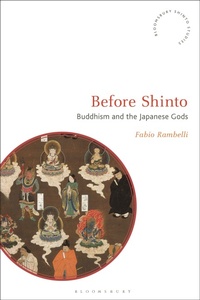
Before Shinto
Buddhism and the Japanese Gods
Will be published approx. on 12. November 2026
Book
Hardback
304 pages
978-1-350-64097-9 (ISBN)
Description
Focusing on the fundamental role played by Buddhism in shaping general ideas about and attitudes toward the Japanese gods (kami), this book presents a new revisionist history of Shinto.
Based on in-depth historical and cultural analysis and presenting numerous pre-modern sources in English translation, Before Shinto goes against received assumptions that something called "Shinto" has always existed in Japan as a foundation upon which religions and philosophies of foreign origin were first accepted and then developed. Rather, it demonstrates that Buddhism, in a complex process of assimilation of pre-existing forms of the sacred combined with Indian divinities, created narratives and representations of the kami, which were until then mostly anonymous and invisible, before adding them to its vast cosmology of gods and meta-human beings.
Shinto emerged as a separate tradition around the sixteenth century as part of a conscious movement away from Buddhism; within this newly emerged framework to envision the gods, different interventions, by Confucian and by Nativist authors, in particular, became possible. Fabio Rambelli details how in the modern period, Shinto, now definitely separate and distinct from Buddhism, has turned into a central element of Japanese nationalism first and cultural identity later.
Based on in-depth historical and cultural analysis and presenting numerous pre-modern sources in English translation, Before Shinto goes against received assumptions that something called "Shinto" has always existed in Japan as a foundation upon which religions and philosophies of foreign origin were first accepted and then developed. Rather, it demonstrates that Buddhism, in a complex process of assimilation of pre-existing forms of the sacred combined with Indian divinities, created narratives and representations of the kami, which were until then mostly anonymous and invisible, before adding them to its vast cosmology of gods and meta-human beings.
Shinto emerged as a separate tradition around the sixteenth century as part of a conscious movement away from Buddhism; within this newly emerged framework to envision the gods, different interventions, by Confucian and by Nativist authors, in particular, became possible. Fabio Rambelli details how in the modern period, Shinto, now definitely separate and distinct from Buddhism, has turned into a central element of Japanese nationalism first and cultural identity later.
More details
Series
Language
English
Place of publication
London
United Kingdom
Publishing group
Bloomsbury Publishing PLC
Target group
Professional and scholarly
Product notice
sewn/stitched
Cloth over boards
With dust jacket
Illustrations
8 bw illus
Dimensions
Height: 234 mm
Width: 156 mm
Thickness: 25 mm
Weight
454 gr
ISBN-13
978-1-350-64097-9 (9781350640979)
Copyright in bibliographic data and cover images is held by Nielsen Book Services Limited or by the publishers or by their respective licensors: all rights reserved.
Schweitzer Classification
Person
Fabio Rambelli is Distinguished Professor of Japanese religions and holder of the International Shinto Foundation chair in Shinto Studies in the departments of Religious Studies and East Asian Languages and Cultural Studies at the University of California, Santa Barbara, USA.
Content
Acknowledgements
List of Illustrations
Notes for the Reader
Preface
Introduction: Buddhism, Shinto, and the Kami
Part I: Buddhism and Local Gods
1. The Kami Encounter Buddhism
Part II: In and Out of Buddhism
2. The Dangerous Kami Called Buddha
3. Japan as the Land of the Kami
4. Buddhism, the Kami, and the Origin of the Universe
5. The Ritual World of Buddhist Kami
6. Origins of Non-Buddhist Discourses on the Kami
Part III: New Kami Discourses
7. The Kami in a Fragmented World: The Emergence of Shinto
8. Conclusion: Floating Signifiers: Alternative Discourses on Kami
Notes
Bibliography
Index
List of Illustrations
Notes for the Reader
Preface
Introduction: Buddhism, Shinto, and the Kami
Part I: Buddhism and Local Gods
1. The Kami Encounter Buddhism
Part II: In and Out of Buddhism
2. The Dangerous Kami Called Buddha
3. Japan as the Land of the Kami
4. Buddhism, the Kami, and the Origin of the Universe
5. The Ritual World of Buddhist Kami
6. Origins of Non-Buddhist Discourses on the Kami
Part III: New Kami Discourses
7. The Kami in a Fragmented World: The Emergence of Shinto
8. Conclusion: Floating Signifiers: Alternative Discourses on Kami
Notes
Bibliography
Index