

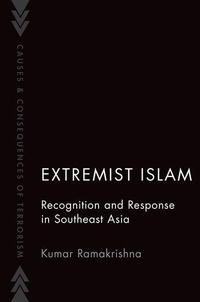
Extremist Islam
Recognition and Response in Southeast Asia
Published on 4. July 2022
Book
Paperback/Softback
432 pages
978-0-19-761097-8 (ISBN)
Description
Since the Bali terrorist attacks in 2002, law enforcement agencies have rigorously combatted terrorist networks in Southeast Asia, yet groups motivated by violent extremist interpretations of Islam remain resilient and dangerous. This book shines a light on specific beliefs, behaviors, and policies that impact these challenges, ultimately offering cutting-edge, effective tools for response.
The book begins by challenging misguided and controversial notions that depict Islam as an inherently violent religion, arguing that the theological-ideological amalgam of what has been called Salafabism is the more useful lens for recognizing closed-minded extremist currents. The book carefully distinguishes this Salafabist extremist mindset from relatively open-minded Salafabist radicalism, paying due attention to "nonviolent extremists" and the ways they can contribute to rather than reduce violent terrorist activity in the region. Using poignant case studies from Malaysia, Singapore, the Philippines and Indonesia, the book clarifies a bewildering range of terminology associated with Islamist violence and explains how imprecise and oversimplified narratives are destructive to progress--and worse, empowering to terrorist organizations. These chapters build up to research-informed policies and rhetorical recommendations for improved outcomes.
With its novel insights into the root causes of extremist terrorism in Southeast Asia, the ineffective policies that prohibit progress and promote unrest in this region, and the avenues for positive change, this book offers a comprehensive strategy for fostering theologically sound yet culturally authentic counterterrorist measures that defend the complex, richly textured tapestry of culture in Southeast Asia.
The book begins by challenging misguided and controversial notions that depict Islam as an inherently violent religion, arguing that the theological-ideological amalgam of what has been called Salafabism is the more useful lens for recognizing closed-minded extremist currents. The book carefully distinguishes this Salafabist extremist mindset from relatively open-minded Salafabist radicalism, paying due attention to "nonviolent extremists" and the ways they can contribute to rather than reduce violent terrorist activity in the region. Using poignant case studies from Malaysia, Singapore, the Philippines and Indonesia, the book clarifies a bewildering range of terminology associated with Islamist violence and explains how imprecise and oversimplified narratives are destructive to progress--and worse, empowering to terrorist organizations. These chapters build up to research-informed policies and rhetorical recommendations for improved outcomes.
With its novel insights into the root causes of extremist terrorism in Southeast Asia, the ineffective policies that prohibit progress and promote unrest in this region, and the avenues for positive change, this book offers a comprehensive strategy for fostering theologically sound yet culturally authentic counterterrorist measures that defend the complex, richly textured tapestry of culture in Southeast Asia.
Reviews / Votes
It has often been claimed that 'Terrorism has no Religion,' Yet major terrorist organizations claim to be acting in the name of true religion and manage to radicalize thousands of young men and women. Kumar Ramakrishna takes a hard look at the ambivalent relationship between religion and violence--an honest and persuasive analysis. * Alex P. Schmid, Editor-in-Chief, Perspectives on Terrorism * In a sweeping, rigorous, interdisciplinary volume that draws from extensive writings of, and interviews with, extremists, Kumar Ramakrishna asks us to take the religious extremist mindset seriously, and shows that both violent and non-violent Islamist extremism in Southeast Asia draw from the same theological DNA. Through detailed looks into the lives of extremists in Indonesia, Singapore, Malaysia, and the Philippines, Ramakrishna shows how they were immersed in an extremist ecosystem that drives their outlook, and makes a major contribution to our understanding of extremism in Southeast Asia. * Justin V. Hastings, Professor of International Relations and Comparative Politics, University of Sydney * This book provides a very comprehensive and cogent analysis of religious extremism, with a focus on disruptive challenges by Salafist groups and regional states' responses to them in Southeast Asia. Its diagnoses of the issues by a very seasoned scholar in the field is highly illuminating and penetrating. The book deserves to be read and its findings applied very widely. * Amin Saikal, Adjunct Professor of Social Sciences, University of Western Australia *More details
Series
Language
English
Place of publication
New York
United States
Target group
Professional and scholarly
Product notice
Paperback (trade)
Unsewn / adhesive bound
Dimensions
Height: 234 mm
Width: 154 mm
Thickness: 30 mm
Weight
604 gr
ISBN-13
978-0-19-761097-8 (9780197610978)
Copyright in bibliographic data and cover images is held by Nielsen Book Services Limited or by the publishers or by their respective licensors: all rights reserved.
Schweitzer Classification
Other editions
Additional editions
Book
04/2023
Oxford University Press Inc
€99.04
Shipment within 15-20 days
E-Book
12/2021
OUP eBook
€24.99
Available for download
E-Book
12/2021
OUP eBook
€24.99
Available for download
Person
Kumar Ramakrishna is the Provost's Chair in National Security Studies and Head of the International Centre for Political Violence and Terrorism Research at the S. Rajaratnam School of International Studies, Nanyang Technological University in Singapore. He has spoken on counterterrorism before local and international audiences, published in numerous prestigious journals, and has been described by Perspectives on Terrorism as "one of Southeast Asia's leading counterterrorism experts" for his research on understanding, preventing, and countering violent extremism in Southeast Asia.