

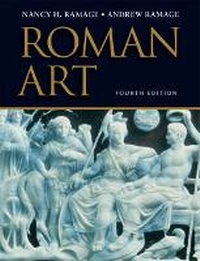
Roman Art
Romulus to Constantine
4th Edition
Published on 22. July 2004
Book
Paperback/Softback
368 pages
978-0-13-150487-5 (ISBN)
Description
For courses in Roman Art, Etruscan and Roman Art, Greek and Roman Art, The Roman World, Roman Civilization, Roman History.
Ideal for students who are studying Roman art for the first time, this exceptionally well-illustrated text explores Roman art in the traditional historical manner-with a focus on painting, sculpture, architecture, and decorative arts. It assumes no prior acquaintance with the classical world, and explains the necessary linguistic, historical, religious, social, and political background needed to fully understand Roman art.
Ideal for students who are studying Roman art for the first time, this exceptionally well-illustrated text explores Roman art in the traditional historical manner-with a focus on painting, sculpture, architecture, and decorative arts. It assumes no prior acquaintance with the classical world, and explains the necessary linguistic, historical, religious, social, and political background needed to fully understand Roman art.
Reviews / Votes
"There is no book, in my opinion, that competes with this one... This book is excellent in every way. The approach is sound, for the authors are leading experts... I would recommend it in glowing terms." - Nancy T. De Grummond, Florida State University, Tallahassee"Ramage and Ramage not only present the Roman world, but they show how Rome has influenced the modern world in many ways, and how the present is bound to the past... We have used no other text since Ramage and Ramage appeared." - Carol C. Mattusch, George Mason University
"The clarity and the use of ample illustrations make this an excellent choice as a text for an undergraduate course on Roman Art." - Mary Sturgeon, University of North Carolina at Chapel Hill
"Each and every chapter flows beautifully... This text, Roman Art, would seem to be appropriate for multidisciplinary classes involving art majors (especially art history), classic culture, history, Latin, architecture, and classical archaeology." - Robin M. Hicks, Ball State University
More details
Edition
4th edition
Language
English
Place of publication
United States
Publishing group
Pearson Education (US)
Target group
Professional and scholarly
Dimensions
Width: 281 mm
Thickness: 17 mm
Weight
1038 gr
ISBN-13
978-0-13-150487-5 (9780131504875)
Copyright in bibliographic data and cover images is held by Nielsen Book Services Limited or by the publishers or by their respective licensors: all rights reserved.
Schweitzer Classification
Other editions
New editions
Nancy H. Ramage | Andrew Ramage
Roman Art
Book
03/2008
5th Edition
Pearson
€108.93
Article is exhausted; no reprint
Previous edition

Nancy H. Ramage | Andrew Ramage
Roman Art, REPRINT
Book
02/2004
3rd Edition
Pearson
€45.79
Article exhausted; check for reprint
Persons
Nancy H. Ramage is Charles A. Dana Professor in the Humanities and Arts at Ithaca College and in 2000 received the Excellence in Teaching award. She has been a trustee of the Archaeological Institute of America and a member of numerous advisory boards of classical organizations and journals, including the American Journal of Archaeology and Etruscan Studies. She sits on the council of the Graduate School of Arts and Sciences at Harvard University and was recently elected a Fellow of the Society of Antiquaries of London. She received her doctorate from Harvard University and has wide experience as a lecturer, writer, and museum consultant. She co-authored two books on material from the excavations at Sardis, and has written many articles on antiquity and its reception in the 18th century.
Andrew Ramage is Professor of the History of Art and Archaeology at Cornell University. He has been the Director of the Archaeology Program at Cornell, Department Chair, and is Associate Director of the Harvard/Comell Archaeological Exploration of Sardis. He is a Fellow of the Society of Antiquaries of London. A Harvard University Ph.D., he has written Lydian Houses and Architectural Terracattas (1978); King Croesus's Gold: Excavations at Sardis and the History of Gold Refining with P. T. Craddock (2000); and A Guide to the Classical Collections of Cornell University with P. I. Kuniholm and N. H. Ramage (2003).
Andrew Ramage is Professor of the History of Art and Archaeology at Cornell University. He has been the Director of the Archaeology Program at Cornell, Department Chair, and is Associate Director of the Harvard/Comell Archaeological Exploration of Sardis. He is a Fellow of the Society of Antiquaries of London. A Harvard University Ph.D., he has written Lydian Houses and Architectural Terracattas (1978); King Croesus's Gold: Excavations at Sardis and the History of Gold Refining with P. T. Craddock (2000); and A Guide to the Classical Collections of Cornell University with P. I. Kuniholm and N. H. Ramage (2003).
Content
1. The Etruscan Forerunners 1000- BC.
2. The Roman Republic 509-27 BC.
3. Augustus and the Imperial Idea 27 BC-AD 14.
4. The Julio-Claudians AD 14-68.
5. The Flavians: Savior to Despot AD 69-98.
6. Trajan, Optimus Princeps AD 98-117.
7. Hadrian and the Classical Revival AD 117-138.
8. The Antonines AD 138-193.
9. The Severans AD 193-235.
10. The Soldier Emperors AD 235-284.
11. The Tetrarchs AD 284-312.
12. Constantine AD 307-337 and the Aftermath.
Timeline.
Roman Emperors.
Ancient Authors.
Glossary.
Roman Gods and Goddesses and their Greek Equivalents.
Select Bibliography.
Photographic Credits.
Index.
2. The Roman Republic 509-27 BC.
3. Augustus and the Imperial Idea 27 BC-AD 14.
4. The Julio-Claudians AD 14-68.
5. The Flavians: Savior to Despot AD 69-98.
6. Trajan, Optimus Princeps AD 98-117.
7. Hadrian and the Classical Revival AD 117-138.
8. The Antonines AD 138-193.
9. The Severans AD 193-235.
10. The Soldier Emperors AD 235-284.
11. The Tetrarchs AD 284-312.
12. Constantine AD 307-337 and the Aftermath.
Timeline.
Roman Emperors.
Ancient Authors.
Glossary.
Roman Gods and Goddesses and their Greek Equivalents.
Select Bibliography.
Photographic Credits.
Index.