

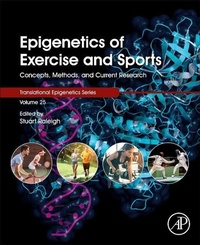
Epigenetics of Exercise and Sports: Volume 25
Concepts, Methods, and Current Research
Published on 15. July 2021
Book
Paperback/Softback
320 pages
978-0-12-820682-9 (ISBN)
Description
Epigenetics of Exercise and Sports: Concepts, Methods, and Current Research explains fundamental epigenetic processes and how these are altered by exercise and sports. After a brief review of fundamental epigenetic biology, this all-new volume in the Translational Epigenetics series offers step-by-step instruction in how epigenetic factors are investigated for their influence over exercise related traits of human physiology, disease, and injury. The current state of knowledge in the field and recent findings are discussed in-depth, illuminating how exercise and sports performance may epigenetically modify our physiology, disease and injury risks, and how this knowledge can be applied in personalized exercise approaches, diagnostics, and treatment. This book also explores the shortcomings of explaining exercise related phenomena using only genomics and traditional biochemical techniques, setting the scene for a paradigm shift in exercise biology. In addition, over a dozen international specialists contribute chapters on exercise and sports epigenetics, and their influence over metabolism, obesity, aging, immunity, and neurological disease, as well as the epigenetic impacts of concussions and sports doping. A concluding chapter discusses ongoing themes in the field and outlooks for future research.
Reviews / Votes
"...covers what epigenetics is, how it works, and how aging, exercise, sport and even concussion change this.... [Will] help readers understand the relationship between exercise/sport and epigenetics in hopes to help the population be more active by enabling more customization to exercise and sports for the individual.... The best aspects of the book are the separate sections/chapters going over the research and role of each different variable with epigenetics. The author makes it easy for the novice to understand the concepts. The book does a fantastic job introducing epigenetics, the current research, and the future potential uses, [which] is incredibly useful to those in sports, lifestyle, and longevity medicine.... [V]ery well written and laid out thoughtfully for easy reference.... This book can be very useful for guidance, further workups and more for people interested in longevity, and optimization of their health using more than just the normal "diet and exercise." -- (c)Doody's Review Service, 2023, Jacob Pfeiffer, DO,MBA (Medical College of Wisconsin)More details
Series
Language
English
Place of publication
San Diego
United States
Publishing group
Elsevier Science Publishing Co Inc
Target group
Professional and scholarly
Human geneticists; human genomicists; translational researchers in genomic medicine, epigenetics, physiology, aging, biochemistry, sports medicine and exercise sciences, molecular biology; life science researchers; immunologists, oncologists; bioengineers; developmental biologists, physiologists
Product notice
Paperback (trade)
Unsewn / adhesive bound
Dimensions
Height: 230 mm
Width: 188 mm
Thickness: 17 mm
Weight
668 gr
ISBN-13
978-0-12-820682-9 (9780128206829)
Copyright in bibliographic data and cover images is held by Nielsen Book Services Limited or by the publishers or by their respective licensors: all rights reserved.
Schweitzer Classification
Other editions
Additional editions
E-Book
07/2021
Academic Press
€155.00
Available for download
Person
Stuart M Raleigh, BSc, FIBMS, PhD is an Associate Professor in Exercise Biochemistry and Epigenetics at Coventry University. His research interests focus on epigenetics, genetics, and biochemical mechanisms of chronic disease. He has a special interest in identifying epigenetic factors that influence the risk of musculoskeletal soft tissue pathologies and he is also exploring the link between miRNA expression and various exercise related traits. Dr. Raleigh led the University of Northampton's Centre for Physical Activity and Chronic Disease (PACD) from 2014-2018 and he has extensive international research collaborations. His teaching interests focus on Alzheimer's disease and multifactorial genetics. He is a Fellow of the Higher Education Academy (HEA), and Section Editor (Genetics theme) for the Journal of Sports Science and Medicine.
Content
Section I Concepts and methods
1. Exercise and sport: Definitions, classifications, and relevance to population health
2. Epigenetic processes-An overview
3. Methods to study exercise and sports epigenetics
Section II Current research and future perspectives
4. Nutrients, metabolism, and epigenetic change
5. Obesity epigenetics and exercise
6. Epigenetic change and different types of exercise
7. Exercise, epigenetics, and aging
8. Epigenetics, exercise, and the immune system
9. Alzheimer's disease, epigenetics, and exercise
10. The current and future state of sports genomics
11. Epigenetic regulation and musculoskeletal injuries
12. Sports concussion and epigenetics
13. Epigenetics and doping in sports-The role of microRNAs
14. Future perspectives and concluding remarks
1. Exercise and sport: Definitions, classifications, and relevance to population health
2. Epigenetic processes-An overview
3. Methods to study exercise and sports epigenetics
Section II Current research and future perspectives
4. Nutrients, metabolism, and epigenetic change
5. Obesity epigenetics and exercise
6. Epigenetic change and different types of exercise
7. Exercise, epigenetics, and aging
8. Epigenetics, exercise, and the immune system
9. Alzheimer's disease, epigenetics, and exercise
10. The current and future state of sports genomics
11. Epigenetic regulation and musculoskeletal injuries
12. Sports concussion and epigenetics
13. Epigenetics and doping in sports-The role of microRNAs
14. Future perspectives and concluding remarks