

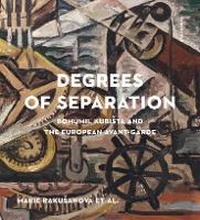
Degrees of Separation
Bohumil Kubista and the European Avant-Garde
Published on 1. September 2021
Book
Hardback
700 pages
978-80-246-4722-7 (ISBN)
Description
In Degrees of Separation, scholars from the Czech Republic, Canada, Germany, and Hungary take a new approach to exploring the work of one of Central Europe's most interesting modernist painters, Bohumil Kubista. While many art historians have viewed Kubista's work solely in the context of an idealized Czech canon, Kubista did not identify with a nation-state clearly defined by ethnicity, language, or territorial reach.
Taking a transnational approach that incorporates thorough topographical research, the authors attempt to redraw the map of European modernism by exploring the artist's subversive approach to the stylistic currents of his time. The book reveals the complex relationships within early twentieth-century Europe, as Kubista and other Central European artists tried to balance their admiration for the dominant artistic trends coming out of Paris with their desire to find alternative forms of expression arising from local artistic and intellectual sources. The richly illustrated book features a wealth of documentation, including an exhaustive timeline with notes, a comprehensive inventory of Kubista's works, and an up-to-date exhibition list.
Taking a transnational approach that incorporates thorough topographical research, the authors attempt to redraw the map of European modernism by exploring the artist's subversive approach to the stylistic currents of his time. The book reveals the complex relationships within early twentieth-century Europe, as Kubista and other Central European artists tried to balance their admiration for the dominant artistic trends coming out of Paris with their desire to find alternative forms of expression arising from local artistic and intellectual sources. The richly illustrated book features a wealth of documentation, including an exhaustive timeline with notes, a comprehensive inventory of Kubista's works, and an up-to-date exhibition list.
More details
Edition
New edition
Language
English
Place of publication
Ovocny
Czech Republic
Edition type
New edition
Product notice
sewn/stitched
Cloth over boards
Dimensions
Height: 260 mm
Width: 235 mm
ISBN-13
978-80-246-4722-7 (9788024647227)
Copyright in bibliographic data and cover images is held by Nielsen Book Services Limited or by the publishers or by their respective licensors: all rights reserved.
Schweitzer Classification
Persons
Marie Rakusanova is associate professor of art history at Charles University, Prague. Phil Jones is a translator of Czech into English. Daniel Morgan is a translator of Czech into English.
Content
I. Introduction (Marie Rakusanova)
II. Map: Kubista and Europe
III. Kubista and the World: Reality Mediated by Objects (Marie Rakusanova)
IV. Map: Kubista in Florence
V. Florence: Objects, Territories and Topographies (Marie Rakusanova - Eva Bendova)
VI. Map: Kubista in Prague
VII. The First Osma Exhibition (Marie Rakusanova - Mahulena Neslehova)
VIII. The Concept of Colour in the Work of Bohumil Kubista (Mahulena Neslehova)
IX. The Second Exhibition of the Osma Group (Marie Rakusanova - Mahulena Neslehova)
X. Kubista's French Connections: Networks, Reception, Ideals (Francoise Lucbert)
XI. Map: Kubista in Paris
XII. Kubista and the Social Topography of Paris: 1909-1910 (Marie Rakusanova)
XIII. Inspirations Drawn from Kubista's Stay in Paris (Mahulena Neslehova)
XIV. Map: The Movement of Kubista's Works through Europe
XV. Bohumil Kubista and Germany (Anke Daemgen)
XVI. Kubista, Ethics, Dietetics, the Psychology of Vision, Spirituality and Monism (Marie Rakusanova)
XVII. The Will to Spirituality and Its Influence on the Composition of Kubista's Works (Mahulena Neslehova)
XVIII. The Concept of Geometric Infrastructure in the Work of Kubista and the Section d'Or (Mahulena Neslehova)
XIX. Kubista's Paradoxical Cubism: 1912-1913 (Marie Rakusanova)
XX. Bohumil Kubista, Cubism and Hungary (Andras Zwickl)
XXI. Kubista - Futurist, Cubist, Expressionist in Lviv in 1913 (Marie Rakusanova)
XXII. Moderni umeni, the 45th Exhibition of the Manes Association of Fine Artists - "The Most Comprehensive Exhibition" in the "Whole World"? (Marie Rakusanova)
XXIII. Map: Kubista in Pula
XXIV. A View through the Cannon Barrel: Bohumil Kubista in Pula, 1905-1906, 1913-1918 (Eva Bendova)
XXV. Indications of Kubista's New Programme (Mahulena Neslehova)
XXVI. Conclusion (Marie Rakusanova)
XXVII. Timeline and Documentary Section
XXVIII. Notes
XXIX. Abbreviation List
XXX. Sources
XXXI. Inventory of Paintings
XXXII. Index of Names
II. Map: Kubista and Europe
III. Kubista and the World: Reality Mediated by Objects (Marie Rakusanova)
IV. Map: Kubista in Florence
V. Florence: Objects, Territories and Topographies (Marie Rakusanova - Eva Bendova)
VI. Map: Kubista in Prague
VII. The First Osma Exhibition (Marie Rakusanova - Mahulena Neslehova)
VIII. The Concept of Colour in the Work of Bohumil Kubista (Mahulena Neslehova)
IX. The Second Exhibition of the Osma Group (Marie Rakusanova - Mahulena Neslehova)
X. Kubista's French Connections: Networks, Reception, Ideals (Francoise Lucbert)
XI. Map: Kubista in Paris
XII. Kubista and the Social Topography of Paris: 1909-1910 (Marie Rakusanova)
XIII. Inspirations Drawn from Kubista's Stay in Paris (Mahulena Neslehova)
XIV. Map: The Movement of Kubista's Works through Europe
XV. Bohumil Kubista and Germany (Anke Daemgen)
XVI. Kubista, Ethics, Dietetics, the Psychology of Vision, Spirituality and Monism (Marie Rakusanova)
XVII. The Will to Spirituality and Its Influence on the Composition of Kubista's Works (Mahulena Neslehova)
XVIII. The Concept of Geometric Infrastructure in the Work of Kubista and the Section d'Or (Mahulena Neslehova)
XIX. Kubista's Paradoxical Cubism: 1912-1913 (Marie Rakusanova)
XX. Bohumil Kubista, Cubism and Hungary (Andras Zwickl)
XXI. Kubista - Futurist, Cubist, Expressionist in Lviv in 1913 (Marie Rakusanova)
XXII. Moderni umeni, the 45th Exhibition of the Manes Association of Fine Artists - "The Most Comprehensive Exhibition" in the "Whole World"? (Marie Rakusanova)
XXIII. Map: Kubista in Pula
XXIV. A View through the Cannon Barrel: Bohumil Kubista in Pula, 1905-1906, 1913-1918 (Eva Bendova)
XXV. Indications of Kubista's New Programme (Mahulena Neslehova)
XXVI. Conclusion (Marie Rakusanova)
XXVII. Timeline and Documentary Section
XXVIII. Notes
XXIX. Abbreviation List
XXX. Sources
XXXI. Inventory of Paintings
XXXII. Index of Names