

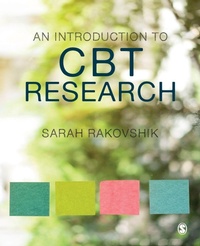
An Introduction to CBT Research
1st Edition
Published on 1. November 2019
Book
Paperback/Softback
248 pages
978-1-5264-2713-7 (ISBN)
Description
This highly practical book will guide students through the different levels of research within CBT by addressing the general principles, how to understand statistics and tackling with general principles. It also highlights how to critically engage with, interpret and evaluate research so that it can be used to shape practice. This important book will help readers see the relevance of research in their working lives and empower them to become active and keen researchers.
Reviews / Votes
This is the book for you if you want an excellent and readable guide that will support you in making sense of research in the context of Psychotherapy in general and Cognitive-Behavioural Therapies in particular. It also enables the reader to understand how to undertake the process of carrying out and disseminating their own research in psychological interventions. The skillful blend of central principles with illustrative examples provides clarity without oversimplification. The author has carefully crafted the narrative and presentation of material to ensure that it is practical and relevant whilst building to an accurate and sophisticated understanding of clinically applicable research. This is achieved through a crystal clear explanation of the fundamental principles of the entire range of research and how these can be applied to improve CBT practice and therefore to benefit those seeking help.-- Paul Salkovskis
More details
Language
English
Place of publication
London
United Kingdom
Target group
Professional and scholarly
Dimensions
Height: 235 mm
Width: 191 mm
Thickness: 14 mm
Weight
471 gr
ISBN-13
978-1-5264-2713-7 (9781526427137)
Copyright in bibliographic data and cover images is held by Nielsen Book Services Limited or by the publishers or by their respective licensors: all rights reserved.
Schweitzer Classification
Other editions
Additional editions
Sarah Rakovshik
An Introduction to CBT Research
Book
11/2019
1st Edition
SAGE Publications Ltd
€160.80
Shipment within 15-20 days
Sarah Rakovshik
An Introduction to CBT Research
E-Book
09/2019
1st Edition
SAGE Publications Ltd
€61.49
Available for download
Person
Dr. Sarah Rakovshik is the co-Director for the University of Oxford Postgraduate CBT Programme and the Oxford Cognitive Therapy Centre. She is an experienced therapist who has worked with a wide range of clinical disorders in both adults and children. Her clinical interests include treatment of comorbid and complex presentations, as well as in the potentially positive effects of adverse life events. She holds a DPhil from Oxford University's Department of Psychiatry. Her research has focused on training methods and their effects on therapists' competence and patients' outcomes. She has had an international role as a trainer, supervisor and consultant for CBT training programmes and research projects.
Content
Introduction
Part I: Why does research matter in CBT?
Chapter 1: What is research and why do we bother?
Chapter 2: Why evidence matters: the research-practice gap
Part II: What do I need to know to understand research?
Chapter 3: Different approaches to evidence
Chapter 4: Common forms of research in CBT
Chapter 5: The role of statistics
Part III: How can I use existing research?
Chapter 6: Finding relevant research
Chapter 7: Evaluating evidence
Part IV: How do I conduct my own research?
Chapter 8: Research question(s) and research design: Direction, route & destination
Chapter 9: Getting the recipe right before you start: Ingredients & method
Chapter 10: Ethical issues in research
Chapter 11: The data collection phase
Chapter 12: The data analysis phase
Chapter 13: Disseminating your research
Part I: Why does research matter in CBT?
Chapter 1: What is research and why do we bother?
Chapter 2: Why evidence matters: the research-practice gap
Part II: What do I need to know to understand research?
Chapter 3: Different approaches to evidence
Chapter 4: Common forms of research in CBT
Chapter 5: The role of statistics
Part III: How can I use existing research?
Chapter 6: Finding relevant research
Chapter 7: Evaluating evidence
Part IV: How do I conduct my own research?
Chapter 8: Research question(s) and research design: Direction, route & destination
Chapter 9: Getting the recipe right before you start: Ingredients & method
Chapter 10: Ethical issues in research
Chapter 11: The data collection phase
Chapter 12: The data analysis phase
Chapter 13: Disseminating your research