

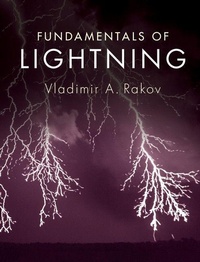
Fundamentals of Lightning
Published on 7. April 2016
Book
Hardback
270 pages
978-1-107-07223-7 (ISBN)
Description
This new book provides a focused set of topics suitable for advanced undergraduate or graduate courses on lightning. It presents the current state of the art in lightning science including areas such as lightning modeling, calculation of lightning electromagnetic fields, electromagnetic methods of lightning location, and lightning damaging effects and protective techniques. Pedagogical features designed to facilitate class learning include end-of-chapter summaries, further reading suggestions, questions and problems, and a glossary explaining key lightning and atmospheric electricity terms. A selection of appendices are provided at the end of the book, which include detailed derivations of exact equations for computing electric and magnetic fields produced by lightning. Designed for a single-semester course on lightning and its effects, and written in a style accessible to technical non-experts, this book will also be a useful, up-to-date reference for scientists, engineers and practitioners who have to deal with lightning in their work.
Reviews / Votes
'This is a very clear, easy to read and insightful book on one of the most fascinating and yet complex natural phenomena. The content and structure of the book are well designed for use on an undergraduate or graduate course on lightning. It is enriched with interesting exercises and problems, and is nicely complemented by nine instructive appendices. The book is a must read for anyone interested in understanding lightning and its effects.' Farhad Rachidi, Electromagnetic Compatibility Laboratory (EMC Lab), Ecole Polytechnique Federale de Lausanne (EPFL), Switzerland 'This is an outstanding textbook, written by a leading expert in our field. It provides an excellent quantitative and in-depth treatment of lightning from its atmospheric origins through to its practical implications. The content is nicely organized and layered, making it well-suited for a variety of levels of undergraduate and graduate courses in electrical engineering, applied physics and atmospheric sciences. It will also serve as a great long-term reference for researchers in our field.' Kenneth L. Cummins, University of ArizonaMore details
Language
English
Place of publication
Cambridge
United Kingdom
Target group
Professional and scholarly
Illustrations
13 Tables, black and white; 125 Halftones, unspecified
Dimensions
Height: 260 mm
Width: 183 mm
Thickness: 19 mm
Weight
708 gr
ISBN-13
978-1-107-07223-7 (9781107072237)
Copyright in bibliographic data and cover images is held by Nielsen Book Services Limited or by the publishers or by their respective licensors: all rights reserved.
Schweitzer Classification
Other editions
Additional editions
Vladimir A. Rakov
Fundamentals of Lightning
E-Book
08/2016
Cambridge University Press
€61.99
Available for download
Vladimir A. Rakov
Fundamentals of Lightning
E-Book
04/2016
Cambridge University Press
€52.99
Available for download
Person
Vladimir A. Rakov is a professor in the Department of Electrical and Computer Engineering at the University of Florida, and Co-Director of the International Center for Lightning Research and Testing (ICLRT). He is the author or coauthor of three other books and over 250 journal papers on various aspects of lightning. Professor Rakov is a Fellow of the Institute of Electrical and Electronics Engineers (IEEE), the American Meteorological Society (AMS), the American Geophysical Union (AGU) and the Institution of Engineering and Technology (IET). He received the Karl Berger Award in 2012 from the Scientific Committee of the International Conference on Lightning Protection (ICLP) for distinguished achievements in lightning research, developing new fields in theory and practice, modeling and measurements.
Content
Dedication; Preface; 1. Types of lightning discharges and lightning terminology; 2. Incidence of lightning to areas and structures; 3. Electrical structure of thunderclouds; 4. Properties of the downward negative lightning discharge to ground; 5. Calculation of lightning electromagnetic fields; 6. Modeling of lightning processes; 7. Measurement of lightning electric and magnetic fields; 8. Electromagnetic methods of lightning location; 9. Lightning damaging effects and protective techniques; Appendix 1. How is lightning initiated in thunderclouds?; Appendix 2. Reconstruction of sources from measured electrostatic field changes; Appendix 3. Derivation of exact equations for computing lightning electric and magnetic fields; Appendix 4. Compact intracloud discharges (CIDs); Appendix 5. Is it true that lightning never strikes the same place twice?; Appendix 6. Is it possible to use lightning as an energy source?; Appendix 7. Lightning safety; Appendix 8. Lightning makes glass; Appendix 9. Bibliography on triggered lightning experiments and natural lightning observations at Camp Blanding, Florida (1995-2014); Glossary; References; Index.