

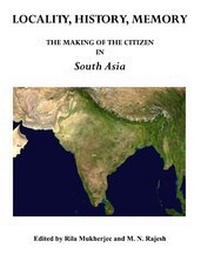
Locality, History, Memory
The Making of the Citizen in South Asia
Published on 8. May 2009
Book
Paperback/Softback
325 pages
978-1-4438-0188-1 (ISBN)
Description
Locality, History, Memory: The Making of the Citizen in South Asia was born out of the need to interrogate the tropes through which place, history and memory underpin notions of citizenship in present Southasia. Time as both time present and time past is framed here in two settings: as privileging both place (material or ideological site) and space. The latter refers to religion, oppression, marginalization and/or dalitisation. Time transcends both site/location and actual physical boundaries. Locality or location is therefore envisioned in terms of both actual place as well as a gateway to a larger space, in terms of a situation where historical memory negotiates the increasingly complex present. Agency and contingency therefore assume a critical importance here.Citizenship, far from being a discrete entity, is found to be multidimensional: it refers to formal status and the legal status of nationality and citizenship authenticated in the passport, but it also refers to rights and privileges; identity and solidarity, religious beliefs and a sense of belonging. Moving away from the role of the state, which has been at the centre of all inquiries on citizenship, we ask here the following questions in Locality, History, Memory: How does our history enforce or dilute the notion of the citizen? How far does memory strengthen or weaken it? What role does features not normally associated with citizenship such as access to natural resources, or ritual, faith and religion play in reinforcing such a status? History in the end is written by the historian and it was easy to map the changing methodologies used by the historians to essay the past but this is becoming increasingly difficult now. Another twist is the shift to hypertext at a popular level echoing what the late E H Carr had once called 'bringing more and more people into history'. These so called alternative histories or people's histories are becoming more and more popular because of the point at which we are located in time. Moreover, devices afforded by the new media enable these alternative histories to have an immediacy that the conventional historical format lacked. The collapse of state control over the new media has led to the resurgence of many archaic voices unimaginable just a decade ago.
More details
Series
Edition
Unabridged edition
Language
English
Place of publication
Newcastle upon Tyne
United Kingdom
Target group
Professional and scholarly
Edition type
Unabridged edition
Product notice
With dust jacket
Dimensions
Height: 212 mm
Width: 148 mm
ISBN-13
978-1-4438-0188-1 (9781443801881)
Copyright in bibliographic data and cover images is held by Nielsen Book Services Limited or by the publishers or by their respective licensors: all rights reserved.
Schweitzer Classification
Other editions
Additional editions
E-Book
01/2009
1st Edition
Cambridge Scholars Publishing
€106.79
Available for download
Persons
Rila Mukherjee is Professor of History at the University of Hyderabad, India. She did her doctoral dissertation at the E.H.E.S.S., Paris.M.N. Rajesh is Lecturer in History at the University of Hyderabad, India and obtained his PhD. Degree from School of International Studies, Jawaharlal Nehru University, New Delhi, India.