

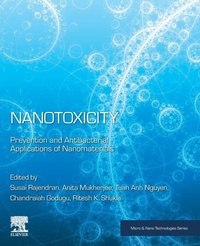
Nanotoxicity
Prevention and Antibacterial Applications of Nanomaterials
Published on 8. April 2020
Book
Paperback/Softback
504 pages
978-0-12-819943-5 (ISBN)
Description
Nanotoxicity: Prevention, and Antibacterial Applications of Nanomaterials focuses on the fundamental concepts for cytotoxicity and genotoxicity of nanomaterials. It sheds more light on the underlying phenomena and fundamental mechanisms through which nanomaterials interact with organisms and physiological media. The book provides good guidance for toxic prevention methods and management in the manufacture/application/disposal. The book also discusses the potential applications of nanomaterials-based antibiotics.
The potential toxic effects of nanomaterials result not only from the type of base materials, but also from their size/ ligands/surface chemical modifications. This book discusses why different classes of nanomaterials display toxic properties, and what can be done to mitigate this toxicity. It also explores how nanomaterials are being used as antimicrobial agents, being used to purify air and water, and counteract a range of infectious diseases.
This is an important reference for materials scientists, environmental scientists and biomedical scientists, who are seeking to gain a greater understanding of how nanomaterials can be used to combat toxic agents, and how the toxicity of nanomaterials themselves can best be mitigated.
The potential toxic effects of nanomaterials result not only from the type of base materials, but also from their size/ ligands/surface chemical modifications. This book discusses why different classes of nanomaterials display toxic properties, and what can be done to mitigate this toxicity. It also explores how nanomaterials are being used as antimicrobial agents, being used to purify air and water, and counteract a range of infectious diseases.
This is an important reference for materials scientists, environmental scientists and biomedical scientists, who are seeking to gain a greater understanding of how nanomaterials can be used to combat toxic agents, and how the toxicity of nanomaterials themselves can best be mitigated.
More details
Series
Language
English
Place of publication
United States
Target group
Professional and scholarly
Materials Scientists, Engineers and Toxicologists in academia
Product notice
Paperback (trade)
Illustrations
Approx. 130 illustrations (80 in full color)
Dimensions
Height: 235 mm
Width: 191 mm
Thickness: 25 mm
Weight
829 gr
ISBN-13
978-0-12-819943-5 (9780128199435)
Copyright in bibliographic data and cover images is held by Nielsen Book Services Limited or by the publishers or by their respective licensors: all rights reserved.
Schweitzer Classification
Other editions
Additional editions
Susai Rajendran | Anita Mukherjee | Chandraiah Godugu
Nanotoxicity
Prevention and Antibacterial Applications of Nanomaterials
E-Book
04/2020
Elsevier
€195.00
Available for download
Persons
Susai Rajendran is Research Director, Professor of Chemistry St. Antony's College of Arts and Sciences For Women, India. His research is in the field of corrosion science and engineering, nanotechnology, applications of nanomaterials in corrosion protection study, and environmental studies. is Professor of Botany at the University of Calcutta, India. Her research focuses in the areas of cell biology, genetic toxicology, and nanobiotechnology is Assistant Professor of Department of Regulatory Toxicology, National Institute of Pharmaceutical Education and Research, Hyderabad, India. His research focuses on the role of Telmisartan in improved intratumral distribution of nanoparticles. is Assistant Professsor of Biological and Life Sciences, Ahmedabad University, India. His research focuses on applied nanotechnology, biotechnology, immunology and toxicology. Tuan Anh Nguyen is a Senior Principal Research Scientist at the Institute for Tropical Technology, Vietnam Academy of Science and Technology, Hanoi, Vietnam. He received a BS in physics from Hanoi University in 1992, a BS in economics from Hanoi National Economics University in 1997, and a PhD in chemistry from the Paris Diderot University, France, in 2003. He was a Visiting Scientist at Seoul National University, South Korea, in 2004, and the University of Wollongong, Australia, in 2005. He then worked as a Postdoctoral Research Associate and Research Scientist at Montana State University, United States in 2006-09. In 2012 he was appointed as the Head of the Microanalysis Department at the Institute for Tropical Technology. His research areas of interest include smart sensors, smart networks, smart hospitals, smart cities, complexiverse, and digital twins. He has edited more than 74 books for Elsevier, 12 books for CRC Press, 1 book for Springer, 1 book for RSC, and 2 books for IGI Global. He is the Editor-in-Chief of Kenkyu Journal of Nanotechnology & Nanoscience.
Editor
Research Director, Professor of Chemistry St. Antony's College of Arts and Sciences For Women, India
University of Calcutta, India
National Institute of Pharmaceutical Education and Research, Hyderabad, India
Assistant Professor of Biological and Life Sciences, School of Arts and Sciences, Ahmedabad University, Ahmedabad, Gujarat- India
Senior Principal Research Scientist, Institute for Tropical Technology, Vietnam Academy of Science and Technology, Hanoi, Vietnam
Content
PART 1: BASIC PRINCIPLES
1. Nano-toxicity: An introduction
2. Nanoparticle-physiological media interactions
3. In vitro standard methods for cellular toxicity of nanoparticles
4. In vivo studies: Nanotoxicity and its biodistribution in organisms
5. In vitro and in vivo inflammatory effect of nanoparticles
6. Standard biological assays for nanotoxicity and its biodistribution
PART 2: TOXICITY OF NANOMATERIALS
7. Toxicity of metallic nanoparticles
8. Toxicity of metal oxide nanoparticles
9. Toxicity of ceramic nanomaterials
10. Toxicity of carbonaceous nanomaterials (CNTs, graphene)
11. Toxicity of polymeric nanomaterials
PART 3: PREVENTION OF NANOTOXICITY
12. General methods for detection and evaluation of nanotoxicity
13. General methods for mitigating nanotoxicity.
14. General regulations for safe manufacturer of nanomaterials
15. General regulations for safe application of nanomaterials
16. General regulations for safe disposal/exposure of nanomaterials
17. Nanomaterial waste management
PART 4: EMERGING ANTIBACTERIAL APPLICATIONS
18. Antibacterial activity of noble metals nanoparticles
19. Antibacterial activity of metal oxide nanoparticles
20. Antibacterial activity of noble metal- metal oxide hybrid nanoparticles
21. Antibacterial nanocoatings
22. Application in agri-food productions
23. Application in building materials
24. Antimicrobial nanomaterials for water disinfection
25. Antimicrobial nanomaterials for air disinfection/purification/remediation
PART 5: CONCLUSIONS AND FUTURE PERSPECTIVES
26. Current industrial scale up application
27. Future scope
1. Nano-toxicity: An introduction
2. Nanoparticle-physiological media interactions
3. In vitro standard methods for cellular toxicity of nanoparticles
4. In vivo studies: Nanotoxicity and its biodistribution in organisms
5. In vitro and in vivo inflammatory effect of nanoparticles
6. Standard biological assays for nanotoxicity and its biodistribution
PART 2: TOXICITY OF NANOMATERIALS
7. Toxicity of metallic nanoparticles
8. Toxicity of metal oxide nanoparticles
9. Toxicity of ceramic nanomaterials
10. Toxicity of carbonaceous nanomaterials (CNTs, graphene)
11. Toxicity of polymeric nanomaterials
PART 3: PREVENTION OF NANOTOXICITY
12. General methods for detection and evaluation of nanotoxicity
13. General methods for mitigating nanotoxicity.
14. General regulations for safe manufacturer of nanomaterials
15. General regulations for safe application of nanomaterials
16. General regulations for safe disposal/exposure of nanomaterials
17. Nanomaterial waste management
PART 4: EMERGING ANTIBACTERIAL APPLICATIONS
18. Antibacterial activity of noble metals nanoparticles
19. Antibacterial activity of metal oxide nanoparticles
20. Antibacterial activity of noble metal- metal oxide hybrid nanoparticles
21. Antibacterial nanocoatings
22. Application in agri-food productions
23. Application in building materials
24. Antimicrobial nanomaterials for water disinfection
25. Antimicrobial nanomaterials for air disinfection/purification/remediation
PART 5: CONCLUSIONS AND FUTURE PERSPECTIVES
26. Current industrial scale up application
27. Future scope