

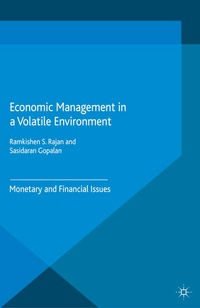
Economic Management in a Volatile Environment
Monetary and Financial Issues
Published on 1. January 2015
Book
Paperback/Softback
XX, 283 pages
978-1-349-47562-9 (ISBN)
Description
This book discusses some of the challenges relating to macroeconomic and financial management in a volatile and uncertain world brought about by greater financial openness. It explores the implications of a key set of issues emanating from financial globalisation on emerging market economies in a rigorous but readable manner.
More details
Edition
1st ed. 2015
Language
English
Place of publication
London
United Kingdom
Target group
Professional and scholarly
Product notice
Paperback (trade)
Unsewn / adhesive bound
Illustrations
XX, 283 p.
Dimensions
Height: 21.6 cm
Width: 14 cm
Weight
389 gr
ISBN-13
978-1-349-47562-9 (9781349475629)
DOI
10.1057/9781137371522
Schweitzer Classification
Other editions
Additional editions
Ramkishen S. Rajan | Sasidaran Gopalan
Economic Management in a Volatile Environment
Monetary and Financial Issues
Book
12/2014
Palgrave Macmillan
€53.49
Shipment within 10-20 days
Persons
Ramkishen S. RAJAN is a Professor of International Economic Policy at the School of Policy, Government and International Affairs (SPGIA), George Mason University (GMU) and has been on the faculty since January 2006. He is also the Co-director of the Center for Emerging Market Policies (CEMP) at SPGIA, GMU. He is currently a Visiting Professor at the Lee Kuan Yew School of Public Policy at the National University of Singapore and an Adjunct Senior Research Fellow at the Asia Competitiveness Institute (ACI), National University of Singapore. He is the Managing Editor of the Journal of International Commerce, Economics and Policy, Associate Editor of the Singapore Economic Review and sits on the Editorial Board of various other academic journals.
Sasidaran GOPALAN is a Post-Doctoral Research Fellow at the Institute for Emerging Market Studies (IEMS) and Institute for Advanced Study (IAS) at the Hong Kong University of Science and Technology (HKUST). He completed his PhD in Public Policy, specializing in International Finance at the School of Policy, Government and International Affairs (SPGIA), George Mason University, USA. He obtained his Bachelors and Masters degrees in Economics from Loyola College (Chennai) and Madras School of Economics (Chennai), respectively.
Sasidaran GOPALAN is a Post-Doctoral Research Fellow at the Institute for Emerging Market Studies (IEMS) and Institute for Advanced Study (IAS) at the Hong Kong University of Science and Technology (HKUST). He completed his PhD in Public Policy, specializing in International Finance at the School of Policy, Government and International Affairs (SPGIA), George Mason University, USA. He obtained his Bachelors and Masters degrees in Economics from Loyola College (Chennai) and Madras School of Economics (Chennai), respectively.
Content
PART I: EXCHANGE RATES, RESERVES AND CONTROLS 1. What is the Extent of Monetary Sterilisation in China? (With A. Ouyang and T.D. Willett) 2. What Determines Real Exchange Rate Fluctuations? (With A. Ouyang) 3. What is the Impact of Capital Controls? (With J. Li) 4. Can International Currency Taxation Stabilise Currency Fluctuations? (With G. Bird) 5. Why Do Countries Accumulate International Reserves? (With V. Yanamandra) PART II: FINANCIAL CRISES, FINANCIAL LIBERALISATION AND FOREIGN BANK ENTRY 6. Comparing Financial Crises: What Lessons for Asia from the Eurozone Crisis? 7. Financial Liberalisation and Foreign Bank Entry: What is the Nexus? 8. Do Foreign Banks Enhance Banking System Efficiency? 9. How Do Foreign Banks Affect Firms' Access to Credit? 10. Why Do Banks Go Abroad?