

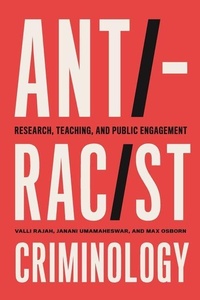
Anti-Racist Criminology
Research, Teaching, and Public Engagement
Will be published approx. on 8. December 2026
Book
Hardback
248 pages
978-1-4798-3784-7 (ISBN)
Description
Anti-Racist Criminology is the first book to reckon with issues of race, racism, and anti-racism in the field, both at the individual level and at the institutional level within the university and the criminal justice system writ large. The authors provide an overview and historical understanding of the field's engagement with racist practices, starting with the slave codes and how that connects to the abuses of "stop and frisk." Given the influence that criminological reporting, statistics, and modeling can have on public debates about crime, the authors stress the field's important role in shaping these debates.
The book addresses three central questions the authors call the "3 Ws" of anti-racist criminology: why it is important that criminologists take up the goal of anti-racism; what anti-racist principles should criminologists aim to incorporate into their work; and who should take up what roles in the endeavor.
The authors explore how these questions apply to research, teaching, and public engagement, and provide "how-tos" for academics interested in anti-racist work. They also offer readers resources to draw upon as they refine their anti-racist ideas and practices. The book closes with a discussion of how anti-racist criminology enhances our understanding of crime, punishment, and harm. Ultimately, Anti-Racist Criminology empowers readers to reimagine how they design research projects, teach, and interact with communities as they participate in a broader movement for social justice and equity.
The book addresses three central questions the authors call the "3 Ws" of anti-racist criminology: why it is important that criminologists take up the goal of anti-racism; what anti-racist principles should criminologists aim to incorporate into their work; and who should take up what roles in the endeavor.
The authors explore how these questions apply to research, teaching, and public engagement, and provide "how-tos" for academics interested in anti-racist work. They also offer readers resources to draw upon as they refine their anti-racist ideas and practices. The book closes with a discussion of how anti-racist criminology enhances our understanding of crime, punishment, and harm. Ultimately, Anti-Racist Criminology empowers readers to reimagine how they design research projects, teach, and interact with communities as they participate in a broader movement for social justice and equity.
More details
Language
English
Place of publication
New York
United States
Target group
Professional and scholarly
Product notice
Trade binding
Illustrations
1 b/w image; 2 tables
Dimensions
Height: 229 mm
Width: 152 mm
ISBN-13
978-1-4798-3784-7 (9781479837847)
Copyright in bibliographic data and cover images is held by Nielsen Book Services Limited or by the publishers or by their respective licensors: all rights reserved.
Schweitzer Classification
Persons
Valli Rajah (Author)
Valli Rajah is Professor of Criminal Justice at John Jay College of Criminal Justice, City University of New York.
Janani Umamaheswar (Author)
Janani Umamaheswar is Associate Professor in the Department of Criminology, Law and Society at George Mason University and co-editor of the Routledge International Handbook of Sensory Criminology.
Max Osborn (Author)
Max Osborn is Assistant Professor in the Department of Sociology & Criminology at Villanova University.
Valli Rajah is Professor of Criminal Justice at John Jay College of Criminal Justice, City University of New York.
Janani Umamaheswar (Author)
Janani Umamaheswar is Associate Professor in the Department of Criminology, Law and Society at George Mason University and co-editor of the Routledge International Handbook of Sensory Criminology.
Max Osborn (Author)
Max Osborn is Assistant Professor in the Department of Sociology & Criminology at Villanova University.