

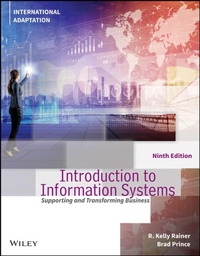
Introduction to Information Systems
International Adaptation
9th Edition
Published on 28. January 2022
Book
Paperback/Softback
592 pages
978-1-119-85993-2 (ISBN)
Description
Introduction to Information Systems, 9th Edition delivers an essential resource for undergraduate business majors seeking ways to harness information technology systems to succeed in their current or future jobs. The book assists readers in developing a foundational understanding of information systems and technology and apply it to common business problems.
This International Adaptation covers applications of the latest technologies with the addition of new cases from Europe, Middle East, Africa, Australia, and Asia-Pacific countries. It focuses on global business environment for students to understand the norms of using technology while operating on online platforms for exploring new avenues in different geographical locations. The book includes real business scenarios of how latest technologies such as Big Data, Cloud Computing, Blockchain, and IoT are perceived and adopted across countries. New cases highlight key technology issues faced by organizations such as designing and implementing IT security policies, dealing with ethical dilemma of securing customer data, moving IT infrastructure to cloud, and identifying how AI can be used to improve the efficiency of business operations.
This International Adaptation covers applications of the latest technologies with the addition of new cases from Europe, Middle East, Africa, Australia, and Asia-Pacific countries. It focuses on global business environment for students to understand the norms of using technology while operating on online platforms for exploring new avenues in different geographical locations. The book includes real business scenarios of how latest technologies such as Big Data, Cloud Computing, Blockchain, and IoT are perceived and adopted across countries. New cases highlight key technology issues faced by organizations such as designing and implementing IT security policies, dealing with ethical dilemma of securing customer data, moving IT infrastructure to cloud, and identifying how AI can be used to improve the efficiency of business operations.
More details
Persons
Content
1 Introduction to Information Systems
Opening Case: The Digital and Physical Transformation of Grocery Stores
Introduction
1.1 Why Should I Study Information Systems?
Before you go
1.2 Overview of Computer-Based Information Systems
IT's About Business 1.2
Before you go
1.3 How Does IT Impact Organizations?
1.4 Importance of Information Systems to Society
Before you go
Summary
Chapter Glossary
Discussion Questions
Problem-Solving Activities
Closing Case
2 Organizational Strategy, Competitive Advantage, and Information Systems
Opening Case
Introduction
2.1 Business Processes
Before you go
2.2 Business Process Reengineering, Business Process Improvement, and Business Process Management
Before you go
2.3 Business Pressures, Organizational Responses, and Information Technology Support
Before you go
2.4 Competitive Advantage and Strategic Information Systems
Before you go
Summary
Chapter Glossary
Discussion Questions
Problem-Solving Activities
Closing Case
3 Ethics and Privacy
Opening Case
Introduction
3.1 Ethical Issues
Before you go
3.2 Privacy
Before you go
Summary
Chapter Glossary
Discussion Questions
Problem-Solving Activities
Closing Case
4 Information Security
Opening Case
Introduction
4.1 Introduction to Information Security
Before you go
4.2 Unintentional Threats to Information Systems
Before you go
4.3 Deliberate Threats to Information Systems
Before you go
4.4 What Organizations Are Doing to Protect Information Resources
Before you go
4.5 Information Security Controls
Before you go
Summary
Chapter Glossary
Discussion Questions
Problem-Solving Activities
Closing Case
5 Data and Knowledge Management
Opening Case
Introduction
5.1 Managing Data
Before you go
5.2 The Database Approach
Before you go
5.3 Big Data
Before you go
5.4 Data Warehouses and Data Marts
Before you go
5.5 Knowledge Management
Before you go
5.6 Appendix: Fundamentals of Relational Database Operations
Before you go
Summary
Chapter Glossary
Discussion Questions
Problem-Solving Activities
Closing Case
6 Telecommunications and Networking
Opening Case
Introduction
6.1 What Is a Computer Network?
Before you go
6.2 Network Fundamentals
Before you go
6.3 The Internet and the World Wide Web
Before you go
6.4 Network Applications: Discovery
Before you go
6.5 Network Applications: Communication
Before you go
6.6 Network Applications: Collaboration
6.7 Network Applications: Educational
Summary
Chapter Glossary
Discussion Questions
Problem-Solving Activities
Closing Case
7 E-Business and E-Commerce
Opening Case
Introduction
7.1 Overview of E-Business and E-Commerce
Before you go
7.2 Business-to-Consumer (B2C) Electronic Commerce
Before you go
7.3 Business-to-Business (B2B) Electronic Commerce
Before you go
7.4 Ethical and Legal Issues in E-Business
Before you go
Summary
Chapter Glossary
Discussion Questions
Problem-Solving Activities
Closing Case
8 Wireless, Mobile Computing, and Mobile Commerce
Opening Case
Introduction
8.1 Wireless Technologies
Before you go
8.2 Wireless Computer Networks and Internet Access
Before you go
8.3 Mobile Computing and Mobile Commerce
Before you go
8.4 The Internet of Things
Before you go
Summary
Chapter Glossary
Discussion Questions
Problem-Solving Activities
Closing Case
9 Social Computing
Opening Case
Introduction
9.1 Web 2.0
Before you go
9.2 Fundamentals of Social Computing in Business
Before you go
9.3 Social Computing in Business: Shopping
Before you go
9.4 Social Computing in Business: Marketing
Before you go
9.5 Social Computing in Business: Customer Relationship Management
9.6 Social Computing in Business: Human Resource Management
Before you go
Summary
Chapter Glossary
Discussion Questions
Problem-Solving Activities
Closing Case
10 Information Systems within the Organization
Opening Case
Introduction
10.1 Transaction Processing Systems
Before you go
10.2 Functional Area Information Systems
Before you go
10.3 Enterprise Resource Planning Systems
Before you go
10.4 ERP Support for Business Processes
Before you go
Summary
Chapter Glossary
Discussion Questions
Problem-Solving Activities
Closing Case
11 Customer Relationship Management and Supply Chain Management
Opening Case
Introduction
11.1 Defining Customer Relationship Management
Before you go
11.2 Operational Customer Relationship Management Systems
Before you go
11.3 Other Types of Customer Relationship Management Systems
Before you go
11.4 Supply Chains
Before you go
11.5 Supply Chain Management
Before you go
11.6 Information Technology Support for Supply Chain Management
Before you go
Summary
Chapter Glossary
Discussion Questions
Problem-Solving Activities
Closing Case
12 Business Analytics
Opening Case
Introduction
12.1 Managers and Decision Making
Before you go
12.2 The Business Analytics Process
Before you go
12.3 Descriptive Analytics
Before you go
12.4 Predictive Analytics
Before you go
12.5 Prescriptive Analytics
Before you go
12.6 Presentation Tools
Before you go
Summary
Chapter Glossary
Discussion Questions
Problem-Solving Activities
Data-Driven Exercise
Closing Case
13 Acquiring Information Systems and Applications
Opening Case
Introduction
13.1 Planning for and Justifying IT Applications
Before you go
13.2 Strategies for Acquiring IT Applications
Before you go
13.3 Traditional Systems Development Life Cycle
Before you go
13.4 Alternative Methods and Tools for Systems Development
Before you go
Summary
Chapter Glossary
Discussion Questions
Problem-Solving Activities
Closing Case
14 Artificial Intelligence
Opening Case
14.1 Introduction to Artificial Intelligence
Before you go
14.2 Machine Learning and Deep Learning
Before you go
14.3 Neural Networks
Before you go
14.4 Artificial Intelligence Applications
Before you go
14.5 Artificial Intelligence in the Functional Areas
14.6 Appendix
Summary
Chapter Glossary
Discussion Questions
Problem-Solving Activities
Closing Case
Technology Guide 1 Hardware
Introduction
TG 1.1 Introduction to Hardware
TG 1.2 Strategic Hardware Issues
TG 1.3 Computer Hierarchy
TG 1.4 Input and Output Technologies
TG 1.5 The Central Processing Unit
Summary
Technology Guide Glossary
Discussion Questions
Problem-Solving Activities
Technology Guide 2 Software
Introduction
TG 2.1 Software Issues
TG 2.2 Systems Software
TG 2.3 Application Software
Summary
Technology Guide Glossary
Discussion Questions
Problem-Solving Activities
Technology Guide 3 Cloud Computing
TG 3.1 Introduction
TG 3.2 What Is Cloud Computing?
TG 3.3 Different Types of Clouds
TG 3.4 Cloud Computing Services
TG 3.5 The Benefits of Cloud Computing
TG 3.6 Concerns and Risks with Cloud Computing
TG 3.7 Web Services and Service-Oriented Architecture
Summary
Technology Guide Glossary
Discussion Questions
Problem-Solving Activities
Appendix Apply the Concept Activities
Opening Case: The Digital and Physical Transformation of Grocery Stores
Introduction
1.1 Why Should I Study Information Systems?
Before you go
1.2 Overview of Computer-Based Information Systems
IT's About Business 1.2
Before you go
1.3 How Does IT Impact Organizations?
1.4 Importance of Information Systems to Society
Before you go
Summary
Chapter Glossary
Discussion Questions
Problem-Solving Activities
Closing Case
2 Organizational Strategy, Competitive Advantage, and Information Systems
Opening Case
Introduction
2.1 Business Processes
Before you go
2.2 Business Process Reengineering, Business Process Improvement, and Business Process Management
Before you go
2.3 Business Pressures, Organizational Responses, and Information Technology Support
Before you go
2.4 Competitive Advantage and Strategic Information Systems
Before you go
Summary
Chapter Glossary
Discussion Questions
Problem-Solving Activities
Closing Case
3 Ethics and Privacy
Opening Case
Introduction
3.1 Ethical Issues
Before you go
3.2 Privacy
Before you go
Summary
Chapter Glossary
Discussion Questions
Problem-Solving Activities
Closing Case
4 Information Security
Opening Case
Introduction
4.1 Introduction to Information Security
Before you go
4.2 Unintentional Threats to Information Systems
Before you go
4.3 Deliberate Threats to Information Systems
Before you go
4.4 What Organizations Are Doing to Protect Information Resources
Before you go
4.5 Information Security Controls
Before you go
Summary
Chapter Glossary
Discussion Questions
Problem-Solving Activities
Closing Case
5 Data and Knowledge Management
Opening Case
Introduction
5.1 Managing Data
Before you go
5.2 The Database Approach
Before you go
5.3 Big Data
Before you go
5.4 Data Warehouses and Data Marts
Before you go
5.5 Knowledge Management
Before you go
5.6 Appendix: Fundamentals of Relational Database Operations
Before you go
Summary
Chapter Glossary
Discussion Questions
Problem-Solving Activities
Closing Case
6 Telecommunications and Networking
Opening Case
Introduction
6.1 What Is a Computer Network?
Before you go
6.2 Network Fundamentals
Before you go
6.3 The Internet and the World Wide Web
Before you go
6.4 Network Applications: Discovery
Before you go
6.5 Network Applications: Communication
Before you go
6.6 Network Applications: Collaboration
6.7 Network Applications: Educational
Summary
Chapter Glossary
Discussion Questions
Problem-Solving Activities
Closing Case
7 E-Business and E-Commerce
Opening Case
Introduction
7.1 Overview of E-Business and E-Commerce
Before you go
7.2 Business-to-Consumer (B2C) Electronic Commerce
Before you go
7.3 Business-to-Business (B2B) Electronic Commerce
Before you go
7.4 Ethical and Legal Issues in E-Business
Before you go
Summary
Chapter Glossary
Discussion Questions
Problem-Solving Activities
Closing Case
8 Wireless, Mobile Computing, and Mobile Commerce
Opening Case
Introduction
8.1 Wireless Technologies
Before you go
8.2 Wireless Computer Networks and Internet Access
Before you go
8.3 Mobile Computing and Mobile Commerce
Before you go
8.4 The Internet of Things
Before you go
Summary
Chapter Glossary
Discussion Questions
Problem-Solving Activities
Closing Case
9 Social Computing
Opening Case
Introduction
9.1 Web 2.0
Before you go
9.2 Fundamentals of Social Computing in Business
Before you go
9.3 Social Computing in Business: Shopping
Before you go
9.4 Social Computing in Business: Marketing
Before you go
9.5 Social Computing in Business: Customer Relationship Management
9.6 Social Computing in Business: Human Resource Management
Before you go
Summary
Chapter Glossary
Discussion Questions
Problem-Solving Activities
Closing Case
10 Information Systems within the Organization
Opening Case
Introduction
10.1 Transaction Processing Systems
Before you go
10.2 Functional Area Information Systems
Before you go
10.3 Enterprise Resource Planning Systems
Before you go
10.4 ERP Support for Business Processes
Before you go
Summary
Chapter Glossary
Discussion Questions
Problem-Solving Activities
Closing Case
11 Customer Relationship Management and Supply Chain Management
Opening Case
Introduction
11.1 Defining Customer Relationship Management
Before you go
11.2 Operational Customer Relationship Management Systems
Before you go
11.3 Other Types of Customer Relationship Management Systems
Before you go
11.4 Supply Chains
Before you go
11.5 Supply Chain Management
Before you go
11.6 Information Technology Support for Supply Chain Management
Before you go
Summary
Chapter Glossary
Discussion Questions
Problem-Solving Activities
Closing Case
12 Business Analytics
Opening Case
Introduction
12.1 Managers and Decision Making
Before you go
12.2 The Business Analytics Process
Before you go
12.3 Descriptive Analytics
Before you go
12.4 Predictive Analytics
Before you go
12.5 Prescriptive Analytics
Before you go
12.6 Presentation Tools
Before you go
Summary
Chapter Glossary
Discussion Questions
Problem-Solving Activities
Data-Driven Exercise
Closing Case
13 Acquiring Information Systems and Applications
Opening Case
Introduction
13.1 Planning for and Justifying IT Applications
Before you go
13.2 Strategies for Acquiring IT Applications
Before you go
13.3 Traditional Systems Development Life Cycle
Before you go
13.4 Alternative Methods and Tools for Systems Development
Before you go
Summary
Chapter Glossary
Discussion Questions
Problem-Solving Activities
Closing Case
14 Artificial Intelligence
Opening Case
14.1 Introduction to Artificial Intelligence
Before you go
14.2 Machine Learning and Deep Learning
Before you go
14.3 Neural Networks
Before you go
14.4 Artificial Intelligence Applications
Before you go
14.5 Artificial Intelligence in the Functional Areas
14.6 Appendix
Summary
Chapter Glossary
Discussion Questions
Problem-Solving Activities
Closing Case
Technology Guide 1 Hardware
Introduction
TG 1.1 Introduction to Hardware
TG 1.2 Strategic Hardware Issues
TG 1.3 Computer Hierarchy
TG 1.4 Input and Output Technologies
TG 1.5 The Central Processing Unit
Summary
Technology Guide Glossary
Discussion Questions
Problem-Solving Activities
Technology Guide 2 Software
Introduction
TG 2.1 Software Issues
TG 2.2 Systems Software
TG 2.3 Application Software
Summary
Technology Guide Glossary
Discussion Questions
Problem-Solving Activities
Technology Guide 3 Cloud Computing
TG 3.1 Introduction
TG 3.2 What Is Cloud Computing?
TG 3.3 Different Types of Clouds
TG 3.4 Cloud Computing Services
TG 3.5 The Benefits of Cloud Computing
TG 3.6 Concerns and Risks with Cloud Computing
TG 3.7 Web Services and Service-Oriented Architecture
Summary
Technology Guide Glossary
Discussion Questions
Problem-Solving Activities
Appendix Apply the Concept Activities