

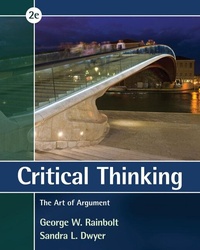
Critical Thinking
The Art of Argument
2nd Edition
Published on 1. January 2014
Book
Paperback/Softback
496 pages
978-1-285-19719-7 (ISBN)
Description
With a complete, approachable presentation, CRITICAL THINKING: THE ART OF ARGUMENT, 2nd Edition, is an accessible yet rigorous introduction to critical thinking. The text emphasizes immediate application of critical-thinking skills to everyday life. The relevance of these skills is shown throughout by highlighting the advantages of basing decisions on a thoughtful understanding of arguments and presenting the overarching commonalities across arguments. With its conversational writing style and carefully selected examples, the book employs a consistent and unified treatment of logical form and an innovative semiformal method of standardizing arguments that illustrates the concept of logical form while maintaining a visible connection to ordinary speech. Without sacrificing accuracy or detail, the authors have clearly presented the material with appropriate study tools and exercises that emphasize application rather than memorization.
More details
Edition
2nd edition
Language
English
Place of publication
Belmont, CA
United States
Publishing group
Cengage Learning, Inc
Target group
College/higher education
Product notice
Paperback (trade)
Unsewn / adhesive bound
Dimensions
Height: 249 mm
Width: 203 mm
Thickness: 15 mm
Weight
771 gr
ISBN-13
978-1-285-19719-7 (9781285197197)
Copyright in bibliographic data and cover images is held by Nielsen Book Services Limited or by the publishers or by their respective licensors: all rights reserved.
Schweitzer Classification
Persons
Dr. George W. Rainbolt is Professor and Chair of the Department of Philosophy at Georgia State University. He is the co-author of ETHICS (Harper-Collins 1994) and the author of THE CONCEPT OF RIGHTS (Springer 2006) as well as numerous articles. He chairs the Georgia State University Senate Committee on Admissions and Standards, has served on Georgia State University's General Education Assessment Committee, was a member of the Georgia State's SACS Accreditation Leadership Team, and is a member of Georgia State's Critical Thinking through Writing Leadership Team. Dr. Sandra L. Dwyer is Senior Lecturer in the Department of Philosophy at Georgia State University. As Coordinator for Graduate Teaching, she mentors twenty to thirty graduate students each year, overseeing their initial experience of teaching philosophy, including Critical Thinking sections. Over the past twenty years, she has taught numerous courses including more than 100 sections of critical thinking. She is the author of THINKING ETHICALLY IN BUSINESS (Humanities-Ebooks, 2008).
Content
Preface.
Introduction: How to Use This Book.
1. Critical Thinking and Arguments. What Is Critical Thinking? What Is an Argument? Why Think Critically? Identifying Arguments. Things That Are Not Arguments. Putting Arguments into Standard Form. Diagramming Arguments. Chapter Summary. Guide: Identifying and Standardizing Arguments.
2. What Makes a Good Argument? The Two Characteristics of a Good Argument. True Premises. Proper Form. Relevance. Arguing about Arguments. Some Improper Forms: Fallacies of Relevance. Chapter Summary. Argument Forms Studied in the Chapter. Guide: Identifying, Standardizing, and Evaluating Arguments.
3. Premises and Conclusions. Empirical Premises. Definitional Premises. Premises and Experts. Conclusions. Chapter Summary.
4. Language. Identifying Definitions. Evaluating Definitions. Language and Clarity. Language and Emotion. Chapter Summary. Argument Forms Studied in the Chapter.
5. Propositional Arguments. Identifying Propositional Statements. Evaluating Propositional Arguments. Chapter Summary. Argument Forms Studied in the Chapter. Guide: Identifying, Standardizing, and Evaluating Propositional Arguments.
6. Categorical Arguments. Identifying Categorical Statements. Evaluating Categorical Arguments with One Premise. Evaluating Categorical Arguments with Two Premises. Chapter Summary. Argument Forms Studied in the Chapter. Guide: Identifying, Standardizing, and Evaluating Categorical Arguments.
7. Analogical Arguments. Identifying Analogical Arguments. Evaluating Analogical Arguments. Chapter Summary. Argument Forms Studied in the Chapter. Guide: Identifying, Standardizing, and Evaluating Analogical Arguments.
8. Statistical Arguments. Descriptive Statistics. Identifying Statistical Arguments. Evaluating Statistical Arguments. Statistical Fallacies. Chapter Summary. Argument Forms Studied in the Chapter. Guide: Identifying, Standardizing, and Evaluating Statistical Arguments.
9. Causal Arguments. The Many Meanings of "Cause." Identifying Causal Arguments. Evaluating Causal Arguments. The Scientific Method. Chapter Summary. Argument Forms Studied in the Chapter. Guide: Identifying, Standardizing, and Evaluating Causal Arguments.
10. Moral Arguments. Identifying Moral Arguments. The Nature of Moral Arguments. Evaluating Moral Arguments. Moral Conflict. A Final Thought. Chapter Summary. Argument Forms Studied in the Chapter. Guide: Identifying, Standardizing, and Evaluating Moral Arguments.
Introduction: How to Use This Book.
1. Critical Thinking and Arguments. What Is Critical Thinking? What Is an Argument? Why Think Critically? Identifying Arguments. Things That Are Not Arguments. Putting Arguments into Standard Form. Diagramming Arguments. Chapter Summary. Guide: Identifying and Standardizing Arguments.
2. What Makes a Good Argument? The Two Characteristics of a Good Argument. True Premises. Proper Form. Relevance. Arguing about Arguments. Some Improper Forms: Fallacies of Relevance. Chapter Summary. Argument Forms Studied in the Chapter. Guide: Identifying, Standardizing, and Evaluating Arguments.
3. Premises and Conclusions. Empirical Premises. Definitional Premises. Premises and Experts. Conclusions. Chapter Summary.
4. Language. Identifying Definitions. Evaluating Definitions. Language and Clarity. Language and Emotion. Chapter Summary. Argument Forms Studied in the Chapter.
5. Propositional Arguments. Identifying Propositional Statements. Evaluating Propositional Arguments. Chapter Summary. Argument Forms Studied in the Chapter. Guide: Identifying, Standardizing, and Evaluating Propositional Arguments.
6. Categorical Arguments. Identifying Categorical Statements. Evaluating Categorical Arguments with One Premise. Evaluating Categorical Arguments with Two Premises. Chapter Summary. Argument Forms Studied in the Chapter. Guide: Identifying, Standardizing, and Evaluating Categorical Arguments.
7. Analogical Arguments. Identifying Analogical Arguments. Evaluating Analogical Arguments. Chapter Summary. Argument Forms Studied in the Chapter. Guide: Identifying, Standardizing, and Evaluating Analogical Arguments.
8. Statistical Arguments. Descriptive Statistics. Identifying Statistical Arguments. Evaluating Statistical Arguments. Statistical Fallacies. Chapter Summary. Argument Forms Studied in the Chapter. Guide: Identifying, Standardizing, and Evaluating Statistical Arguments.
9. Causal Arguments. The Many Meanings of "Cause." Identifying Causal Arguments. Evaluating Causal Arguments. The Scientific Method. Chapter Summary. Argument Forms Studied in the Chapter. Guide: Identifying, Standardizing, and Evaluating Causal Arguments.
10. Moral Arguments. Identifying Moral Arguments. The Nature of Moral Arguments. Evaluating Moral Arguments. Moral Conflict. A Final Thought. Chapter Summary. Argument Forms Studied in the Chapter. Guide: Identifying, Standardizing, and Evaluating Moral Arguments.