

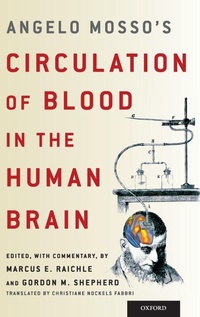
Angelo Mosso's Circulation of Blood in the Human Brain
Published on 20. November 2014
Book
Hardback
240 pages
978-0-19-935898-4 (ISBN)
Description
Modern brain imaging is revolutionizing the study of brain function in health and disease. Few realize that its origins began with a pioneering study in the nineteenth century by an Italian scientist, Angelo Mosso, of several subjects brought to him with head injuries that exposed their brains to direct observation. He took advantage of this opportunity to observe for the first time changes in cerebral blood flow in relation to different behaviors, the same changes that are the basis for the measurements underlying modern methods.
Although Mosso was widely recognized for this highly original study by his contemporaries, through a German translation in 1881, there has never been a translation through which his magnificent achievement could be recognized in English. His rightful role as the pioneer in brain imaging has thus not been recognized. This unique volume corrects that deficiency. Through it, the modern reader, whether an expert in the field or an interested scientist or member of the public, can gain a new perspective on the remarkable insights Mosso gained into how behaviors as subtle as thinking about a subject or feeling an emotion can produce the changes in pulsations of the brain that he observed.
The special features of this volume begin with a brief summary of Mosso's life. Two pioneers of modern brain imaging, Marcus Raichle and Gordon M. Shepherd, then provide an extensive commentary that succinctly summarizes Mosso's work and explains its relevance to modern methods. The authors not only emphasize Mosso's role as a pioneer in brain imaging, but also through this study as a pioneer in the eventual rise of cognitive neuroscience. The English translation then follows, together with all of the plates and illustrations of the original volume. The result is a classic of neuroscience now available for wide appreciation by neuroscientists, neurologists, psychologists, psychiatrists, historians of science and medicine, and the general public.
Although Mosso was widely recognized for this highly original study by his contemporaries, through a German translation in 1881, there has never been a translation through which his magnificent achievement could be recognized in English. His rightful role as the pioneer in brain imaging has thus not been recognized. This unique volume corrects that deficiency. Through it, the modern reader, whether an expert in the field or an interested scientist or member of the public, can gain a new perspective on the remarkable insights Mosso gained into how behaviors as subtle as thinking about a subject or feeling an emotion can produce the changes in pulsations of the brain that he observed.
The special features of this volume begin with a brief summary of Mosso's life. Two pioneers of modern brain imaging, Marcus Raichle and Gordon M. Shepherd, then provide an extensive commentary that succinctly summarizes Mosso's work and explains its relevance to modern methods. The authors not only emphasize Mosso's role as a pioneer in brain imaging, but also through this study as a pioneer in the eventual rise of cognitive neuroscience. The English translation then follows, together with all of the plates and illustrations of the original volume. The result is a classic of neuroscience now available for wide appreciation by neuroscientists, neurologists, psychologists, psychiatrists, historians of science and medicine, and the general public.
Reviews / Votes
This fascinating manuscript illuminates the thought process of a brilliant scientist and forerunner of modern neuroscience. In rescuing Mosso from oblivion, Fabbri, Raichle and Shepherd have given historians, students and neuroscientists a valuable new resource to fill gaps in the narrative that modern neuroscience was built upon. Moreover, the works of Mosso give us a new perspective on age old questions of the mind and perhaps pause to appreciate the newage of wonder we live in and to attack these questions with renewed vigor and greater humility. * Dhananjay Bambah-Mukku, Department of Molecular and Cellular Biology and Howard Hughes Medical Institute, Harvard University, in Studies in History and Philosophy of Biological and Biomedical Sciences XXX (2016) * This unique work stands alone in terms of value and placing Mosso in historical perspective as the inventor of the plethysmograph and as a researcher who measured the relationship between emotion and brain activity. * Doody's Notes *More details
Language
English
Place of publication
New York
United States
Target group
College/higher education
Professional and scholarly
Illustrations
96 illustrations
Dimensions
Height: 240 mm
Width: 161 mm
Thickness: 17 mm
Weight
526 gr
ISBN-13
978-0-19-935898-4 (9780199358984)
Copyright in bibliographic data and cover images is held by Nielsen Book Services Limited or by the publishers or by their respective licensors: all rights reserved.
Schweitzer Classification
Other editions
Additional editions
Marcus E. Raichle | Gordon M. Shepherd
Angelo Mosso's Circulation of Blood in the Human Brain
E-Book
09/2014
1st Edition
OUP eBook
€53.99
Available for download
Marcus E. Raichle | Gordon M. Shepherd
Angelo Mosso's Circulation of Blood in the Human Brain
E-Book
09/2014
1st Edition
OUP eBook
€53.99
Available for download
Persons
Marcus E Raichle, MD, PhD, Departments of Radiology, Neurology, Anatomy and Neurobiology, Washington University School of Medicine, St Louis, Missouri, USA
Gordon M Shepherd, PhD, Department of Neurobiology, Yale University Medical School, New Haven, CT, USA.
Gordon M Shepherd, PhD, Department of Neurobiology, Yale University Medical School, New Haven, CT, USA.
Content
Introduction ; Brief Biography of Angelo Mosso and His Times ; Commentary: From Mosso to Modern Brain Imaging ; Note on the Translation ; Critical Historical Introduction ; Translation: The Circulation of the Blood in the Human Brain ; 1. Notes concerning the disease states of the three subjects in whom ; the conditions of the cerebral circulation were studied ; 2. Description of the apparatus used to record the pulse ; of the brain and of other parts of the body ; 3General information concerning the form of the pulse ; 4.Concerning the response of the cerebral circulation during enhanced mental ; activity and during emotional and sensory impressions ; Sleep and its relationship to the cerebral circulation ; 1. Observations on Catherina X ; 2. Observations on Thron during sleep ; 3. Observations on Caudana during sleep ; 4. Observations on Bertino during sleep ; 5. Chloral hydrate induced sleep ; 6. Considerations about the nature of sleep and its ; concomitant manifestations ; 7. Concerning the variations of the cerebral tracings, which depended ; on the motions of the vessels and of the heart ; 8. Concerning the movements of the blood vessels in the external ear ; of the rabbit L ; 9. The influence of breathing on the circulation of the blood in the ; brain and in the lungs ; 10. Experimental critique of the investigations on the pulmonary ; circulation undertaken ; 11. The influence of breathing on the systemic (general) circulation ; 12. The influence of amyl nitrite on the blood circulation in the brain ; 13. . Anemia and hyperemia of the brain ; 14. Concerning the circulation of the blood within the intact skull ; 15. Investigations concerning the movements of the cerebrospinal fluid.