

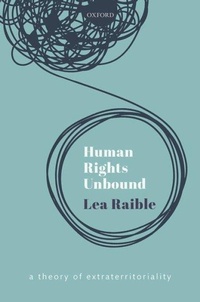
Human Rights Unbound
A Theory of Extraterritoriality
Published on 11. June 2020
Book
Hardback
254 pages
978-0-19-886337-3 (ISBN)
Description
This book explores to what extent a state owes human rights obligations to individuals outside of its territory, when the conduct of that state impacts upon the lives of those individuals. It draws upon legal and political philosophy to develop a theory of extraterritoriality based on the nature of human rights, merging accounts of economic, social, and cultural rights with those of civil and political rights
Lea Raible outlines four main arguments aimed at changing the way we think about the extraterritoriality of human rights. First, she argues that questions regarding extraterritoriality are really about justifying the allocation of human rights obligations to specific states. Second, the book shows that human rights as found in international human rights treaties are underpinned by the values of integrity and equality. Third, she shows that these same values justify the allocation of human rights obligations towards specific individuals to public institutions - including states - that hold political power over those individuals. And finally, the book demonstrates that title to territory is best captured by the value of stability, as opposed to integrity and equality. On this basis, Raible concludes that all standards in international human rights treaties that count as human rights require that a threshold of jurisdiction, understood as political power over individuals, is met. The book applies this theory of extraterritoriality to explain the obligations of states in a wide range of cases.
Lea Raible outlines four main arguments aimed at changing the way we think about the extraterritoriality of human rights. First, she argues that questions regarding extraterritoriality are really about justifying the allocation of human rights obligations to specific states. Second, the book shows that human rights as found in international human rights treaties are underpinned by the values of integrity and equality. Third, she shows that these same values justify the allocation of human rights obligations towards specific individuals to public institutions - including states - that hold political power over those individuals. And finally, the book demonstrates that title to territory is best captured by the value of stability, as opposed to integrity and equality. On this basis, Raible concludes that all standards in international human rights treaties that count as human rights require that a threshold of jurisdiction, understood as political power over individuals, is met. The book applies this theory of extraterritoriality to explain the obligations of states in a wide range of cases.
More details
Language
English
Place of publication
Oxford
United Kingdom
Target group
Professional and scholarly
Product notice
sewn/stitched
Cloth over boards
Dimensions
Height: 236 mm
Width: 157 mm
Thickness: 20 mm
Weight
522 gr
ISBN-13
978-0-19-886337-3 (9780198863373)
Copyright in bibliographic data and cover images is held by Nielsen Book Services Limited or by the publishers or by their respective licensors: all rights reserved.
Schweitzer Classification
Other editions
Additional editions
E-Book
05/2020
1st Edition
OUP eBook
€70.99
Available for download
E-Book
05/2020
1st Edition
OUP eBook
€70.99
Available for download
Person
Lea Raible is a Lecturer in Public Law at the University of Glasgow. She has previously held academic positions at Maastricht University, the University of Edinburgh, and University College London.
Content
Introduction
1: Extraterritoriality as a Matter of Interpretation
2: The Values of International Human Rights Law
3: Jurisdiction and Justification
4: A Concept of Power as the Basis of Jurisdiction
5: Jurisdiction as Political Power
6: Title to Territory and Jurisdiction: Three and a Half Models for a Fraught Relationship
7: Connecting the Dots: Case Studies
Conclusion
1: Extraterritoriality as a Matter of Interpretation
2: The Values of International Human Rights Law
3: Jurisdiction and Justification
4: A Concept of Power as the Basis of Jurisdiction
5: Jurisdiction as Political Power
6: Title to Territory and Jurisdiction: Three and a Half Models for a Fraught Relationship
7: Connecting the Dots: Case Studies
Conclusion