

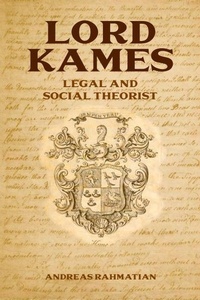
Lord Kames
Legal and Social Theorist
Will be published approx. on 31. October 2026
Book
Paperback/Softback
384 pages
978-1-3995-7196-8 (ISBN)
Description
The Scottish jurist, judge, legal historian and philosopher Henry Home (1696-1782) took the title Lord Kames when he was elevated to the bench of the Scottish Court of Session in 1752. In the 18th century, his books were influential and widely read; the educated classes and representatives of the Enlightenment in England, France and in the German states were all familiar with his aesthetic and philosophical writings. Andreas Rahmatian explains Kames' conceptions of legal philosophy, including black-letter law, legal science, legal theory, legal sociology and anthropology in its early stages, setting them in the context of the Scottish Enlightenment. He looks at how Kames came to be one of the forefathers of comparative law, sociology of law, legal psychology and 'legal science' in its proper meaning, as opposed to 'law'.
From the APF:
Portmahomack today is a serene fishing village on the Dornoch Firth, north east Scotland where archaeological excavations have written a new history of the origins of Scotland. This book brings alive the expedition and its discoveries, most famously a monastery of the eighth century in the land of the Picts.
Starting from chance finds of Pictish carved stone in St Colman's churchyard, the archaeologists unearthed four settlements one on top of the other. An elite farm was succeeded by the Pictish monastery, which, following a Viking raid in AD800, became a trading place and then a medieval village. Scientific analysis shows at each stage where the people came from, their life-style and what they ate. Together it creates a story of the heroic adaptation of a European nation to new politics between the sixth and sixteenth century.
The Picts were the outstanding sculptors of their day, producing carved stone monuments equal to anything being made in contemporary Europe. They were Britons, who resisted the Romans invaders and created their own warrior nation in the north east of the island. Coming under pressure from the Scots and the Norse, they disappeared from history in the ninth century AD. Now archaeology is finding them again.
From the APF:
Portmahomack today is a serene fishing village on the Dornoch Firth, north east Scotland where archaeological excavations have written a new history of the origins of Scotland. This book brings alive the expedition and its discoveries, most famously a monastery of the eighth century in the land of the Picts.
Starting from chance finds of Pictish carved stone in St Colman's churchyard, the archaeologists unearthed four settlements one on top of the other. An elite farm was succeeded by the Pictish monastery, which, following a Viking raid in AD800, became a trading place and then a medieval village. Scientific analysis shows at each stage where the people came from, their life-style and what they ate. Together it creates a story of the heroic adaptation of a European nation to new politics between the sixth and sixteenth century.
The Picts were the outstanding sculptors of their day, producing carved stone monuments equal to anything being made in contemporary Europe. They were Britons, who resisted the Romans invaders and created their own warrior nation in the north east of the island. Coming under pressure from the Scots and the Norse, they disappeared from history in the ninth century AD. Now archaeology is finding them again.
Reviews / Votes
Andreas Rahmatian deploys multi- and inter-disciplinary skills worthy of the polymathic Kames himself, setting him in the context of eighteenth-century law and Enlightenment but also arguing that we should pay close attention to what his writings tell us today. The result is challenging new insight on the work of a remarkable jurist. * Hector L MacQueen, University of Edinburgh Law School *More details
Language
English
Place of publication
Edinburgh
United Kingdom
Target group
Professional and scholarly
Dimensions
Height: 234 mm
Width: 156 mm
ISBN-13
978-1-3995-7196-8 (9781399571968)
Copyright in bibliographic data and cover images is held by Nielsen Book Services Limited or by the publishers or by their respective licensors: all rights reserved.
Schweitzer Classification
Person
Andreas Rahmatian is Professor of Commercial Law at the University of Glasgow, where he teaches intellectual property law and commercial law. His research interests comprise intellectual property law, property law and property theory, commercial law, comparative (private) law and intellectual history and the law. In the areas of property theory and legal history, he has published on Lord Kames's property theory and his Principles of Equity.
Content
Preface; Abbreviated Bibliography; I. Introduction; II. Aesthetics; III. Moral Philosophy I: Principles; IV. Moral Philosophy II: Development; V. Political Philosophy, Anthropology and Commerce; VI. Legal History, Legal Science and Comparative Law; VII. Property; VIII. Equity; IX. Obligations and Enforcement; X. Criminal Law; XI. Lord Kames's influence on some of the founders of the United States; Bibliography.