

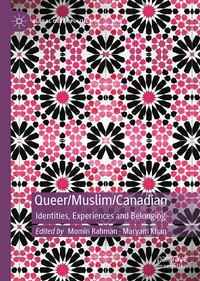
Queer/Muslim/Canadian
Identities, Experiences and Belonging
Published on 18. October 2024
Book
Hardback
XIX, 356 pages
978-3-031-55839-9 (ISBN)
Description
This book presents original qualitative research on the lives, identities, and experiences of queer Canadian Muslims and is the largest study to date on this population. Presented through a queer intersectional framework, the volume contains core evidence-based chapters on the lived experience, as well as the transnational politics of Islamophobia and LGBTQ+ rights promotion, the research on Muslim attitudes to queer issues, and the representations of queer Muslim issues within Canada. Key issues covered include: queer Muslim organizing, how queer Muslims reconcile faith, sexuality and gender identity through affirmative and liberatory frameworks and actions, how Muslims in Canada respond to sexual and gender diversity. The contributors also lay out future academic and research possibilities for further investigation and for the development of equity practices for recognizing and challenging the oppressions suffered by queer Muslims, addressing the discussion to queer Muslims as well as mainstream LGBTQ+ groups and mainstream Muslim groups.
More details
Series
Edition
2024 ed.
Language
English
Place of publication
Cham
Switzerland
Publishing group
Springer International Publishing
Target group
Professional and scholarly
Illustrations
3 farbige Abbildungen, 3 s/w Abbildungen
XIX, 356 p. 6 illus., 3 illus. in color.
Dimensions
Height: 216 mm
Width: 153 mm
Thickness: 25 mm
Weight
598 gr
ISBN-13
978-3-031-55839-9 (9783031558399)
DOI
10.1007/978-3-031-55840-5
Schweitzer Classification
Other editions
Additional editions
E-Book
10/2024
1st Edition
Palgrave Macmillan
€149.79
Available for download
Persons
Momin Rahman
is Professor of Sociology at Trent University, Canada.
Maryam Khan is Assistant Professor of Social Work at Wilfrid Laurier University, Canada.
Maryam Khan is Assistant Professor of Social Work at Wilfrid Laurier University, Canada.
Content
Chapter 1: Introduction.- Part One: Queer Women's Navigation of Islam.- Chapter 2: The Absence and Presence of Female Same Sex Eroticism in Muslim Cultures.- Chapter 3: Challenging the Understanding of Islam as Inherently Homophobic: The Possibilities of Queer Muslim Inclusion Through Faith-Based Framing.- Chapter 4: Empowerment Through Islam for Queer Muslim Women.- Part Two: Intersectional Identities and Transnational Experiences.- Chapter 5: Queer Muslim Intersectionality as Refractional Empowerment Methodology.- Chapter 6: Thematic Reflections on Research with Queer Muslims.- Chapter 7: Interview Results Chapter.- Part Three: Canadian Contexts.- Chapter 8: Canadian Diversity and Muslim Integration.- Chapter 9: The Muslim Public's Response to Sexual Diversity.- Chapter 10: Muslim Institutional Response to Sexual Diversity in Canada and the United States.- Chapter 11: Islamophobia, Sexual Diversity, and the Representation of LGBTQ+ Muslims in Canada.- Chapter 12: Conclusion.