

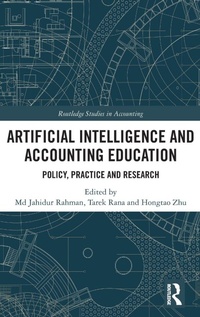
Artificial Intelligence and Accounting Education
Policy, Practice and Research
1st Edition
Will be published approx. on 30. June 2026
Book
Hardback
250 pages
978-1-041-25317-4 (ISBN)
Description
As the educational landscape undergoes a profound transformation driven by technological advancements, this book establishes the critical significance of artificial intelligence (AI) in reshaping accounting and business pedagogy. It provides a comprehensive exploration of the subject with a specific focus on the integration of AI within higher education and its implications for teaching, learning, and ethical practice.
While the book draws significantly on empirical studies and contextual examples, its examination of AI's role in enhancing learning outcomes, personalizing instruction, and addressing ethical challenges holds international relevance. The work bridges the gap between theoretical frameworks and practical application, offering readers in-depth insights into the intricate dynamics of AI adoption in education. Drawing on robust data, case studies, and diverse student and faculty perspectives, it provides practical insights into the effectiveness of various AI tools and their impact on student engagement, skill acquisition, and academic performance. It focuses on the crucial role of AI in fostering future employability, its potential for sustainable growth in educational settings, and its wider impact on the future of the accounting and business professions. Additionally, the book examines how the responsible and strategic integration of AI is important for developing effective educational strategies and evolving academic policies.
Accompanied by actionable recommendations, this book is a valuable resource for anyone navigating the intricate landscape of AI in education, offering a roadmap to informed pedagogical decision-making and innovative teaching practices. It will be particularly beneficial for academics, educational administrators, curriculum designers, and policymakers as it translates complex AI concepts and educational theories into tangible, practical strategies for implementation.
While the book draws significantly on empirical studies and contextual examples, its examination of AI's role in enhancing learning outcomes, personalizing instruction, and addressing ethical challenges holds international relevance. The work bridges the gap between theoretical frameworks and practical application, offering readers in-depth insights into the intricate dynamics of AI adoption in education. Drawing on robust data, case studies, and diverse student and faculty perspectives, it provides practical insights into the effectiveness of various AI tools and their impact on student engagement, skill acquisition, and academic performance. It focuses on the crucial role of AI in fostering future employability, its potential for sustainable growth in educational settings, and its wider impact on the future of the accounting and business professions. Additionally, the book examines how the responsible and strategic integration of AI is important for developing effective educational strategies and evolving academic policies.
Accompanied by actionable recommendations, this book is a valuable resource for anyone navigating the intricate landscape of AI in education, offering a roadmap to informed pedagogical decision-making and innovative teaching practices. It will be particularly beneficial for academics, educational administrators, curriculum designers, and policymakers as it translates complex AI concepts and educational theories into tangible, practical strategies for implementation.
More details
Series
Language
English
Place of publication
London
United Kingdom
Publishing group
Taylor & Francis Ltd
Target group
College/higher education
Professional and scholarly
Academic and Postgraduate
Illustrations
54 s/w Tabellen, 39 s/w Abbildungen, 39 s/w Zeichnungen
54 Tables, black and white; 39 Line drawings, black and white; 39 Illustrations, black and white
Dimensions
Height: 234 mm
Width: 156 mm
ISBN-13
978-1-041-25317-4 (9781041253174)
Copyright in bibliographic data and cover images is held by Nielsen Book Services Limited or by the publishers or by their respective licensors: all rights reserved.
Schweitzer Classification
Other editions
Additional editions
Md Jahidur Rahman | Tarek Rana | Hongtao Zhu
Artificial Intelligence and Accounting Education
Policy, Practice and Research
E-Book
approx. 06/2026
1st Edition
Routledge
€60.49
Available for download
Md Jahidur Rahman | Tarek Rana | Hongtao Zhu
Artificial Intelligence and Accounting Education
Policy, Practice and Research
E-Book
approx. 06/2026
1st Edition
Routledge
€60.49
Available for download
Persons
Md Jahidur Rahman is an assistant professor of accounting at Wenzhou-Kean University in Wenzhou, China.
Tarek Rana is an associate professor of accounting at RMIT University, Melbourne, Australia.
Hongtao Zhu is a PhD candidate in accountancy at City University of Hong Kong, Hong Kong, China.
Tarek Rana is an associate professor of accounting at RMIT University, Melbourne, Australia.
Hongtao Zhu is a PhD candidate in accountancy at City University of Hong Kong, Hong Kong, China.
Content
List of Figures. List of Tables. About the Editors. List of Contributors. Preface. 1 AI in Higher Education-A Paradigm Shift in Accounting and Business Pedagogy. 2 Generative AI in Accounting Education: Empirical Evidence on Personalized Learning and Ethical Challenges. 3 Balancing Efficiency and Engagement: The Role of Generative AI Feedback in Accounting Education. 4 Leveraging Generative AI: Enhancing Learning Outcomes in Accounting Education. 5 Transforming Accounting Education: The Impact of Generative AI on Student Learning Experiences. 6 Generative AI: Reshaping Accounting and Finance Education for the Future. 7 Unlocking Student Engagement: The Role of AI in Accounting Education. 8 The AI Paradox in Accounting and Business Studies: Efficiency Versus Ethics. 9 Navigating Ethics in the AI Age: Perceptions of Academic Integrity in Accounting Education. 10 AI-Powered Personalization in Accounting Pedagogy: A TAM-SDT Integration Framework. 11 Generative AI in Accounting Education: Student Perceptions and Effectiveness in an Advanced Accounting Course. 12 Theorizing AI in Accounting Education: Extending Cognitive Load Theory, Technology Acceptance Model, and Self-Regulated Learning for Text Summarization. 13 Policy, Practice, and Future Research on AI in Accounting Education. Index.