

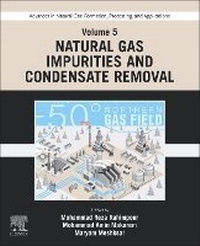
Advances in Natural Gas: Formation, Processing, and Applications. Volume 5: Natural Gas Impurities and Condensate Removal
Published on 21. March 2024
Book
Paperback/Softback
318 pages
978-0-443-19223-4 (ISBN)
Description
Advances in Natural Gas: Formation, Processing, and Applications is a comprehensive eight-volume set of books that discusses in detail the theoretical basics and practical methods of various aspects of natural gas from exploration and extraction, to synthesizing, processing and purifying, producing valuable chemicals and energy. The volumes introduce transportation and storage challenges as well as hydrates formation, extraction, and prevention.
Volume 5 titled Natural Gas Impurities and Condensates Removal comprehensively discusses related techniques for particulates like arsenic and condensates removal techniques from natural gas as well as mercury, nitrogen, and helium removal from natural gas by absorption, adsorption, cryogenic, and membrane-based processes.
Volume 5 titled Natural Gas Impurities and Condensates Removal comprehensively discusses related techniques for particulates like arsenic and condensates removal techniques from natural gas as well as mercury, nitrogen, and helium removal from natural gas by absorption, adsorption, cryogenic, and membrane-based processes.
More details
Language
English
Place of publication
Philadelphia
United States
Target group
Professional and scholarly
Dimensions
Height: 235 mm
Width: 191 mm
Weight
650 gr
ISBN-13
978-0-443-19223-4 (9780443192234)
Copyright in bibliographic data and cover images is held by Nielsen Book Services Limited or by the publishers or by their respective licensors: all rights reserved.
Schweitzer Classification
Other editions
Additional editions
Mohammad Reza Rahimpour | Mohammad Amin Makarem | Maryam Meshksar
Advances in Natural Gas: Formation, Processing, and Applications. Volume 5: Natural Gas Impurities and Condensate Removal
E-Book
03/2024
Elsevier
€205.00
Available for download
Persons
Prof. Mohammad Reza Rahimpour is a professor in Chemical Engineering at Shiraz University, Iran. He received his Ph.D. in Chemical Engineering from Shiraz University joint with University of Sydney, Australia 1988. He started his independent career as Assistant Professor in September 1998 at Shiraz University. Prof. M.R. Rahimpour, was a Research Associate at University of California, Davis from 2012 till 2017. During his stay in University of California, he developed different reaction networks and catalytic processes such as thermal and plasma reactors for upgrading of lignin bio-oil to biofuel with collaboration of UCDAVIS. He has been a Chair of Department of Chemical Engineering at Shiraz University from 2005 till 2009 and from 2015 till 2020. Prof. M.R. Rahimpour leads a research group in fuel processing technology focused on the catalytic conversion of fossil fuels such as natural gas, and renewable fuels such as bio-oils derived from lignin to valuable energy sources. He provides young distinguished scholars with perfect educational opportunities in both experimental methods and theoretical tools in developing countries to investigate in-depth research in the various field of chemical engineering including carbon capture, chemical looping, membrane separation, storage and utilization technologies, novel technologies for natural gas conversion and improving the energy efficiency in the production and use of natural gas industries.
Dr. Mohammad Amin Makarem is an Adjunct Lecturer at the School of Engineering, Taylor's University, Malaysia, with a PhD in Chemical
Engineering from Shiraz University, Iran. Although his research spans gas separation and purification, green energy, nanofluids, microfluidics, and catalyst synthesis, Dr. Makarem has also established a strong reputation as an editor and contributor to scholarly publishing.
He has served as Editor or Co-editor for numerous books, book series, and major reference works published by well-known academic publishers. His editorial contributions encompass a wide range of scientific and engineering disciplines, including carbon capture and storage, bioenergy, greenhouse gases, hydrotreating technologies, oily wastewater, crises in chemical industries, hydrogen energy, methanol production, homogeneous catalysis, nanofluids, synthesis gas, natural gas, and renewable energy systems. Through these efforts, he has
helped shape authoritative resources that serve as critical references for researchers, industry professionals, and policymakers worldwide. By combining his deep technical expertise with editorial leadership, Dr. Makarem continues to advance knowledge dissemination in chemical engineering and energy sciences, supporting the global scientific community through high-impact publishing initiatives. Dr. Maryam Meshksar is currently a Process Engineer at Petrochemical Industries Design and Engineering Company (PIDEC). Beside the
experience of design and construction of oil, gas, and petrochemical industries, she has worked at Shiraz University as a research associate for more than 2 years because she got her PhD in Chemical Engineering
from this university in 2022. Her research has focused on gas separation, clean energy, and catalyst synthesis. In gas separation, she
is working on the membrane separation process, and in the clean energy field, she has more than 14 articles on different reforming-based processes for syngas production from methane experimentally. She has also synthesized novel catalysts for these processes that are tested for the first time. These
catalysts were synthesized via hard templating materials like leaf biotemplates and glucose.
Dr. Meshksar has also contributed significantly to the writing and editing of numerous books
and book chapters for esteemed publishers like Elsevier, Springer, and Wiley. She served as
editor of several book series on the fields of greenhouse gases, synthesis gases, natural gas, and homogeneous catalysis.
Dr. Mohammad Amin Makarem is an Adjunct Lecturer at the School of Engineering, Taylor's University, Malaysia, with a PhD in Chemical
Engineering from Shiraz University, Iran. Although his research spans gas separation and purification, green energy, nanofluids, microfluidics, and catalyst synthesis, Dr. Makarem has also established a strong reputation as an editor and contributor to scholarly publishing.
He has served as Editor or Co-editor for numerous books, book series, and major reference works published by well-known academic publishers. His editorial contributions encompass a wide range of scientific and engineering disciplines, including carbon capture and storage, bioenergy, greenhouse gases, hydrotreating technologies, oily wastewater, crises in chemical industries, hydrogen energy, methanol production, homogeneous catalysis, nanofluids, synthesis gas, natural gas, and renewable energy systems. Through these efforts, he has
helped shape authoritative resources that serve as critical references for researchers, industry professionals, and policymakers worldwide. By combining his deep technical expertise with editorial leadership, Dr. Makarem continues to advance knowledge dissemination in chemical engineering and energy sciences, supporting the global scientific community through high-impact publishing initiatives. Dr. Maryam Meshksar is currently a Process Engineer at Petrochemical Industries Design and Engineering Company (PIDEC). Beside the
experience of design and construction of oil, gas, and petrochemical industries, she has worked at Shiraz University as a research associate for more than 2 years because she got her PhD in Chemical Engineering
from this university in 2022. Her research has focused on gas separation, clean energy, and catalyst synthesis. In gas separation, she
is working on the membrane separation process, and in the clean energy field, she has more than 14 articles on different reforming-based processes for syngas production from methane experimentally. She has also synthesized novel catalysts for these processes that are tested for the first time. These
catalysts were synthesized via hard templating materials like leaf biotemplates and glucose.
Dr. Meshksar has also contributed significantly to the writing and editing of numerous books
and book chapters for esteemed publishers like Elsevier, Springer, and Wiley. She served as
editor of several book series on the fields of greenhouse gases, synthesis gases, natural gas, and homogeneous catalysis.
Content
Preface
Acknowledgments
About the Editors
Section 1: Particulates and Condensates Removal from Natural Gas
1. Introduction to non-acidic impurities of natural gas: particulates, condensates, mercury, nitrogen, and helium
2. Arsenic removal from natural gas condensates
3. Condensates stabilization processes
4. Refrigeration process for condensate recovery from natural gas
5. Membrane technologies for condensates recovery from natural gas
6. Supersonic technology for condensate removal from natural gas*
Section 2: Mercury Removal from Natural Gas
7. Mercury removal from natural gas by absorption and adsorption processes
8. Membrane technologies for mercury removal from natural gas
Section 3: Nitrogen Removal from Natural Gas
9. Nitrogen separation from natural gas using absorption and cryogenic processes
10. Nitrogen rejection from natural gas by adsorption processes and swing technologies
11. Membrane technologies for nitrogen separation from natural gas
Section 4: Helium Removal from Natural Gas
12. Adsorption processes and swing technologies for helium removal from natural gas
13. Helium removal from natural gas by membrane technologies
Acknowledgments
About the Editors
Section 1: Particulates and Condensates Removal from Natural Gas
1. Introduction to non-acidic impurities of natural gas: particulates, condensates, mercury, nitrogen, and helium
2. Arsenic removal from natural gas condensates
3. Condensates stabilization processes
4. Refrigeration process for condensate recovery from natural gas
5. Membrane technologies for condensates recovery from natural gas
6. Supersonic technology for condensate removal from natural gas*
Section 2: Mercury Removal from Natural Gas
7. Mercury removal from natural gas by absorption and adsorption processes
8. Membrane technologies for mercury removal from natural gas
Section 3: Nitrogen Removal from Natural Gas
9. Nitrogen separation from natural gas using absorption and cryogenic processes
10. Nitrogen rejection from natural gas by adsorption processes and swing technologies
11. Membrane technologies for nitrogen separation from natural gas
Section 4: Helium Removal from Natural Gas
12. Adsorption processes and swing technologies for helium removal from natural gas
13. Helium removal from natural gas by membrane technologies