

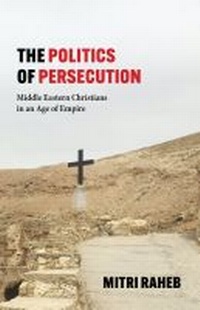
The Politics of Persecution
Middle Eastern Christians in an Age of Empire
Published on 30. September 2021
Book
Hardback
215 pages
978-1-4813-1440-4 (ISBN)
Description
Persecution of Christians in the Middle East has been a recurring theme since the middle of the nineteenth century. The topic has experienced a resurgence in the last few years, especially during the Trump era. Middle Eastern Christians are often portrayed as a homogeneous, helpless group ever at the mercy of their Muslim enemies, a situation that only Western powers can remedy. The Politics of Persecution revisits this narrative with a critical eye.
Mitri Raheb charts the plight of Christians in the Middle East from the invasion of Napoleon Bonaparte in 1799 to the so-called Arab Spring. The book analyzes the diverse socioeconomic and political factors that led to the diminishing role and numbers of Christians in Palestine, Egypt, Syria, Lebanon, and Jordan during the eras of Ottoman, French, and British Empires, through the eras of independence, Pan-Arabism, and Pan-Islamism, and into the current era of American empire. With an incisive expose of the politics that lie behind alleged concerns for these persecuted Christians-and how the concept of persecution has been a tool of public diplomacy and international politics-Raheb reveals that Middle Eastern Christians have been repeatedly sacrificed on the altar of Western national interests. The West has been part of the problem for Middle Eastern Christianity and not part of the solution, from the massacre on Mount Lebanon to the rise of ISIS.
The Politics of Persecution, written by a well-known Palestinian Christian theologian, provides an insider perspective on this contested region. Middle Eastern Christians survived successive empires by developing great elasticity in adjusting to changing contexts; they learned how to survive atrocities and how to resist creatively while maintaining a dynamic identity. In this light, Raheb casts the history of Middle Eastern Christians not so much as one of persecution but as one of resilience.
Mitri Raheb charts the plight of Christians in the Middle East from the invasion of Napoleon Bonaparte in 1799 to the so-called Arab Spring. The book analyzes the diverse socioeconomic and political factors that led to the diminishing role and numbers of Christians in Palestine, Egypt, Syria, Lebanon, and Jordan during the eras of Ottoman, French, and British Empires, through the eras of independence, Pan-Arabism, and Pan-Islamism, and into the current era of American empire. With an incisive expose of the politics that lie behind alleged concerns for these persecuted Christians-and how the concept of persecution has been a tool of public diplomacy and international politics-Raheb reveals that Middle Eastern Christians have been repeatedly sacrificed on the altar of Western national interests. The West has been part of the problem for Middle Eastern Christianity and not part of the solution, from the massacre on Mount Lebanon to the rise of ISIS.
The Politics of Persecution, written by a well-known Palestinian Christian theologian, provides an insider perspective on this contested region. Middle Eastern Christians survived successive empires by developing great elasticity in adjusting to changing contexts; they learned how to survive atrocities and how to resist creatively while maintaining a dynamic identity. In this light, Raheb casts the history of Middle Eastern Christians not so much as one of persecution but as one of resilience.
More details
Language
English
Place of publication
Waco
United States
Target group
Professional and scholarly
Dimensions
Height: 216 mm
Width: 140 mm
Thickness: 22 mm
Weight
424 gr
ISBN-13
978-1-4813-1440-4 (9781481314404)
Copyright in bibliographic data and cover images is held by Nielsen Book Services Limited or by the publishers or by their respective licensors: all rights reserved.
Schweitzer Classification
Other editions
Additional editions
E-Book
08/2021
Baylor University Press
€24.49
Available for download
Person
Dr. Mitri Raheb is the Founder and President of Dar al-Kalima University College of Arts and Culture in Bethlehem. The most widely published Palestinian theologian to date, Dr. Raheb is the author of more than twenty books.
Content
Introduction
1. Under Ottoman Rule
2. Religious Mobility
3. A Massacre on Mount Lebanon
4. Agents of Renaissance
5. Christian Zionism
6. The Road to Genocide
7. Minorities in Nation-States
8. A Catastrophe
9. Arab and Christian
10. A Turning Point
11. Petrodollars
12. Challenging Times
Epilogue
1. Under Ottoman Rule
2. Religious Mobility
3. A Massacre on Mount Lebanon
4. Agents of Renaissance
5. Christian Zionism
6. The Road to Genocide
7. Minorities in Nation-States
8. A Catastrophe
9. Arab and Christian
10. A Turning Point
11. Petrodollars
12. Challenging Times
Epilogue