

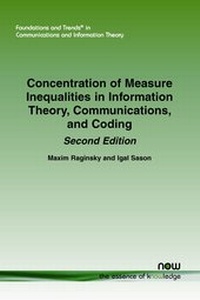
Concentration of Measure Inequalities in Information Theory, Communications, and Coding: Second Edition
2nd Edition
Published on 2. October 2014
Book
Paperback/Softback
256 pages
978-1-60198-906-2 (ISBN)
Description
This second edition includes several new sections and provides a full update on all sections. This book was welcomed when it was first published as an important comprehensive treatment of the subject which is now brought fully up to date. Concentration inequalities have been the subject of exciting developments during the last two decades, and have been intensively studied and used as a powerful tool in various areas. These include convex geometry, functional analysis, statistical physics, mathematical statistics, pure and applied probability theory (e.g., concentration of measure phenomena in random graphs, random matrices, and percolation), information theory, theoretical computer science, learning theory, and dynamical systems. Concentration of Measure Inequalities in Information Theory, Communications, and Coding focuses on some of the key modern mathematical tools that are used for the derivation of concentration inequalities, on their links to information theory, and on their various applications to communications and coding. In addition to being a survey, this monograph also includes various new recent results derived by the authors. Concentration of Measure Inequalities in Information Theory, Communications, and Coding is essential reading for all researchers and scientists in information theory and coding.
More details
Series
Edition
2nd Revised edition
Language
English
Place of publication
Hanover
United States
Target group
College/higher education
Edition type
Revised edition
Dimensions
Height: 234 mm
Width: 156 mm
Thickness: 14 mm
Weight
365 gr
ISBN-13
978-1-60198-906-2 (9781601989062)
DOI
10.1561/9781601989062
Copyright in bibliographic data and cover images is held by Nielsen Book Services Limited or by the publishers or by their respective licensors: all rights reserved.
Schweitzer Classification
Content
1 Introduction 2 Concentration Inequalities via the Martingale Approach 3 The Entropy Method, Logarithmic Sobolev Inequalities, and Transportation-Cost Inequalities. Acknowledgments. References.