

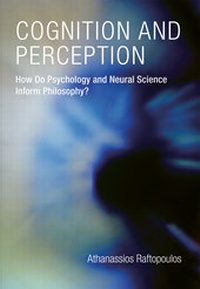
Cognition and Perception
How Do Psychology and Neural Science Inform Philosophy?
Published on 1. August 2009
Book
Hardback
448 pages
978-0-262-01321-5 (ISBN)
Description
An argument that there are perceptual mechanisms that retrieve information in cognitively and conceptually unmediated ways and that this sheds light on various philosophical issues.In Cognition and Perception, Athanassios Raftopoulos discusses the cognitive penetrability of perception and claims that there is a part of visual processes (which he calls "perception") that results in representational states with nonconceptual content; that is, a part that retrieves information from visual scenes in conceptually unmediated, "bottom-up," theory-neutral ways. Raftopoulos applies this insight to problems in philosophy of science, philosophy of mind, and epistemology, and examines how we access the external world through our perception as well as what we can know of that world. To show that there is a theory-neutral part of existence, Raftopoulos turns to cognitive science and argues that there is substantial scientific evidence. He then claims that perception induces representational states with nonconceptual content and examines the nature of the nonconceptual content. The nonconceptual information retrieved, he argues, does not allow the identification or recognition of an object but only its individuation as a discrete persistent object with certain spatiotemporal properties and other features. Object individuation, however, suffices to determine the referents of perceptual demonstratives. Raftopoulos defends his account in the context of current discussions on the issue of the theory-ladenness of perception (namely the Fodor-Churchland debate), and then discusses the repercussions of his thesis for problems in the philosophy of science. Finally, Raftopoulos claims that there is a minimal form of realism that is defensible. This minimal realism holds that objects, their spatiotemporal properties, and such features as shape, orientation, and motion are real, mind-independent properties in the world.
More details
Series
Language
English
Place of publication
Massachusetts
United States
Publishing group
MIT Press Ltd
Target group
Professional and scholarly
Interest Age: From 18 years
Product notice
Cloth over boards
Illustrations
2 figures
Dimensions
Height: 229 mm
Width: 152 mm
Thickness: 29 mm
Weight
726 gr
ISBN-13
978-0-262-01321-5 (9780262013215)
Copyright in bibliographic data and cover images is held by Nielsen Book Services Limited or by the publishers or by their respective licensors: all rights reserved.
Schweitzer Classification
Other editions
Additional editions
Athanassios Raftopoulos
Cognition and Perception
How Do Psychology and Neural Science Inform Philosophy?
E-Book
07/2009
Bradford Books
€43.99
Available for download