

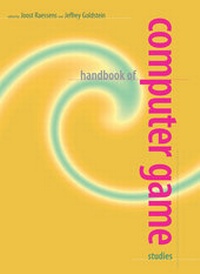
Handbook of Computer Game Studies
Published on 1. May 2005
Book
Hardback
472 pages
978-0-262-18240-9 (ISBN)
Description
New media students, teachers, and professionals have long needed a
comprehensive scholarly treatment of digital games that deals with the history,
design, reception, and aesthetics of games along with their social and cultural
context. The Handbook of Computer Game Studies fills this need with a definitive
look at the subject from a broad range of perspectives. Contributors come from
cognitive science and artificial intelligence, developmental, social, and clinical
psychology, history, film, theater, and literary studies, cultural studies, and
philosophy as well as game design and development. The text includes both scholarly
articles and journalism from such well-known voices as Douglas Rushkoff, Sherry
Turkle, Henry Jenkins, Katie Salen, Eric Zimmerman, and others.Part I considers the
"prehistory" of computer games (including slot machines and pinball machines), the
development of computer games themselves, and the future of mobile gaming. The
chapters in part II describe game development from the designer's point of view,
including the design of play elements, an analysis of screenwriting, and game-based
learning. Part III reviews empirical research on the psychological effects of
computer games, and includes a discussion of the use of computer games in clinical
and educational settings. Part IV considers the aesthetics of games in comparison to
film and literature, and part V discusses the effect of computer games on cultural
identity, including gender and ethnicity. Finally, part VI looks at the relation of
computer games to social behavior, considering, among other matters, the inadequacy
of laboratory experiments linking games and aggression and the different modes of
participation in computer game culture.
comprehensive scholarly treatment of digital games that deals with the history,
design, reception, and aesthetics of games along with their social and cultural
context. The Handbook of Computer Game Studies fills this need with a definitive
look at the subject from a broad range of perspectives. Contributors come from
cognitive science and artificial intelligence, developmental, social, and clinical
psychology, history, film, theater, and literary studies, cultural studies, and
philosophy as well as game design and development. The text includes both scholarly
articles and journalism from such well-known voices as Douglas Rushkoff, Sherry
Turkle, Henry Jenkins, Katie Salen, Eric Zimmerman, and others.Part I considers the
"prehistory" of computer games (including slot machines and pinball machines), the
development of computer games themselves, and the future of mobile gaming. The
chapters in part II describe game development from the designer's point of view,
including the design of play elements, an analysis of screenwriting, and game-based
learning. Part III reviews empirical research on the psychological effects of
computer games, and includes a discussion of the use of computer games in clinical
and educational settings. Part IV considers the aesthetics of games in comparison to
film and literature, and part V discusses the effect of computer games on cultural
identity, including gender and ethnicity. Finally, part VI looks at the relation of
computer games to social behavior, considering, among other matters, the inadequacy
of laboratory experiments linking games and aggression and the different modes of
participation in computer game culture.
More details
Language
English
Place of publication
Cambridge, Mass.
United States
Publishing group
MIT Press Ltd
Target group
Professional and scholarly
US School Grade: College Graduate Student and over
Illustrations
58 illus.
Dimensions
Height: 279 mm
Width: 203 mm
Thickness: 0 mm
Weight
1543 gr
ISBN-13
978-0-262-18240-9 (9780262182409)
Copyright in bibliographic data and cover images is held by Nielsen Book Services Limited or by the publishers or by their respective licensors: all rights reserved.
Schweitzer Classification
Other editions
New editions
Joost Raessens | Jeffrey Goldstein
Handbook of Computer Game Studies
Book
08/2011
MIT Press
€46.00
Article not available