

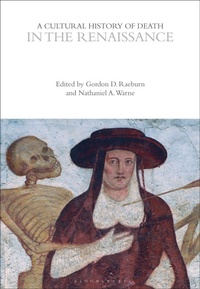
A Cultural History of Death in the Renaissance
Published on 11. June 2026
Book
Hardback
192 pages
978-1-4725-3756-0 (ISBN)
Description
The movement from the Renaissance to the early modern period may have been one of the most tumultuous times in the history of the western world. Everything, sacred and profane, was up for grabs which meant attitudes and behaviors around death underwent a profound change. This book examines the period between 1450 and 1650, encompassing the Reformation and the Renaissance and the significant changes in theology, philosophy, and culture, as long-held scientific, moral, and philosophical presumptions were beginning to be questioned and scrutinized. Contributors to the volume explore how the conflicting ideas brought about by figures such as Martin Luther and Galileo, inventions such as the printing press, and the changing tides of religion and spiritual ideals of 'the good death' contributed to an evolving sense of what dying and death meant to people at the time.
Drawing upon a wealth of visual and textual sources, this volume presents essays that examine key tenets of death; Dead and Dying Bodes; The Sensory Aesthetics of Death; Emotions, Mortality and Vitality; Death's Ritual-Symbolic Performance; Sites, Power and the Politics of Death; Gender, Age and Identity; Belief, Law and Ethics and the Undead and Eternal.
A Cultural History of Death is part of The Cultural Histories Series. Titles are available as hardcover sets for libraries needing just one subject or preferring a tangible reference for their shelves or as part of a fully-searchable digital library. The digital product is available to institutions by annual subscription or on perpetual access via www.bloomsburyculturalhistory.com. Individual volumes for academics and researchers interested in specific historical periods are also available in print or digitally via www.bloomsburycollections.com.
Drawing upon a wealth of visual and textual sources, this volume presents essays that examine key tenets of death; Dead and Dying Bodes; The Sensory Aesthetics of Death; Emotions, Mortality and Vitality; Death's Ritual-Symbolic Performance; Sites, Power and the Politics of Death; Gender, Age and Identity; Belief, Law and Ethics and the Undead and Eternal.
A Cultural History of Death is part of The Cultural Histories Series. Titles are available as hardcover sets for libraries needing just one subject or preferring a tangible reference for their shelves or as part of a fully-searchable digital library. The digital product is available to institutions by annual subscription or on perpetual access via www.bloomsburyculturalhistory.com. Individual volumes for academics and researchers interested in specific historical periods are also available in print or digitally via www.bloomsburycollections.com.
More details
Series
Language
English
Place of publication
London
United Kingdom
Publishing group
Bloomsbury Publishing PLC
Target group
College/higher education
Product notice
Laminated cover
Illustrations
39 bw illus
Dimensions
Height: 229 mm
Width: 152 mm
Thickness: 10 mm
Weight
266 gr
ISBN-13
978-1-4725-3756-0 (9781472537560)
Copyright in bibliographic data and cover images is held by Nielsen Book Services Limited or by the publishers or by their respective licensors: all rights reserved.
Schweitzer Classification
Persons
Gordon D. Raeburn is Postdoctoral Fellow at the School of Historical and Philosophical Studies at the University of Melbourne, Australia.
Nathaniel A. Warne is an independent scholar who obtained his Theology PhD at Durham University, UK. He is the co-editor, along with Douglas J. Davies, of Emotions and Religious Dynamics (2013).
Nathaniel A. Warne is an independent scholar who obtained his Theology PhD at Durham University, UK. He is the co-editor, along with Douglas J. Davies, of Emotions and Religious Dynamics (2013).
Content
Introduction
1. Dead and Dying Bodies, Bruce Gordon, (Yale University and Divinity School, USA)
2. The Sensory Aesthetics of Death, Tess Knighton, (Cambridge University, UK)
3. Emotions, Mortality and Vitality, Gordon D. Raeburn, (University of Melbourne, Australia)
4. Death's Ritual-Symbolic Performance, Clare Gittings (Independent Scholar, UK)
5. Sites, Power and Politics of Death, Peter Sherlock, (University of Divinity, Australia)
6. Gender, Age and Identity, Susan Broomhall, (Australian Catholic University, Australia)
7. Explaining Death: Belief, Law and Ethics, Sarah Covington, (Queens College, The City, University of New York, USA)
8. The Undead and Eternal, Katherine Edwards, (University of South Carolina, USA)
Bibliography
Notes
Index
1. Dead and Dying Bodies, Bruce Gordon, (Yale University and Divinity School, USA)
2. The Sensory Aesthetics of Death, Tess Knighton, (Cambridge University, UK)
3. Emotions, Mortality and Vitality, Gordon D. Raeburn, (University of Melbourne, Australia)
4. Death's Ritual-Symbolic Performance, Clare Gittings (Independent Scholar, UK)
5. Sites, Power and Politics of Death, Peter Sherlock, (University of Divinity, Australia)
6. Gender, Age and Identity, Susan Broomhall, (Australian Catholic University, Australia)
7. Explaining Death: Belief, Law and Ethics, Sarah Covington, (Queens College, The City, University of New York, USA)
8. The Undead and Eternal, Katherine Edwards, (University of South Carolina, USA)
Bibliography
Notes
Index