

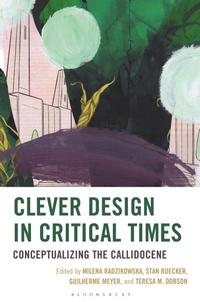
Clever Design in Critical Times
Conceptualizing the Callidocene
Published on 16. October 2025
Book
Hardback
232 pages
978-1-6669-6229-1 (ISBN)
Description
This edited volume identifies and establishes the idea of the Callidocene, which the authors position as an epoch that both includes and extends beyond the current conception of the Anthropocene.
While the word 'Anthropocene' has become strongly associated with concerns over humanity's impact on the planet, contributors turn instead to the Callidocene-intended to encompass human, machine, and system cleverness- to emphasize the hopeful and positive aspects of human influence on the world. Contributors posit that designers in particular have increasingly attempted to consider the impact of their work on society, culture, and the environment, and this book will contribute to this conversation through its analyses of a wide range of topics, including complexity in design, media toxicity, and community innovation in sustainability. Collectively, contributions to this volume highlight the potential of human cleverness to address - or even reverse- the damage we've inflicted on both ourselves and our planet. Scholars of sociology, environmental studies, cultural studies, media studies, and communication will find this book of particular interest.
While the word 'Anthropocene' has become strongly associated with concerns over humanity's impact on the planet, contributors turn instead to the Callidocene-intended to encompass human, machine, and system cleverness- to emphasize the hopeful and positive aspects of human influence on the world. Contributors posit that designers in particular have increasingly attempted to consider the impact of their work on society, culture, and the environment, and this book will contribute to this conversation through its analyses of a wide range of topics, including complexity in design, media toxicity, and community innovation in sustainability. Collectively, contributions to this volume highlight the potential of human cleverness to address - or even reverse- the damage we've inflicted on both ourselves and our planet. Scholars of sociology, environmental studies, cultural studies, media studies, and communication will find this book of particular interest.
More details
Language
English
Place of publication
United States
Publishing group
Bloomsbury Publishing Plc
Target group
Professional and scholarly
Illustrations
12 tables
Dimensions
Height: 235 mm
Width: 157 mm
Thickness: 17 mm
Weight
487 gr
ISBN-13
978-1-6669-6229-1 (9781666962291)
Copyright in bibliographic data and cover images is held by Nielsen Book Services Limited or by the publishers or by their respective licensors: all rights reserved.
Schweitzer Classification
Other editions
Additional editions
Clever Design in Critical Times
Conceptualizing the Callidocene
E-Book
08/2025
1st Edition
Bloomsbury Academic
€90.99
Available for download
Clever Design in Critical Times
Conceptualizing the Callidocene
E-Book
08/2025
1st Edition
Bloomsbury Academic
€90.99
Available for download
Persons
Teresa M. Dobson is director of the Master of Educational Technology Program and professor of language and literacy education at the University of British Columbia.
Guilherme Meyer is a designer, educator and researcher.
Milena Radzikowska is an established researcher in humanities-based data visualization, feminist human-computer interaction (HCI), and interface design for decision support.
Stan Ruecker is an international design research consultant.
Guilherme Meyer is a designer, educator and researcher.
Milena Radzikowska is an established researcher in humanities-based data visualization, feminist human-computer interaction (HCI), and interface design for decision support.
Stan Ruecker is an international design research consultant.
Content
Introduction
Being Affected by the Anthropocene
Guilherme Englert Correa Meyer
Part One: Complexity
Chapter One
Framing Anthropocene with Experimental Prototyping
Guilherme Englert Correa Meyer
Chapter Two
The Three Approaches to Complexity in Design: Design as Configuration, Execution, and Attribution
Cliff Shin and Juan Salamanca
Chapter Three
(Re)Designing Intersectional Feminist Futures: "Vital Structuring" as Critical Praxis
Brianna I. Wiens
Chapter Four
Re-stitching Texts: A Geography of Fragmentation in Five Movements
Teresa M. Dobson
Part Two: Techne
Chapter Five
Graphic Design from the Perspective of Contemporary Technological Relationships
Juan De La Rosa
Chapter Six
Design and Machine Learning: Tipping the balance toward the Callidocene
Gerry Derksen
Chapter Seven
"We Still Don't Understand We're at War": Media Toxicity and Social Media Disinformation Ecologies
Shana MacDonald and Brianna I. Wiens
Part Three: Action
Chapter Eight
A Project May Be More Than You Think It Is
Ricardo Triska and Stan Ruecker
Chapter Nine
Are Surveys Necessary? Designing Virtual Environments for Participatory Research
Colter Wehmeier
Chapter Ten
Ride the Bullet: An Introduction to Design Reading
Milena Radzikowska and Stan Ruecker
Chapter Eleven
Designing Futures and Framing Worlds: Posthuman Worldbuilding in Speculative Comics Created by Youths
Andrea Hoff and Teresa M. Dobson
Conclusion
Why the Callidocene?
Stan Ruecker
Being Affected by the Anthropocene
Guilherme Englert Correa Meyer
Part One: Complexity
Chapter One
Framing Anthropocene with Experimental Prototyping
Guilherme Englert Correa Meyer
Chapter Two
The Three Approaches to Complexity in Design: Design as Configuration, Execution, and Attribution
Cliff Shin and Juan Salamanca
Chapter Three
(Re)Designing Intersectional Feminist Futures: "Vital Structuring" as Critical Praxis
Brianna I. Wiens
Chapter Four
Re-stitching Texts: A Geography of Fragmentation in Five Movements
Teresa M. Dobson
Part Two: Techne
Chapter Five
Graphic Design from the Perspective of Contemporary Technological Relationships
Juan De La Rosa
Chapter Six
Design and Machine Learning: Tipping the balance toward the Callidocene
Gerry Derksen
Chapter Seven
"We Still Don't Understand We're at War": Media Toxicity and Social Media Disinformation Ecologies
Shana MacDonald and Brianna I. Wiens
Part Three: Action
Chapter Eight
A Project May Be More Than You Think It Is
Ricardo Triska and Stan Ruecker
Chapter Nine
Are Surveys Necessary? Designing Virtual Environments for Participatory Research
Colter Wehmeier
Chapter Ten
Ride the Bullet: An Introduction to Design Reading
Milena Radzikowska and Stan Ruecker
Chapter Eleven
Designing Futures and Framing Worlds: Posthuman Worldbuilding in Speculative Comics Created by Youths
Andrea Hoff and Teresa M. Dobson
Conclusion
Why the Callidocene?
Stan Ruecker