

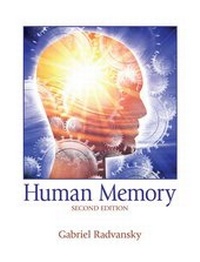
Human Memory
United States Edition
2nd Edition
Published on 15. November 2010
Book
Paperback/Softback
432 pages
978-0-205-73482-5 (ISBN)
Description
Provides students with a guide to human memory, its properties, theories about how it works, and how studying it can help us understand who we are and why we do the things that we do.
This book provides a very broad range of topics covering more territory than most books. In addition to some coverage of basic issues of human memory and cognition that are of interest to researchers in the field, the chapters also cover issues that will be relevant to students with a range of interests , including those students interested in clinical, social, and developmental psychology, as well as those planning on going on to medical and law schools. The writing is aimed at talking directly to students (as opposed to talking down to them) in a clear and effective manner. Not too dense, but also not too conversational as well. The new edition will include, in addition to a broader range of topics, a series of exercises that allow the student to try out the concepts and principles conveyed in the chapters, or to use as the basis for exploring their own ideas.
This book provides a very broad range of topics covering more territory than most books. In addition to some coverage of basic issues of human memory and cognition that are of interest to researchers in the field, the chapters also cover issues that will be relevant to students with a range of interests , including those students interested in clinical, social, and developmental psychology, as well as those planning on going on to medical and law schools. The writing is aimed at talking directly to students (as opposed to talking down to them) in a clear and effective manner. Not too dense, but also not too conversational as well. The new edition will include, in addition to a broader range of topics, a series of exercises that allow the student to try out the concepts and principles conveyed in the chapters, or to use as the basis for exploring their own ideas.
More details
Other editions
New editions
Book
03/2017
3rd Edition
Routledge
€222.84
Article exhausted; check for reprint
Additional editions
Book
12/2010
2nd Edition
Routledge
Unfortunately, price unknown
No shipping information available

Book
11/2010
2nd Edition
Routledge
€116.55
Article exhausted; check different version
Person
Professor Radvansky was largely raised in the Cleveland area, attending St. Ignatius High School and then earning his undergraduate degree in 1987 from Cleveland State University under the watchful eye of Mark Ashcraft, with whom he has recently coauthored a textbook: Cognition. Afterward, he attended Michigan State University where his mentor, Rose Zacks, helped drive him to earn his master's and doctoral degrees in 1989 and 1992, respectively. After graduating he spent a few months at the University of Illinois, Urbana-Champaign doing postdoctoral work before accepting his current position at the University of Notre Dame. During his career Professor Radvansky has explored many research ideas in memory, language, aging, and comprehension, with a special emphasis on event cognition. All during this time, Professor Radvansky has worked to keep abreast of a wide range of issues and developments in research on human memory. This has led him to be an action editor at two scientific journals, Memory & Cognition and the Quarterly Journal of Experimental Psychology, as well as to put him in a prime position to convey the wide range of topics involving human memory to a broad audience through his textbook on Human Memory. Professor Radvansky hates being bored, and he imagines that many students dislike this as well. So, he has worked hard to make his textbook as interesting, accessible, and painless as possible for readers. Therefore, this book serves a nice student's guide to human memory.
Content
1. Overview and History of Memory Research.
2. Neuroscience of Memory.
3. Methods and Principles.
4. Sensory and Short-Term Memory.
5. Working Memory.
6. Non-Declarative Memory.
7. Episodic Memory.
8. Memory for Space and Time.
9. Semantic Memory.
10. Formal Models of Memory.
11. Autobiographical Memory.
12. Memory and Reality.
13. Memory and the Law.
14. Metamemory.
15. Memory and Development.
16. Amnesia.
17. Other Conditions that Affect Memory.
Appendix: Memory Methods.
2. Neuroscience of Memory.
3. Methods and Principles.
4. Sensory and Short-Term Memory.
5. Working Memory.
6. Non-Declarative Memory.
7. Episodic Memory.
8. Memory for Space and Time.
9. Semantic Memory.
10. Formal Models of Memory.
11. Autobiographical Memory.
12. Memory and Reality.
13. Memory and the Law.
14. Metamemory.
15. Memory and Development.
16. Amnesia.
17. Other Conditions that Affect Memory.
Appendix: Memory Methods.