

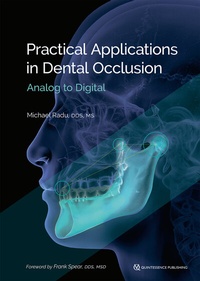
Practical Applications in Dental Occlusion
Analog to Digital
1st Edition
Published on 1. May 2024
Book
Paperback/Softback
200 pages
978-1-64724-126-1 (ISBN)
Description
Occlusion is often boiled down to the "tap, tap, and grind" of articulating paper marks dentists perform daily. And for 90% of appointments, occlusion can be largely ignored until it's time to get out the articulating paper at the end of the appointment. Tap, tap, and grind. Drill the red marks. However, sometimes the patient's current bite won't allow the necessary treatment, and a new occlusion must be built and transferred to the lab. But how? Should the patient determine the maxillomandibular position (ie, show where they feel comfortable), or should scientific principles be applied to find the physiologic maxillomandibular relationship? How do you capture the new occlusion for the lab? That's where this book comes in-to teach you a simplified concept of occlusion that can help you perform predictable and successful treatment. The book is divided into two parts: Part 1 outlines guiding principles and a simplified model of occlusion, and Part 2 features specific situations you will come across as you diagnose, treatment plan, and treat your patients' cases.
Author Michael Radu breaks everything down and offers explanatory analogies to help you conceptualize the principles of occlusion in a way you can understand and apply to daily practice for the benefit of your patients cases.
Author Michael Radu breaks everything down and offers explanatory analogies to help you conceptualize the principles of occlusion in a way you can understand and apply to daily practice for the benefit of your patients cases.
More details
Edition
1st Edition 2024
Language
English
Place of publication
Batavia
United States
Target group
Professional and scholarly
General dentists, Restorative dentists
Zahnärztinnen und Zahnärzte
Zahnmedizerinerinnen und Zahnmediziner
Edition type
New edition
Product notice
Klappenbroschur
Illustrations
Illustrations
Dimensions
Height: 24.1 cm
Width: 17.2 cm
Weight
565 gr
ISBN-13
978-1-64724-126-1 (9781647241261)
Schweitzer Classification
Other editions
Additional editions
E-Book
05/2024
1st Edition
Quintessence Publishing Co, Inc
€74.99
Available for download
E-Book
05/2024
1st Edition
Quintessence Publishing Co, Inc
€74.99
Available for download
Person
Author
Michael Radu, DDS, MS, is a dentist who has practiced for over 40 years in three different countries across two continents. He believes strongly that his work is to help dentists with occlusion in their practice, so he lectures and educates his fellow dentists every chance he gets. He believes in science above all, which is why occlusion lies so close to his heart. Michael Radu also believes in the power of mentorship and the importance of sharing ideas to achieve new levels of understanding. Beginning with his physics professor in college and stretching to Klaus Pfeiffle and Michael Noczinski in Germany, Peter Dawson and Frank Spear in the United States, and the coterie of dentists at the American Equilibration Society, the support and positive challenges he was given have shaped his scientific approach to occlusion. In his eyes, the simplest, most irrefutable evidence is mathematics. When we think in terms of stability, vector of force, angles, and alike, we are less prone to make mistakes. Dentists will always prefer to work in the existing occlusion because no changes seem safer than the alternative, but Michael Radu challenges this notion and implores his colleagues to understand the scientific principles underlying the concept of occlusion so they can better care for their patients
ISNI:
ISNI:
Content
Contents
Chapter 01. Why Do We Need Occlusion?
Chapter 02. Practical Principles of Occlusion
Chapter 03. The Occlusion Formula
Chapter 04. There Are Only Two Bites
Chapter 05. Clinical Techniques and Principles of Interocclusal Registrations
Chapter 06. Techniques for Examination and Treatment Planning
Chapter 07. Techniques for Interocclusal Registration of an Existing Occlusion
Chapter 08. Techniques for Interocclusal Registration for a New Occlusion
Chapter 09. Techniques for Equilibration of the Occlusion
Chapter 10. Techniques for Recording the Envelope of Function
Chapter 11. Techniques for Communicating with the Laboratory
Chapter 12. Analog Versus Digital Techniques for Interocclusal Registration
Notes (providing context for the concepts described in the book)
Chapter 01. Why Do We Need Occlusion?
Chapter 02. Practical Principles of Occlusion
Chapter 03. The Occlusion Formula
Chapter 04. There Are Only Two Bites
Chapter 05. Clinical Techniques and Principles of Interocclusal Registrations
Chapter 06. Techniques for Examination and Treatment Planning
Chapter 07. Techniques for Interocclusal Registration of an Existing Occlusion
Chapter 08. Techniques for Interocclusal Registration for a New Occlusion
Chapter 09. Techniques for Equilibration of the Occlusion
Chapter 10. Techniques for Recording the Envelope of Function
Chapter 11. Techniques for Communicating with the Laboratory
Chapter 12. Analog Versus Digital Techniques for Interocclusal Registration
Notes (providing context for the concepts described in the book)