

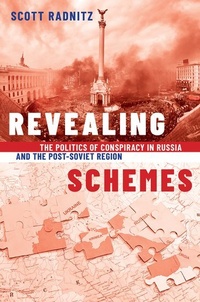
Revealing Schemes
The Politics of Conspiracy in Russia and the Post-Soviet Region
Published on 6. July 2021
Book
Hardback
260 pages
978-0-19-757353-2 (ISBN)
Description
Conspiracy theories are not just outlandish ideas. They can also be political weapons.
Conspiracy theories have come to play an increasingly prominent role in political systems around the world. In Revealing Schemes, Scott Radnitz moves beyond psychological explanations for why people believe conspiracy theories to explore the politics surrounding them, placing two questions at the center of his account: What leads regimes to promote conspiracy claims? And what effects do those claims have on politics and society? Focusing on the former Soviet Union-a region of the world where such theories have long thrived-he shows that incumbent politicians tend to make conspiracy claims to demonstrate their knowledge and authority at moments of uncertainty and threat. They emerge more often where there is serious political competition rather than unbridled autocracy and in response to events that challenge a regime's ability to rule. Yet conspiracy theories can also be habit-forming and persist as part of an official narrative even where immediate threats have subsided-a strategy intended to strengthen regimes, but that may inadvertently undermine them. Revealing Schemes explores the causes, consequences, and contradictions of conspiracism in politics with an original collection of over 1,500 conspiracy claims from across the post-Soviet region, two national surveys, and 12 focus groups. At a time of heightened distrust in democratic institutions and rising illiberal populism around the world, understanding how conspiracy theories operate in a region where democracy came late-or never arrived-can be instructive for concerned citizens everywhere.
Conspiracy theories have come to play an increasingly prominent role in political systems around the world. In Revealing Schemes, Scott Radnitz moves beyond psychological explanations for why people believe conspiracy theories to explore the politics surrounding them, placing two questions at the center of his account: What leads regimes to promote conspiracy claims? And what effects do those claims have on politics and society? Focusing on the former Soviet Union-a region of the world where such theories have long thrived-he shows that incumbent politicians tend to make conspiracy claims to demonstrate their knowledge and authority at moments of uncertainty and threat. They emerge more often where there is serious political competition rather than unbridled autocracy and in response to events that challenge a regime's ability to rule. Yet conspiracy theories can also be habit-forming and persist as part of an official narrative even where immediate threats have subsided-a strategy intended to strengthen regimes, but that may inadvertently undermine them. Revealing Schemes explores the causes, consequences, and contradictions of conspiracism in politics with an original collection of over 1,500 conspiracy claims from across the post-Soviet region, two national surveys, and 12 focus groups. At a time of heightened distrust in democratic institutions and rising illiberal populism around the world, understanding how conspiracy theories operate in a region where democracy came late-or never arrived-can be instructive for concerned citizens everywhere.
Reviews / Votes
Revealing Schemes is an original and refreshing contribution to the study of conspiratorial politics in non-Western context, one that advances our understanding of the phenomenon in regional settings and represents an excellent read for specialists and students alike. * Kiril Avramov, The Russian Review * Radnitz's book adds much to the literature, and it deserves being read widely. * Michael Gentile, University of Oslo, Eurasian Geography and Economics * Under what circumstances do authoritarian regimes, and their opponents, use conspiracy theories as rhetorical weapons in political struggles? Nowhere is this question more apposite than in post-Soviet space. Radnitz brings a unique database and survey results to the fight over conspiracy theories in Russia, Ukraine and Central Asia. The result is a clear and comprehensive win for social science. * Gerard Toal, Virginia Tech * Radnitz takes on one of the most perplexing political phenomena of our time: the use of conspiracy theories by those in power. He shows why and how leaders in post-Soviet countries use conspiracy theories to build coalitions, control information flows, and maintain power. This is an essential read for anyone interested in post-Soviet politics or contemporary conspiracy theories. * Joseph E. Uscinski, University of Miami * Radnitz's book is as useful as it is topical. It provides a competent analysis of the anatomy of conspiracism and the conditions under which it thrives, and it makes an important contribution to the analysis of how shadowy regimes try to legitimize their rule and sometimes, but not always, get away with it. * Bo Petersson, Slavonic and East European Review *More details
Language
English
Place of publication
New York
United States
Target group
Professional and scholarly
Dimensions
Height: 160 mm
Width: 243 mm
Thickness: 19 mm
Weight
499 gr
ISBN-13
978-0-19-757353-2 (9780197573532)
Copyright in bibliographic data and cover images is held by Nielsen Book Services Limited or by the publishers or by their respective licensors: all rights reserved.
Schweitzer Classification
Other editions
Additional editions
Book
08/2021
Oxford University Press Inc
€37.50
Shipment within 15-20 days
E-Book
05/2021
OUP eBook
€17.49
Available for download
E-Book
05/2021
OUP eBook
€17.49
Available for download
Person
Scott Radnitz is the Herbert J. Ellison Associate Professor of Russian and Eurasian Studies in the Jackson School of International Studies at the University of Washington. He is the author of Weapons of the Wealthy: Predatory Regimes and Elite-Led Protests in Central Asia. He is also an associate editor of Communist and Post-Communist Studies and a member of the Program on New Approaches to Research and Security (PONARS) in Eurasia.
Content
Introduction: Conspiracy Claims after Communism
Chapter 1: Of Power and Peril: Conspiracy Claims as Fighting Words
Chapter 2: Traumas and Tyranny? The Long-term and Proximate Roots of Conspiracism
Chapter 3: The Lay of the Land: What 20 Years of Post-Soviet Conspiracy Claims Tells Us
Chapter 4: Connecting the Dots: Patterns of Conspiracism in Post-Soviet Politics
Chapter 5: The Emergence and Ascendancy of Conspiracism in Russia
Chapter 6: Shadowy Deeds in Russia's Shadow: Conspiracy Claims in Four Countries
Chapter 7: The Consequences of Conspiracism: What People Believe and Why
Chapter 8: Citizen Cynics: How People Talk and Think about Conspiracy
Chapter 9: Disaffection, Disinformation, and Democracy
Appendix
Chapter 1: Of Power and Peril: Conspiracy Claims as Fighting Words
Chapter 2: Traumas and Tyranny? The Long-term and Proximate Roots of Conspiracism
Chapter 3: The Lay of the Land: What 20 Years of Post-Soviet Conspiracy Claims Tells Us
Chapter 4: Connecting the Dots: Patterns of Conspiracism in Post-Soviet Politics
Chapter 5: The Emergence and Ascendancy of Conspiracism in Russia
Chapter 6: Shadowy Deeds in Russia's Shadow: Conspiracy Claims in Four Countries
Chapter 7: The Consequences of Conspiracism: What People Believe and Why
Chapter 8: Citizen Cynics: How People Talk and Think about Conspiracy
Chapter 9: Disaffection, Disinformation, and Democracy
Appendix