

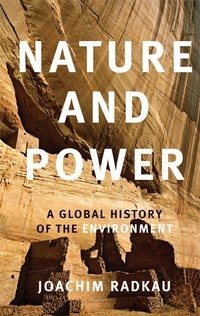
Nature and Power
A Global History of the Environment
Published on 4. February 2008
Book
Paperback/Softback
450 pages
978-0-521-61673-7 (ISBN)
Description
This book aims to demonstrate that the changing relationship between humanity and nature is key to understanding world history. Humans have been grappling with environmental problems since prehistoric times, and the environmental unsustainability of human practices has often been a decisive, if not immediately evident, shaping factor in history. The measures that societies and states have adopted to stabilize the relationship between humans and the natural world have repeatedly contributed to environmental crises over the course of history. Nature and Power traces the expanding scope of environmental action: from initiatives undertaken by individual villages and cities, environmental policy has become a global concern. Efforts to steer human use of nature and natural resources have become complicated, as Nature and Power shows, by particularities of culture and by the vagaries of human nature itself. Environmental history, the author argues, is ultimately the history of human hopes and fears.
Reviews / Votes
"Joachim Radkau's Nature and Power offers the best overview of world environmental history available in the English language. Radkau has an independent cast of mind and an uncanny ability to focus on the 'hot' topics in the global environmental field. His perspective is always fresh and insightful, even when he is taking the reader down well-trodden paths."- Mark Cioc, University of California, Santa Cruz "Americans may have invented the field of environmental history, but today some of the most ambitious work is coming from outside the country, offering provocative new approaches and perspectives. Joachim Radkau joins that international band of innovative historians with this extraordinary work of global synthesis. It is bold, opinionated, and important."
- Donald Worster, University of Kansas "...an indispensable addition to library collections on environmental history. Essential." -Choice "A review like this cannot do justice to the richness of Radkau's account of world environmental history. And it is perhaps the richness, the diversity, and the complexity of this account that will be this book's most important legacy to world environmental history." - David Christian "Radkau has crafted a book of extraordinary scope by building on regional environmental histories as well as earlier world histories...Thomas Dunlap translated Nature and Power for this English edition, and his translation is virtually flawless, providing exquisite prose that never reveals that the ideas originated in a different language."
World History Bulletin, Kim Little, University of Central Arkansas
More details
Series
Language
English
Place of publication
Cambridge
United Kingdom
Target group
College/higher education
Professional and scholarly
Product notice
Paperback (trade)
Dimensions
Height: 234 mm
Width: 156 mm
Thickness: 25 mm
Weight
679 gr
ISBN-13
978-0-521-61673-7 (9780521616737)
Copyright in bibliographic data and cover images is held by Nielsen Book Services Limited or by the publishers or by their respective licensors: all rights reserved.
Schweitzer Classification
Other editions
Additional editions
Book
02/2008
Cambridge University Press
€98.30
Shipment within 15-20 days
Persons
Joachim Radkau is Associate Professor of History at Universitaet Bielefeld in Germany. His books include Deutsche Industrie und Politik von Bismarck bis zur Gegenwart (1974). Holz: Ein Naturstoff in der Technikgeschichte (in collaboration with Ingrid Schaefer, 1987), Das Zeitalter der Nervositaet: Deutschland zwischen Bismarck und Hitler (1998), and the biography of Max Weber, Die Leidenschaft des Denkens (2005).
Content
1. Thinking about environmental history; 2. The ecology of subsistence and tacit knowledge - primeval symbioses between humans and nature; 3. Water, forests, and power; 4. Colonialism as a watershed in environmental history; 5. At the limits of nature; 6. In the labyrinth of globalization; Conclusion.