

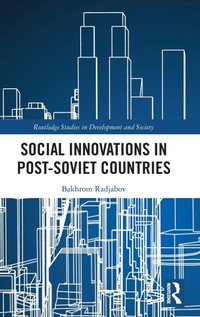
Social Innovations in Post-Soviet Countries
1st Edition
Published on 2. June 2022
Book
Hardback
204 pages
978-0-367-76173-8 (ISBN)
Description
This book evaluates the evolution of social innovation in post-Soviet Central Asia, Eastern Europe and Caucasus.
Following the dissolution of the USSR, organisations such as the UNDP have encouraged local communities and governments to innovate in order to find solutions to existing social problems. This book demonstrates that progress with social innovations has varied, with countries with low government support such as Uzbekistan struggling, whereas countries with better government support and a more active civil society, such as Armenia and Ukraine, have seen more positive results. Covering the period 2012-2020 and a broad range of countries, including Kazakhstan, Kyrgyzstan, Tajikistan and Uzbekistan, Moldova, Ukraine, Azerbaijan, Armenia, and Georgia, this book provides an impressively broad-ranging critical analysis of post-Soviet social innovation.
Including social innovations emerging as a result of the Covid-19 outbreak, this will be an important comparative study for researchers and practitioners working on social innovation, and to those with an interest in post-Soviet development.
Following the dissolution of the USSR, organisations such as the UNDP have encouraged local communities and governments to innovate in order to find solutions to existing social problems. This book demonstrates that progress with social innovations has varied, with countries with low government support such as Uzbekistan struggling, whereas countries with better government support and a more active civil society, such as Armenia and Ukraine, have seen more positive results. Covering the period 2012-2020 and a broad range of countries, including Kazakhstan, Kyrgyzstan, Tajikistan and Uzbekistan, Moldova, Ukraine, Azerbaijan, Armenia, and Georgia, this book provides an impressively broad-ranging critical analysis of post-Soviet social innovation.
Including social innovations emerging as a result of the Covid-19 outbreak, this will be an important comparative study for researchers and practitioners working on social innovation, and to those with an interest in post-Soviet development.
More details
Series
Language
English
Place of publication
London
United Kingdom
Publishing group
Taylor & Francis Ltd
Target group
College/higher education
Professional and scholarly
Academic and Postgraduate
Illustrations
29 s/w Tabellen
29 Tables, black and white
Dimensions
Height: 240 mm
Width: 161 mm
Thickness: 16 mm
Weight
490 gr
ISBN-13
978-0-367-76173-8 (9780367761738)
Copyright in bibliographic data and cover images is held by Nielsen Book Services Limited or by the publishers or by their respective licensors: all rights reserved.
Schweitzer Classification
Other editions
Additional editions
Bakhrom Radjabov
Social Innovations in Post-Soviet Countries
Book
08/2024
1st Edition
Routledge
€63.40
Shipment within 15-20 days
Bakhrom Radjabov
Social Innovations in Post-Soviet Countries
E-Book
06/2022
1st Edition
Routledge
€55.49
Available for download
Bakhrom Radjabov
Social Innovations in Post-Soviet Countries
E-Book
06/2022
1st Edition
Routledge
€55.49
Available for download
Person
Bakhrom Radjabov completed his PhD at the University of Tsukuba, Japan, and is an Adjunct Professor at the Webster University.
Content
Introduction Chapter One. Background Chapter Two. Generation, features and assessment of the 'social innovation' projects supported by different organizations in post-Soviet Central Asia Chapter Three. Generation, features and assessment of the 'social innovation' projectssupported by different organizations in post-Soviet Caucasus Chapter Four. Generation, features and assessment of 'social innovation' projects supported by different organizations in post-Soviet Eastern Europe Chapter Five. COVID-19 and 'social innovation' projects in post-Soviet countries Chapter Six. Analysis and conclusion on 'social innovation' projects in post-Soviet countries: Findings and perspectives