

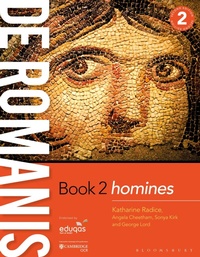
de Romanis Book 2 (2nd edition)
homines
2nd Edition
Published on 20. March 2025
Book
Paperback/Softback
288 pages
978-1-350-53163-5 (ISBN)
Description
Now endorsed by OCR and under review by Eduqas, this popular Latin course for students aged 11-16 is breathing new life into Latin teaching and learning.
de Romanis is a vibrant and accessible introduction to both the Latin language and the cultural world of the Romans. Throughout the course, students gradually build their proficiency in Latin while exploring cultural topics through background notes, primary sources and engaging stories.
This new edition of Book 2 has been revised throughout based on teacher feedback. Chapter introductions and core language sections are more accessible; you will find new boxes to offer opportunities for quick practice and enhance literacy through derivation skills; new primary sources expand your experience of the material world; revised stories support understanding of the darker side of Roman history.
What makes de Romanis so special?
- Language learning is split between Core and Additional to ensure effective differentiation and flexible timetabling.
- Fun and varied exercises include word identification, word manipulation and source analysis to encourage wider discussion.
- Two-way translation exercises, derivation tasks and grammar explanations develop key literacy skills, promoting the understanding of English as well as Latin.
- Vocabulary is consistently consolidated, and the clear and systematic explanations of grammar encourage steady progress to GCSE and beyond.
- Early introduction of Latin stories rather than isolated sentences builds student confidence from the start.
- The course is supported by over 300 additional online resources to support your teaching.
In Book 2, students meet the most famous historical figures of the Roman world, introduced through a variety of reading passages in Latin. From the earliest legends of the kings of Rome through the turbulent events of the Republic to seminal moments from imperial history, this is the perfect way to learn about Roman history and key institutions that enabled power.
A Companion Website is available at https://bloomsbury.pub/de-romanis.
de Romanis is a vibrant and accessible introduction to both the Latin language and the cultural world of the Romans. Throughout the course, students gradually build their proficiency in Latin while exploring cultural topics through background notes, primary sources and engaging stories.
This new edition of Book 2 has been revised throughout based on teacher feedback. Chapter introductions and core language sections are more accessible; you will find new boxes to offer opportunities for quick practice and enhance literacy through derivation skills; new primary sources expand your experience of the material world; revised stories support understanding of the darker side of Roman history.
What makes de Romanis so special?
- Language learning is split between Core and Additional to ensure effective differentiation and flexible timetabling.
- Fun and varied exercises include word identification, word manipulation and source analysis to encourage wider discussion.
- Two-way translation exercises, derivation tasks and grammar explanations develop key literacy skills, promoting the understanding of English as well as Latin.
- Vocabulary is consistently consolidated, and the clear and systematic explanations of grammar encourage steady progress to GCSE and beyond.
- Early introduction of Latin stories rather than isolated sentences builds student confidence from the start.
- The course is supported by over 300 additional online resources to support your teaching.
In Book 2, students meet the most famous historical figures of the Roman world, introduced through a variety of reading passages in Latin. From the earliest legends of the kings of Rome through the turbulent events of the Republic to seminal moments from imperial history, this is the perfect way to learn about Roman history and key institutions that enabled power.
A Companion Website is available at https://bloomsbury.pub/de-romanis.
More details
Edition
2nd edition
Language
English
Place of publication
London
United Kingdom
Publishing group
Bloomsbury Publishing PLC
Target group
Primary & secondary/elementary & high school
College/higher education
Illustrations
42 colour and 30 bw illus
Dimensions
Height: 210 mm
Width: 269 mm
Thickness: 18 mm
Weight
942 gr
ISBN-13
978-1-350-53163-5 (9781350531635)
Copyright in bibliographic data and cover images is held by Nielsen Book Services Limited or by the publishers or by their respective licensors: all rights reserved.
Schweitzer Classification
Persons
Katharine Radice teaches Classics at the Stephen Perse Foundation, UK. She is a regular speaker at Classics conferences on the methodology of effective Latin teaching. She is an experienced examiner and has co-authored recent A Level editions of Ovid (Bloomsbury Academic, 2011), Cicero (Bloomsbury Academic, 2013), Tacitus (Bloomsbury Academic, 2016) and Nepos and Tacitus (Bloomsbury Academic, 2025).
Angela Cheetham teaches Classics at the Stephen Perse Foundation, UK.
Sonya Kirk teaches Classics at the Stephen Perse Foundation, UK.
George Lord is an Independent Scholar, UK.
Angela Cheetham teaches Classics at the Stephen Perse Foundation, UK.
Sonya Kirk teaches Classics at the Stephen Perse Foundation, UK.
George Lord is an Independent Scholar, UK.
Content
Chapter 7: The History of Rome - Kings and the Republic
Introduction and Sources to Study
Core Language including the following Latin stories
-Rome elects its second king; Horatius kills his sister; The rape of Lucretia; Cincinnatus is chosen as dictator; What to do about Hannibal?
Additional Language
Chapter 8: Oratory and Cicero
Introduction and Sources to Study
Core Language including the following Latin stories
- Cato the Elder; Cicero and Catiline; Cicero and his daughter; Cicero's death; Pliny prefers to study than to go and see a volcano
Additional Language
Chapter 9: The Army and Julius Caesar
Introduction and Sources to Study
Core Language including the following Latin stories
- Marius reforms the Roman army; Lucullus is denied a triumph; Caesar launches an invasion of Britain; Caesar conquers Vercingetorix and all of Gaul; Civil War in Rome
Additional Language
Chapter 10: Egypt and Cleopatra
Introduction and Sources to Study
Core Language including the following Latin stories
- Herodotus travels to Egypt; Alexandria; Cleopatra, Queen of Egypt; Cleopatra and Julius Caesar; Cleopatra meets Mark Antony
Additional Language
Chapter 11: Augustus and Image
Introduction and Sources to Study
Core Language including the following Latin stories
- Octavian becomes Julius Caesar's heir; Octavian, Mark Antony and Lepidus; Actium; Augustus as princeps; Augustus and the poets
Additional Language
Chapter 12: Roman Britain and Boudicca
Introduction and Sources to Study
Core Language including the following Latin stories
- The emperor Claudius invades Britain; Boudicca leads a rebellion; Boudicca is defeated; Calgacus rouses the Scots; Hadrian's Wall
Additional Language
Bibliography
Grammar Reference
Glossary of Names
Vocabulary List (Latin to English and English to Latin)
Introduction and Sources to Study
Core Language including the following Latin stories
-Rome elects its second king; Horatius kills his sister; The rape of Lucretia; Cincinnatus is chosen as dictator; What to do about Hannibal?
Additional Language
Chapter 8: Oratory and Cicero
Introduction and Sources to Study
Core Language including the following Latin stories
- Cato the Elder; Cicero and Catiline; Cicero and his daughter; Cicero's death; Pliny prefers to study than to go and see a volcano
Additional Language
Chapter 9: The Army and Julius Caesar
Introduction and Sources to Study
Core Language including the following Latin stories
- Marius reforms the Roman army; Lucullus is denied a triumph; Caesar launches an invasion of Britain; Caesar conquers Vercingetorix and all of Gaul; Civil War in Rome
Additional Language
Chapter 10: Egypt and Cleopatra
Introduction and Sources to Study
Core Language including the following Latin stories
- Herodotus travels to Egypt; Alexandria; Cleopatra, Queen of Egypt; Cleopatra and Julius Caesar; Cleopatra meets Mark Antony
Additional Language
Chapter 11: Augustus and Image
Introduction and Sources to Study
Core Language including the following Latin stories
- Octavian becomes Julius Caesar's heir; Octavian, Mark Antony and Lepidus; Actium; Augustus as princeps; Augustus and the poets
Additional Language
Chapter 12: Roman Britain and Boudicca
Introduction and Sources to Study
Core Language including the following Latin stories
- The emperor Claudius invades Britain; Boudicca leads a rebellion; Boudicca is defeated; Calgacus rouses the Scots; Hadrian's Wall
Additional Language
Bibliography
Grammar Reference
Glossary of Names
Vocabulary List (Latin to English and English to Latin)