

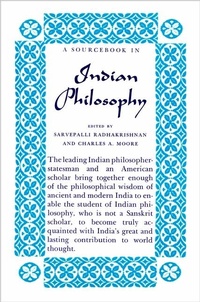
A Sourcebook in Indian Philosophy
A Source Book in Indian Philosophy
Published on 21. April 1967
Book
Paperback/Softback
720 pages
978-0-691-01958-1 (ISBN)
Description
Here are the chief riches of more than 3,000 years of Indian philosophical thought-the ancient Vedas, the Upanisads, the epics, the treatises of the heterodox and orthodox systems, the commentaries of the scholastic period, and the contemporary writings. Introductions and interpretive commentaries are provided.
Reviews / Votes
"This book ... is not only for the Western student, but for all of us who must gauge our impacted twentieth-century world and find our path in its confusion."--The New York TimesMore details
Edition
Revised edition
Language
English
Place of publication
New Jersey
United States
Target group
Professional and scholarly
College/higher education
Product notice
Paperback (trade)
Dimensions
Height: 215 mm
Width: 137 mm
Thickness: 42 mm
Weight
816 gr
ISBN-13
978-0-691-01958-1 (9780691019581)
Copyright in bibliographic data and cover images is held by Nielsen Book Services Limited or by the publishers or by their respective licensors: all rights reserved.
Schweitzer Classification
Other editions
Additional editions
Sarvepalli Radhakrishnan | Charles A. Moore
A Sourcebook in Indian Philosophy
Source Book in Indian Philosophy
E-Book
07/2014
1st Edition
Princeton University Press
€48.99
Available for download
Persons
Sarvepalli Radhakrishnan (1888-1975) was an Indian statesman, philosopher, and scholar of comparative religion and philosophy. He was India's second president and his academic appointments included the Spalding Chair of Eastern Religion and Ethics at the University of Oxford. His many books included An Idealist View of Life. Charles A. Moore (1901-1967), an American philosopher and historian, was professor of philosophy at the University of Hawai'i. He founded and edited the journal Philosophy East and West.
Content
*FrontMatter, pg. i*Preface, pg. ix*Contents, pg. xv*General Introduction, pg. xvii*Chapter I. The Vedas, pg. 3*Chapter II. The Upanisads, pg. 37*Introduction, pg. 99*Chapter III. The Bhagavad-Gita, pg. 101*Chapter IV. The Mahabharata, pg. 164*Chapter V. The Laws of Manu, pg. 172*Chapter VI. Kautilya's Artha-Sastra, pg. 193*Chapter VII. Carvaka, pg. 227*Chapter VIII. Jainism, pg. 250*Chapter IX. Buddhism, pg. 272*Introduction, pg. 349*Chapter X. Nyaya, pg. 356*Chapter XI. Vaisesika, pg. 386*Chapter XII. Samkhya, pg. 424*Chapter XIII. Yoga, pg. 453*Chapter XIV. Purva Mimamsa, pg. 486*Chapter XV. Vedanta, pg. 506*Chapter XVI. Sri Aurobindo, pg. 575*Chapter XVII. Sarvepalli Radhakrishnan, pg. 610*Appendices, pg. 638*Bibliography, pg. 643*Index, pg. 671