

Semiotics in Mathematics Education
Epistemology, History, Classroom, and Culture
Published on 1. January 2008
Book
Hardback
284 pages
978-90-8790-596-5 (ISBN)
Description
Current interest in semiotics is undoubtedly related to our increasing awareness that our manners of thinking and acting in our world are deeply indebted to a variety of signs and sign systems (language included) that surround us.
Since mathematics is something that we accomplish through written, oral, bodily and other signs, semiotics appears well suited to furthering our understanding of the mathematical processes of thinking, symbolizing and communicating. Resorting to different semiotic perspectives (e. g., Peirce's, Vygotsky's, Saussure's), the authors of this book deal with questions about the teaching and learning of mathematics as well as the history and epistemology of the discipline. Mathematics discourse and thinking and the technologically-mediated self of mathematical cultural practices are examined through key concepts such as metaphor, intentionality, gestures, interaction, sign-use, and meaning.
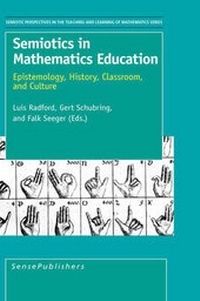
The cover picture comes from Jacob Leupold's (1727) Theatrum Arithmetico-Geometrico. It conveys the cultural, historical, and embodied aspects of mathematical thinking variously emphasized by the contributors of this book.
Since mathematics is something that we accomplish through written, oral, bodily and other signs, semiotics appears well suited to furthering our understanding of the mathematical processes of thinking, symbolizing and communicating. Resorting to different semiotic perspectives (e. g., Peirce's, Vygotsky's, Saussure's), the authors of this book deal with questions about the teaching and learning of mathematics as well as the history and epistemology of the discipline. Mathematics discourse and thinking and the technologically-mediated self of mathematical cultural practices are examined through key concepts such as metaphor, intentionality, gestures, interaction, sign-use, and meaning.
The cover picture comes from Jacob Leupold's (1727) Theatrum Arithmetico-Geometrico. It conveys the cultural, historical, and embodied aspects of mathematical thinking variously emphasized by the contributors of this book.
More details
Series
Language
English
Place of publication
Rotterdam
Netherlands
Target group
Professional and scholarly
Product notice
Laminated cover
Dimensions
Height: 234 mm
Width: 156 mm
Weight
581 gr
ISBN-13
978-90-8790-596-5 (9789087905965)
Copyright in bibliographic data and cover images is held by Nielsen Book Services Limited or by the publishers or by their respective licensors: all rights reserved.
Schweitzer Classification
Other editions
Additional editions
Luis Radford | Gert Schubring | Falk Seeger
Semiotics in Mathematics Education
Epistemology, History, Classroom, and Culture
Book
01/2008
Sense Publishers
€58.00
Shipment within 15-20 days
Persons
Luis Radford is Full Professor at Laurentian University in Canada. His research interests include the investigation of mathematics thinking and knowing from a cultural-semiotic perspective. For many years he has been conducting classroom research with primary and high-school teachers about the teaching and learning of mathematics as well as the historical and cultural roots of cognition.
Gert Schubring is department head at the Institut für Didaktik der Mathematik at Bielefeld University, Germany. His research interests focus on the history of mathematics and the sciences in the eighteenth and nineteenth centuries and on their systemic interrelation with socio-cultural systems.
Falk Seeger is retired from a position of Senior Lecturer at the Institut für Didaktik der Mathematik at Bielefeld University, Germany. His research interests include the analysis of mathematical learning from a cultural-historical perspective. In his current work, he puts a focus on the semiotic roots of intentionality in human development, drawing heavily on Vygotsky's work and on Peirce's ideas.
Gert Schubring is department head at the Institut für Didaktik der Mathematik at Bielefeld University, Germany. His research interests focus on the history of mathematics and the sciences in the eighteenth and nineteenth centuries and on their systemic interrelation with socio-cultural systems.
Falk Seeger is retired from a position of Senior Lecturer at the Institut für Didaktik der Mathematik at Bielefeld University, Germany. His research interests include the analysis of mathematical learning from a cultural-historical perspective. In his current work, he puts a focus on the semiotic roots of intentionality in human development, drawing heavily on Vygotsky's work and on Peirce's ideas.