

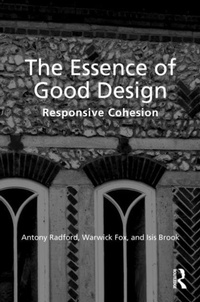
The Essence of Good Design
Description
Written by a designer and two philosophers, this short, highly illustrated book explores the idea that responsive cohesion is the essence of good design.
Responsive cohesion refers to a state in which things 'hold together' (or cohere) due to the mutual responsiveness of the features that constitute them. This contrasts with fixed cohesion (in which things hold - or are held - together in a more forced, constrained, or non-mutually responsive way) and discohesion (in which things don't hold together well or at all). The authors argue that responsive cohesion is the best form of organisation in general and, thus, the best guide to creating those deliberate forms of organisation we refer to as 'design'. Moreover, this claim applies not only to individual examples of design but also, and importantly, to how these items fit with their wider human-constructed, human social, and ecological contexts.
The book shows how these ideas illuminate and can be applied to a wide range of design areas, ranging from gardens and domestic objects to architecture, urban design and cultural landscapes. Both accessible and rigorous, this book is essential reading for designers and a compelling introduction for those interested in design.
More details
Other editions
Additional editions

Persons
Antony Radford is Emeritus Professor of Architecture at Adelaide University, Australia, where he has taught and researched architecture, urban design, and digital design. In 1999 he contributed to an international conference on Ethics in the Built Environment organised by Warwick Fox, and was immediately attracted to Warwick's Theory of General Ethics and his idea of responsive cohesion. It provided a unifying philosophical basis for design themes that interested him, such as respect for contexts, cooperation, and sustainability. Antony's other books include Digital Design: A Critical Introduction (with Dean Bruton), Understanding Sustainable Architecture (with Terry Williamson and Helen Bennetts), and The Elements of Modern Architecture, an analysis of contemporary buildings through annotated drawings (with Amit Srivastava and Selen Morkoç). Alongside research and writing, Antony draws, hikes, and competes in the navigation sport of orienteering.
Warwick Fox is Emeritus Professor of Philosophy, University of Lancashire, and his books include Toward a Transpersonal Ecology: Developing New Foundations for Environmentalism; Ethics and the Built Environment (ed.); A Theory of General Ethics: Human Relationships, Nature, and the Built Environment; and On Beautiful Days Such as This: A Philosopher's Search for Love, Work, Place, Meaning, and Suchlike. His main areas of philosophical interest are environmental philosophy, general ethics (a term he coined and defined ), developing his theory of responsive cohesion approach to general ethics, and the nature of the interior lives of humans and other animals. When not researching and writing, Warwick's interests include singing and playing acoustic guitar, songwriting, listening to music, and reading and watching good quality drama. His personal website is www.warwickfox.com
Isis Brook (PhD) has taught a wide range of philosophy courses for the Open University, Lancaster University, and the University of Lancashire. Her main research emphases have been environmental philosophy and aesthetics. She was Course Leader of Lancaster University's pioneering MA in Values and Environment and was also Managing Editor for the journal Environmental Values. She has published numerous articles and book chapters on phenomenology of place, landscape, aesthetics of nature, and Goethe's approach to nature. Isis co-authored Between Nature and Culture: The Aesthetics of Modified Environments (with Emily Brady and Jonathan Prior, 2018) and is Deputy Editor of the journal Plant Perspectives, an interdisciplinary journal for plant humanities. Her current research and writing focus is plant-human relationships. Her passion, unsurprisingly, is gardening. Her personal website is: https://isisbrook.uk/
Content
1. An Orientation to Design 2. The Idea of Responsive Cohesion 3. The Importance of Contexts 4. 5. Domestic Objects and Responsive Cohesion 6. Architecture and Responsive Cohesion 7. Urban Design and Responsive Cohesion 8. Cultural Landscapes and Responsive Cohesion 9. What Have We Learnt? 10. How to: Implementing Responsively Cohesive Design