

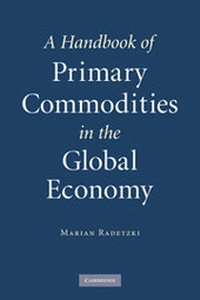
A Handbook of Primary Commodities in the Global Economy
1st Edition
Published on 2. December 2010
Book
Paperback/Softback
244 pages
978-0-521-18264-5 (ISBN)
Description
The world is going through an exceptional commodity boom triggered by a global demand shock largely caused by the sudden emergence of China and India as sizeable raw material importers. Prices of numerous commodities tripled between 2003 and 2006, resulting in huge windfalls for producers and a financial squeeze on consumers. A Handbook of Primary Commodities in the Global Economy is a guide to the ins and outs of this increasingly crucial part of the world economy. Assuming nothing more from readers than a basic understanding of economics, Marian Radetzki introduces and explains pertinent issues surrounding international commodity markets such as the global geography of raw materials, price formation, price trends, the role of commodity exchanges, the threat of depletion, cartel action, state ownership and the commodity nationalism.
Reviews / Votes
Review of the hardback: 'Professor Radetzki has produced a magisterial account of primary commodities and their persistent and critical importance in the world economy. This timely, well-written, and accessible handbook covers the history and geography of the subject as well as the economics, institutions, and controversies involved, and deserves wide readership in industry and government offices as well as in academia.' Thorvaldur Gylfason, University of Iceland Review of the hardback: 'A treasure chest of information based on 40 years of research and experience. An essential resource for understanding how commodity markets behave and why.' John E. Tilton , Colorado School of Mines Review of the hardback: 'Markets have short memories. At a time when commodities are being heavily promoted to investors as a new asset class, Radetzki's book brings a balanced and readable perspective to the analysis of what remain the workhorses of our industrial civilisation.' David Humphreys, Chief Economist, Norilsk Nickel Review of the hardback: 'This book is essential reading for all those involved in any way with primary commodities. It provides a good perspective in which to place today's preoccupations, and demonstrates that the underlying issues never change although their relative importance varies over time.' The Ringsider Review of the hardback: 'It provides a very nice overview of a huge field, i.e., a worldwide scope and a focus on a large number of commodities. The most important strengths of the book include a solid economic analysis of commodity markets but with the avoidance of technical jargon, as well as the author's ability to pedagogically address a mix of economic, political and historical factors shaping these markets.' Resources, Conservation and Recycling Review of the hardback: 'Provides several valuable contributions related to primary commodities in international markets. ... The book comes at an opportune point in time, provides a wealth of information, and is useful as a guide to really understanding the themes addressed.' Resources, Conservation and Recycling Review of the hardback: 'A very timely and wide-ranging book.' Journal of Economic Literature Review of the hardback: 'Wonderfully comprehensive.' Resources PolicyMore details
Language
English
Place of publication
Cambridge
United Kingdom
Target group
Professional and scholarly
Product notice
Paperback (trade)
Illustrations
Worked examples or Exercises
Dimensions
Height: 229 mm
Width: 152 mm
Thickness: 13 mm
Weight
330 gr
ISBN-13
978-0-521-18264-5 (9780521182645)
Copyright in bibliographic data and cover images is held by Nielsen Book Services Limited or by the publishers or by their respective licensors: all rights reserved.
Schweitzer Classification
Other editions
Additional editions
Marian Radetzki
A Handbook of Primary Commodities in the Global Economy
E-Book
04/2008
1st Edition
Cambridge University Press
€36.99
Available for download
Person
Content
List of figures; List of tables; Acknowledgements; Introduction; 1. The historical framework; 2. The geography of commodity production and trade; 3. Comparative advantage and the trade policy distortions; 4. Price formation and price trends in primary commodities; 5. The commodity exchanges, commodity investments and speculation; 6. The economics of exhaustible resource depletion; 7. Fears of and measures to assure supply security; 8. Producer cartels in international commodity markets; 9. Public ownership in primary commodity production; 10. The monoeconomies. Issues raised by heavy dependence on commodity production and exports; References; Index.