

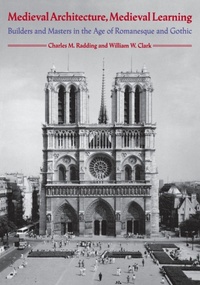
Medieval Architecture, Medieval Learning
Builders and Masters in the Age of Romanesque and Gothic
Will be published approx. on 1. November 1994
Book
Paperback/Softback
180 pages
978-0-300-06130-7 (ISBN)
Description
The eleventh and twelfth centuries witnessed a thoroughgoing transformation of European culture, as new ways of thinking revitalized every aspect of man's endeavor, from architecture and the visual arts to history, philosophy, theology, and even law. In this book Charles M. Radding and William W. Clark offer fresh perspectives on changes in architecture and learning at three moments in time. Unlike previous studies, including Erwin Panofsky's classic essay Gothic Architecture and Scholasticism, Radding and Clark's book not only compares buildings and treatises, but argues that the ways of thinking and the ways of solving problems were analogous.
The authors trace the professional contexts and creative activities of builders and masters from the creation of the Romanesque to the achievements of the Gothic and, in the process, establish new criteria for defining each. During the eleventh and early twelfth centuries, they argue, both intellectual treatises and Romanesque architecture reveal a growing mastery of a body of relevant expertise and the expanding techniques by which that knowledge could be applied to problems of reasoning and building. In the twelfth century, new intellectual directions, set by such specialists as Peter Abelard and the second master builder working at Saint-Denis, began to shape new systems of thinking based on a coherent view of the world. By the thirteenth century these became the standards by which all practitioners of a discipline were measured. The great ages of scholastic learning and of Gothic architecture are some of the results of this experimentation. At each stage Radding and Clark take the reader into the workshops and centers of study to examine the methods used by builders and masters to create the artistic and intellectual works for which the Middle Ages are justly famous.
Handsomely illustrated and clearly written, this book will be of great interest to scholars and students of medieval art, culture, philosophy, history, intellectual history, and the history of technology.
The authors trace the professional contexts and creative activities of builders and masters from the creation of the Romanesque to the achievements of the Gothic and, in the process, establish new criteria for defining each. During the eleventh and early twelfth centuries, they argue, both intellectual treatises and Romanesque architecture reveal a growing mastery of a body of relevant expertise and the expanding techniques by which that knowledge could be applied to problems of reasoning and building. In the twelfth century, new intellectual directions, set by such specialists as Peter Abelard and the second master builder working at Saint-Denis, began to shape new systems of thinking based on a coherent view of the world. By the thirteenth century these became the standards by which all practitioners of a discipline were measured. The great ages of scholastic learning and of Gothic architecture are some of the results of this experimentation. At each stage Radding and Clark take the reader into the workshops and centers of study to examine the methods used by builders and masters to create the artistic and intellectual works for which the Middle Ages are justly famous.
Handsomely illustrated and clearly written, this book will be of great interest to scholars and students of medieval art, culture, philosophy, history, intellectual history, and the history of technology.
More details
Language
English
Place of publication
United States
Target group
College/higher education
Professional and scholarly
Product notice
Paperback (trade)
Illustrations
126 b-w illus.
Dimensions
Height: 254 mm
Width: 179 mm
Thickness: 12 mm
Weight
458 gr
ISBN-13
978-0-300-06130-7 (9780300061307)
Copyright in bibliographic data and cover images is held by Nielsen Book Services Limited or by the publishers or by their respective licensors: all rights reserved.
Schweitzer Classification
Content
Introduction - art history as intellectual history. Part 1 The 11th century: beginnings; masters; builders. Part 2 Four crucial decades: transformations - Abelard and Saint-Denis. Part 3 The later 12th century: an age of experiment; learning and the schools in the late 12th century; the first half-century of Gothic.