

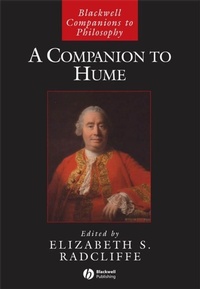
A Companion to Hume
1st Edition
Will be published approx. on 4. April 2008
Book
Hardback
592 pages
978-1-4051-1455-4 (ISBN)
Description
Comprised of twenty-nine specially commissioned essays, A Companion to Hume examines the depth of the philosophies and influence of one of history's most remarkable thinkers.
Demonstrates the range of Hume's work and illuminates the ongoing debates that it has generated
Organized by subject, with introductions to each section to orient the reader
Explores topics such as knowledge, passion, morality, religion, economics, and politics
Examines the paradoxes of Hume's thought and his legacy, covering the methods, themes, and consequences of his contributions to philosophy
Demonstrates the range of Hume's work and illuminates the ongoing debates that it has generated
Organized by subject, with introductions to each section to orient the reader
Explores topics such as knowledge, passion, morality, religion, economics, and politics
Examines the paradoxes of Hume's thought and his legacy, covering the methods, themes, and consequences of his contributions to philosophy
Reviews / Votes
"This is a superb collection of essays by both established Hume scholars and newer names in Hume studies . . . such books do this job very well and this one on Hume especially so: the reader is fortunate to have as guides, Louis Loeb on induction, Rachel Cohon on the passions, and Terence Penelhum on religion, to pick, as examples, just three of the excellent range of authors". (Metapsychology Online Reviews, 2011)"Blackwell's fortieth Companion to Philosophy is a splendid and long-overdue Companion to Hume, expertly pulled together by Elizabeth Radcliffe, a former editor of the journal Hume Studies. Although the Blackwell Companions are promoted as a student reference series, this particular volume is clearly of considerable value to serious scholars as well." (Religion in the Age of Enlightenment, December 2010)"One distinctive feature of this Blackwell Companion to Hume is that it attempts to be more careful than is common with books of its sort to mark a distinction between explicating Hume's own ideas and arguments, and assessing their relevance to present-day philosophical discussion." (Notre Dame Philosophical Reviews, February 2009)
"[The book is] highly approachable, well-organized, and-in a field where a lot is published-a distinctive addition. A book for academic and specialist libraries almost exclusively." (Reference Reviews, Issue 7 2008)
"The essays are of uniformly high quality, and many are written by well-established, respected philosophers.... David Hume is widely recognized as one of the most important and influential figures in modern philosophy. Every library should have a copy of this valuable resource, which will appeal to anyone interested in Hume's philosophy. Highly recommended." (Choice, November 2008)
More details
Series
Language
English
Place of publication
Hoboken
United Kingdom
Publishing group
John Wiley and Sons Ltd
Target group
Professional and scholarly
Product notice
sewn/stitched
Cloth over boards
With dust jacket
Dimensions
Height: 251 mm
Width: 185 mm
Thickness: 49 mm
Weight
1211 gr
ISBN-13
978-1-4051-1455-4 (9781405114554)
Copyright in bibliographic data and cover images is held by Nielsen Book Services Limited or by the publishers or by their respective licensors: all rights reserved.
Schweitzer Classification
Other editions
Additional editions
Elizabeth S. Radcliffe
A Companion to Hume
E-Book
04/2008
Wiley-Blackwell
€33.99
Available for download
Person
Elizabeth S. Radcliffe is Professor of Philosophy at Santa Clara University. Her areas of specialization include Hume, ethical theory, motivational psychology, and seventeenth- and eighteenth-century philosophy. She is the author of On Hume (2000), editor of A Companion to Hume (Blackwell, 2007), and was co-editor of the journal Hume Studies from 2000 to 2005.
Content
Notes on Contributors viii
Acknowledgments xii
Note on Citations xiii
Introduction 1
Hume's Context 19
1 Hume in the Enlightenment Tradition 21
Stephen Buckle
Part I Mind and Knowledge 39
2 Hume's Theory of Ideas 41
Don Garrett
3 Hume on Memory and Imagination 58
Saul Traiger
4 Hume and the Origin of Our Ideas of Space and Time 72
Wayne Waxman
5 Hume on the Relation of Cause and Effect 89
Francis Watanabe Dauer
6 Inductive Inference in Hume's Philosophy 106
Louis E. Loeb
7 Hume on Belief in the External World 126
Michel Malherbe
8 Hume on Personal Identity 140
Donald C. Ainslie
Part II Passions and Action 157
9 Hume's Indirect Passions 159
Rachel Cohon
10 Hume on the Direct Passions and Motivation 185
Tito Magri
11 Hume on Liberty and Necessity 201
John Bricke
Part III Morality and Beauty 217
12 Hume on Moral Rationalism, Sentimentalism, and Sympathy 219
Charlotte R. Brown
13 Sympathy and Hume's Spectator-centered Theory of Virtue 240
Kate Abramson
14 Hume's Theory of Justice, or Artificial Virtue 257
Eugenio Lecaldano
15 Hume on Beauty and Virtue 273
Jacqueline Taylor
16 Enquiry concerning the Principles of Morals: Incomparably the Best? 293
Annette C. Baier
Part IV Religion 321
17 Hume's Views on Religion: Intellectual and Cultural Influences 323
Terence Penelhum
18 Hume on the Nature and Existence of God 338
Martin Bell
19 Hume on Miracles and Immortality 353
Michael P. Levine
Part V Economics, Politics, and History 371
20 Hume's Economic Theory 373
Tatsuya Sakamoto
21 "One of the Finest and Most Subtile Inventions": Hume on Government 388
Richard H. Dees
22 "The Most Illustrious Philosopher and Historian of the Age": Hume's History of England 406
Mark Salber Phillips
Part VI Contemporary Themes 423
23 Hume's Naturalism and His Skepticism 425
Janet Broughton
24 Is Hume a Realist or an Anti-realist? 441
P. J. E. Kail
25 Hume's Epistemological Legacy 457
William Edward Morris
26 The Humean Theory of Motivation and Its Critics 477
Elizabeth S. Radcliffe
27 The Sources of Normativity in Hume's Moral Theory 493
Tom L. Beauchamp
28 Hume's Metaethics: Is Hume a Moral Noncognitivist? 513
Nicholas L. Sturgeon
Bibliography 529
Index 553
Acknowledgments xii
Note on Citations xiii
Introduction 1
Hume's Context 19
1 Hume in the Enlightenment Tradition 21
Stephen Buckle
Part I Mind and Knowledge 39
2 Hume's Theory of Ideas 41
Don Garrett
3 Hume on Memory and Imagination 58
Saul Traiger
4 Hume and the Origin of Our Ideas of Space and Time 72
Wayne Waxman
5 Hume on the Relation of Cause and Effect 89
Francis Watanabe Dauer
6 Inductive Inference in Hume's Philosophy 106
Louis E. Loeb
7 Hume on Belief in the External World 126
Michel Malherbe
8 Hume on Personal Identity 140
Donald C. Ainslie
Part II Passions and Action 157
9 Hume's Indirect Passions 159
Rachel Cohon
10 Hume on the Direct Passions and Motivation 185
Tito Magri
11 Hume on Liberty and Necessity 201
John Bricke
Part III Morality and Beauty 217
12 Hume on Moral Rationalism, Sentimentalism, and Sympathy 219
Charlotte R. Brown
13 Sympathy and Hume's Spectator-centered Theory of Virtue 240
Kate Abramson
14 Hume's Theory of Justice, or Artificial Virtue 257
Eugenio Lecaldano
15 Hume on Beauty and Virtue 273
Jacqueline Taylor
16 Enquiry concerning the Principles of Morals: Incomparably the Best? 293
Annette C. Baier
Part IV Religion 321
17 Hume's Views on Religion: Intellectual and Cultural Influences 323
Terence Penelhum
18 Hume on the Nature and Existence of God 338
Martin Bell
19 Hume on Miracles and Immortality 353
Michael P. Levine
Part V Economics, Politics, and History 371
20 Hume's Economic Theory 373
Tatsuya Sakamoto
21 "One of the Finest and Most Subtile Inventions": Hume on Government 388
Richard H. Dees
22 "The Most Illustrious Philosopher and Historian of the Age": Hume's History of England 406
Mark Salber Phillips
Part VI Contemporary Themes 423
23 Hume's Naturalism and His Skepticism 425
Janet Broughton
24 Is Hume a Realist or an Anti-realist? 441
P. J. E. Kail
25 Hume's Epistemological Legacy 457
William Edward Morris
26 The Humean Theory of Motivation and Its Critics 477
Elizabeth S. Radcliffe
27 The Sources of Normativity in Hume's Moral Theory 493
Tom L. Beauchamp
28 Hume's Metaethics: Is Hume a Moral Noncognitivist? 513
Nicholas L. Sturgeon
Bibliography 529
Index 553