

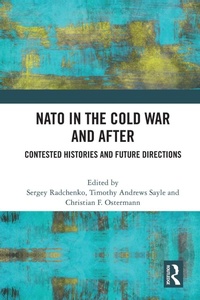
NATO in the Cold War and After
Contested Histories and Future Directions
1st Edition
Published on 29. January 2024
Book
Paperback/Softback
284 pages
978-1-032-17064-0 (ISBN)
Description
This book examines episodes in NATO's history from the founding of the North Atlantic Alliance in 1949 to its transition to the post-Cold War order in the 1990s, with an eye to better understanding its present and its future.
NATO's history, now running over seventy years, can no longer be framed in Cold War terms alone. Nor can the organization be understood fully as a post-Cold War institution. Today's NATO is a product of both these eras. This edited volume offers a reconsideration of NATO's place in history, looking both at how the alliance coped with the Cold War and how it managed its difficult transition to the post-Cold War international order. Contributors recount how NATO coped with its many political and operational challenges, which on occasion threatened - but never managed to - derail the alliance. The book opens new vistas for explaining how NATO thrived and survived for decades and ponders whether it will survive for many more.
The book will be of great value to scholars, students and policymakers interested in Politics, International Studies, Global Affairs and Public Policy.
The chapters were originally published as a special issue of Journal of Strategic Studies.
NATO's history, now running over seventy years, can no longer be framed in Cold War terms alone. Nor can the organization be understood fully as a post-Cold War institution. Today's NATO is a product of both these eras. This edited volume offers a reconsideration of NATO's place in history, looking both at how the alliance coped with the Cold War and how it managed its difficult transition to the post-Cold War international order. Contributors recount how NATO coped with its many political and operational challenges, which on occasion threatened - but never managed to - derail the alliance. The book opens new vistas for explaining how NATO thrived and survived for decades and ponders whether it will survive for many more.
The book will be of great value to scholars, students and policymakers interested in Politics, International Studies, Global Affairs and Public Policy.
The chapters were originally published as a special issue of Journal of Strategic Studies.
More details
Language
English
Place of publication
London
United Kingdom
Publishing group
Taylor & Francis Ltd
Target group
College/higher education
Postgraduate and Undergraduate
Dimensions
Height: 234 mm
Width: 156 mm
Thickness: 16 mm
Weight
453 gr
ISBN-13
978-1-032-17064-0 (9781032170640)
Copyright in bibliographic data and cover images is held by Nielsen Book Services Limited or by the publishers or by their respective licensors: all rights reserved.
Schweitzer Classification
Other editions
Additional editions
Sergey Radchenko | Timothy Andrews Sayle | Christian Ostermann
NATO in the Cold War and After
Contested Histories and Future Directions
Book
12/2021
1st Edition
Routledge
€206.80
Shipment within 10-20 days
Sergey Radchenko | Timothy Andrews Sayle | Christian Ostermann
NATO in the Cold War and After
Contested Histories and Future Directions
E-Book
12/2021
1st Edition
Routledge
€59.49
Available for download
Sergey Radchenko | Timothy Andrews Sayle | Christian Ostermann
NATO in the Cold War and After
Contested Histories and Future Directions
E-Book
12/2021
1st Edition
Routledge
€59.49
Available for download
Persons
Sergey Radchenko is Wilson E. Schmidt Distinguished Professor, School of Advanced International Studies, Johns Hopkins University, USA.
Timothy Andrews Sayle is Assistant Professor, Department of History, University of Toronto, Canada.
Christian F. Ostermann is Director of the History and Public Policy Program, Woodrow Wilson International Center for Scholars, USA.
Timothy Andrews Sayle is Assistant Professor, Department of History, University of Toronto, Canada.
Christian F. Ostermann is Director of the History and Public Policy Program, Woodrow Wilson International Center for Scholars, USA.
Content
Introduction - NATO: Past & Present 1. 'Nothing but humiliation for Russia': Moscow and NATO's eastern enlargement, 1993-1995 2. Eastbound and down: The United States, NATO enlargement, and suppressing the Soviet and Western European alternatives, 1990-1992 3. The overlooked importance of economics: why the Bush Administration wanted NATO enlargement 4. An uncertain journey to the promised land: The Baltic states' road to NATO membership 5. Debating detente: NATO's Tindemans Initiative, or why the Harmel Report still mattered in the 1980s 6. A nuclear education: the origins of NATO's Nuclear Planning Group 7. The zero option and NATO's dual-track decision: Rethinking the paradox 8. Visions of the next war or reliving the last one? Early alliance views of war with the Soviet Bloc 9. NATO's inherent dilemma: strategic imperatives vs. value foundations